Showing posts with label Christianity and culture. Show all posts

23 April 2026

Christianity and Civilization

When Western missionaries came to southern Africa in the 19th century to spread the gospel of Christ, they soon discovered a problem. The culture of the people they were preaching to was premodern, and the gospel they preached had, comparatively recently, been contexualised into the culture of Western modernity. The book to read on this encounter is Of Revelation and Revolution: Christianity, Colonialism, and Consciousness in South Africa by John and Jean Comaroff. Several missionaries studied the culture of the people they went to, but the Comaroffs were among the few that also studied the culture that the missionaries came from, which shaped their outlook and the way they responded to premodern cultures. 

One response of these 19th-century Western missionaries was to say that before Africans could be Christianised, they must first be civilised. The gospel they had brought had been contextualised to deal with the problems of Western modernity, problems that most Africans did not have. Therefore they must be taught to exchange their premodern problems for modern ones, ones that the Western gospel had been adapted to solve, and the way to do this was to civilise the Africans. 

The Westerners thought it important to distinguish between elements in African cultures that were compatible with Christianity, and those that weren't. They were often not as critical of elements in their own culture that were incompatible with Christianity. Western culture had undoubtedly been influenced by Christianity -- see Western civilisation and Christian values. By the middle of the 20th century the apartheid government of South Africa was claiming that it represented and was the defender of "White Western Christian Civilization", and that was the society that I grew up in -- see Christianity, Western Civilization, and me.

I've read quite a bit on this topic recently, indicating that quite a lot of people are concerned about it, and so I'm trying to bring some of the things I've read together in a traditional blog post -- traditional in the sense of a weB LOG -- an annotated log of web sites visited. Some of these are things I've written, and some have been written by others. 

One of the better ones I've seen, and also one of the most recent, is Against Christian Civilization by Paul Kingsnorth, who also quotes something that could perhaps summarise the whole theme:

It is my personal belief, after thirty-five years experience of it, that there is no such thing as “Christian civilization.” I believe that Christianity and modern civilization are opposed and irreconcilable, and the spirit of Christianity and of our ancient religion is essentially the same.

For something else on similar lines see Inculturation, indigenisation, syncretism and cultural appropriation. I also heard Thorsten Marbach speaking at TGIF[1] about Paul Kingsnorth's book Against the Machine, which I have not been able to read yet, but you can catch Thorsten's talk here. I discovered that Paul Kingsnorth had recently become an Orthodox Christian.

I have also written something on Orthodox Mission in the 21st Century, which deals with similar themes.

I will be adding more material and links to this post.   


__________

Notes & References

1. TGIF (Thank God It's Friday) meets early on alternate Fridays in the cities of Johannesburg and Tshwane, and someone speaks on some topic relating to Christianity in the modern world, followed by questions and discussion. Some of the talks have been recorded, and you can find them here.

10 July 2020

Hippies in the Church


I was very excited to see that there is a new Russian web site called Hippies in the Church. It has a list of monks and clergy who were at one time involved in the hippie movement of the 1960s and 1970s.

Here is a rough translation of its introductory blurb:
In December 2018, the Metropolitan of Belgorod and Stary Oskol, John rather favorably spoke about youth subcultures of the second half of the twentieth century. But even more interesting is the last phrase:

“In the 20th century, as a protest against a consumer society on Russian soil, under the influence of the West, subcultures developed that acquired a special social orientation, at the same time it was a search for spirituality. The first subcultures are dudes, hipsters in the early 60s, then there is a period of the sixties. There appear hippies who belong to different religious directions. They even had the slogan: "Christ was the first hippie because he was protesting against the existing system." I must say that this subculture is very close to the Orthodox Church: in the USSR, the Church was persecuted, and hippies sympathized. Many clergymen and mothers sitting here have gone through this subculture. ”

The recognition of Metropolitan John is worth a lot. However, there was no list of hippies (rockers and punks added) who became Orthodox priests and monks (lay people also added) until recently. A small list was published by historian Irina Gordeeva on Facebook. Based on this list, a much more extensive one has arisen, which I quote below. It continues to be replenished and refined (last updated July 1, 2020)

My interest in this topic goes back 60 years, to July 1960, to the founding conference of the Anglican Students Federation (ASF) of South Africa, which was held at Modderpoort in the Free State in July 1960. It was held in rather inauspicious circumstances, during the State of Emergency that followed the Sharpeville Massacre, and I travelled to it with two students, Benjamin Photolo and Jacob Maleke, who actually lived in Sharpeville, and who, though they were not themselves witnesses of the shooting, knew several people who had been affected by it. For more on the background, see Tales from Dystopia VI: 1960 was a very bad year | Khanya.

One of the speakers at the was Brother Roger, of the Community of the Resurrection, who spoke on Pilgrims of the Absolute. He spoke of a number of counter-cultural figures, some Christian, some less so. Among them were Leon Bloy, Benedict Joseph l'Abre (one of the few Western "fools for Christ") and Beat Generation authors like Jack Kerouac.  He said they were all looking for something that was not found in the conventional and respectable values of their society, and that, whether they knew it or not, they were looking for God, and he asked why the Church had so often hidden God from them behind a camouflage of respectability.

Brother Roger, CR


It made quite an impression on me and others there, and Brother Roger was asked to speak again on the same topic the following year, and I have posted a combined version of both papers here: Pilgrims of the Absolute. For the next couple of years Brother Roger guided my reading, lending me books from the Community of the Resurrection's well-stocked library (which was also the library for St Peter's Theological College, which they ran, and among the students there at that time was Desmond Tutu, who later became Anglican Archbishop of Cape Town. Brother Roger introduced me to authors like Samuel Beckett, Jean Genet, Charles Williams and others, and also to the Beat Generation authors like Jack Kerouac and John Clellon Holmes.


It was mainly the Beat Generation who took the technical term "cool" from jazz and applied it to everyday life, and in doing so brought it quite close to some technical terms in Orthodox spirituality -- see Coolness and dispassion | Khanya. Brother Roger referred to Francis of Assisi as "God's cool cat", or God's hip cat. , and one of the beat poets referred to their generation as "Angel-headed hipsters burning for the ancient heavenly connection to the starry dynamo in the machinery of night". Jack Kerouac never realised the ideal of a Zen Catholicism he sketched in his novel The Dharma bums, but his friend Gary Snyder, a Buddhist (Japhy Ryder in The Dharma bums), spoke of a "rucksack revolution" of young people leaving the rat race of the acquisitive society and wandering around spreading a message of love and peace. Brother Roger rather hoped that some of the youth at the Anglican Students Federation conferences might catch a similar vision, but few did.

By the end of the 1960s "hipsters" had got shortened to "hippies" and happily accepted the label "freaks" applied to them by straight society. Among them were some Jesus freaks, and for a time they locked as if they might represent a real Christian counterculture, but many were coopted by suit 'n tie evangelical Christians, who turned many of the symbols of the movement into kitsch merchandise.

One of the evangelists who got involved with the movement came closer to the "rucksack revolution" idea. He was Dave Berg, who founded the Children of God, who lived in Christian hippie communes throughout the world, and saw themselves as colonies of the Kingdom of God. They produced an interesting handbook for members, Revolution for Jesus: how to do it. Unfortunately Dave Berg, who called himself Moses David, or just Mo, succumbed to a temptation common in such movements -- he allowed himself to become the object of a personality cult, and the emphasis gradually shifted from leading people to Jesus to leading them to himself, and that particular branch of the Jesus movement went off the rails. I believe there is still a remnant somewhere, calling itself "The Family".
The Durban colony of the Children of God, 1974: Deborah, Jonathan, Stephen, Shemaiah, Sharon
 Another of these evangelists, however, Jack Sparks, followed a different path. He became became involved in the Christian World Liberation Front (CWLF), which produced a Christian underground newspaper called Right On. Jack Sparks was led to Orthodoxy, and became an Orthodox priest, and died a few years ago in Alaska.

So I am interested in the Christian arm of the Hipster-Beat-Hippie movement, and I think it would be rather good if the project of documenting "Hippies in the Church" was not confined to Russia only, but should become a worldwide one. So if anyone has any biographical information on hippies in the Church, or anecdotes of such a movement, please send them to me and I'll make a preliminary collection, and pass them on to any official collectors, should any appear. My contact info here Steve Hayes - personal links.

22 January 2010

Evangelism, or cultural imperialism

Since the US invasion of Iraq, Western-style Protestant evangelical Christianity has begun to appear in that country. It is not, however, converting Muslims to the Christian faith, but proselytising among other Christians.

Evangelicals Building a Base in Iraq - washingtonpost.com:
The U.S.-led toppling of Saddam Hussein, who limited the establishment of new denominations, has altered the religious landscape of predominantly Muslim Iraq. A newly energized Christian evangelical activism here, supported by Western and other foreign evangelicals, is now challenging the dominance of Iraq's long-established Christian denominations and drawing complaints from Muslim and Christian religious leaders about a threat to the status quo.

The evangelicals' numbers are not large -- perhaps a few thousand -- in the context of Iraq's estimated 800,000 Christians. But they are emerging at a time when the country's traditional churches have lost their privileged Hussein-era status and have experienced massive depletions of their flocks because of decades-long emigration. Now, traditional church leaders see the new evangelical churches filling up, not so much with Muslim converts but with Christians like Tawfik seeking a new kind of worship experience.

There is much talk in Western Christian missiological circles about inculturation and contextualisation, and the need for Christianity, when it enters a society of a different culture, to become part of that culture.

But this seems, on the face of it, to be the opposite: taking already indigenous Christians, and converting them to an exotic culture.

On the other hand, globalisation is such that exotic cultures often seem attracive. Some traditional Christians in countries like Iraq achieve their desire to identify with exotic cultures by emigrating. Others, perhaps those who can't afford to emigrate, do so by joining exotic churches, like Western Baptists, and enjoy the foreign cultural ambiance.

So is it evangelisation, proselytisation, or disinculturation (or could one say "exculturation"? Is that a word?)

01 December 2009

You might be an American Evangelical if...

You might be an American Evangelical if:


10. T-shirts with Christian catch-phrases are a part of your evangelism strategy.

9. Your car is equipped with the ever-popular license plate frame that reads, "In case of rapture, the car is yours!"

8. You're convinced Jesus was a Republican.

7. Tim LaHaye's Left Behind book series is gospel truth.

6. Your favorite authors are Stormie Omartian and Joel Osteen.

5. Anyone who disagrees with you has taken the wide path.

4. You're convinced Sarah Palin has a bright future as a political candidate.

3. Your notion of God's purpose for your life happens to correspond nicely with upper middle-class suburban life.

2. You can't fit anymore music on your ipod because it's full of songs by John Tesh and Michael W. Smith.

1. You feel this post is alienating and abrasive, and your first inclination is to unsubscribe from this blog.

With acknowledgements to Christians in Context: from orthodoxy to orthopraxy.: Top Ten Marks of a Mainline Evangelical.

16 July 2009

Synchroblog on Syncretism

There is a synchroblog on syncretism this month. Syncretism is mixing up two (or more) religions to make another religion that is different from those that went to make it up. It is not quite the same as borrowing elements from other religions, and nor is it quite the same as what the Russians call dvoeverie -- practising two or more religions side-by-side. But actually the synchroblog posts deal with all three.

You may find the posts here:


And then there is this post The Deacon's Bench: Buying into the "Prosperity Gospel", which seems not unrelated.

11 June 2009

Hope Transfigured: Crusading Koreans?

Hope Transfigured: Crusading Koreans?:
With Korea now sending more cross-cultural missionaries than any other country outside the US (so Julie claimed) their missiology and methodology must be significant. I was struck by how many times Julie spoke of the Korean mindset as 'crusading' - ouch!! - but she's right in many respects. Another colleague later talked of Korean missionaries as being 'modern' (rational, linear, success oriented, goal setting) and therefore finding it difficult to address pre- and post-modern mission contexts.

When I read this paragraph in Mark Oxbrow's blog (I met Mark at the conference of the International Association of Mission Studies - IAMS - at Hammanskraal in 2000) I briefly wondered what might have caused Korean missionaries to become "modern", and then I remembered the Haggai Institute.

I attended a mission training course at the Haggai Institute in Singapore in May 1985. It lasted a month, and there were people there from nineteen different countries, including four South Africans. The aim was to train third-world leaders in mission methods in such a way that they could return to their own countries and train others. And one of the things that characterised the traning was that it was modern -- rational, linear, success-oriented, goal setting. I found the training quite useful, though some parts were more useful than others.

The teaching was done by various people, from different backgrounds. Some of was informational -- for example on religions like Islam and Hinduism. Some was academic -- a sociology lecturer from the University of Singapore taught several classes. Some were practical "how to" lessons -- one taught about writing, preparing manuscripts for publication, using audiovisual media (especially where there was no mains electricity) and so on. Some were more theological -- on the Biblical basis and theology of missions. And some were a bit like motivational speakers, and the modernity was especially apparent in what they said.

I wouldn't knock that either, however. I found it useful, not so much for setting goals myself (I tend not to work like that) but for questioning the goals of activities proposed by others and even me. Step-by-step goal-setting and working everything out on paper beforehand just isn't my style, but it can be useful when someone comes up with an idea that sounds impressive until one tries to determine the goal behind it, and then suddenly it become clear that there are many better ways of reaching that goal, and that the activity proposed might actually be counterproductive in reaching the stated goal. And if people persist in pursuing the proposed couse of action, one then needs to look for an UNstated goal. An example (with which most people are no doubt familiar) is the US invasion of Iraq. What was it intended to achieve? What did the initiators SAY it was intended to achieve? Was it the best way of achieving what they SAID they wanted to achieve? And with hindsight, what did it actually achieve.

That may seem remote from a mission goal, but remember that at one point George Bush said "mission accomplished" -- so what was the mission, and was it accomplished?

But that is an illustration. The questions about it are rhetorical, so please don't try to answer them in comments!

The point here is that goal-setting is part of the modern approach that characterises Korean missionaries. And a bit strange, that, too, talking of "Korean missionaries". Because they are all, I am fairly sure, SOUTH Korean missionaries. I have my doubts that NORTH Korean missionaries, if any, take that approach.

When I was at the Haggai Institute there was one person there from South Korea, Byung Jae Jeong. We were the 85th and 86th session, so if there was an average of one South Korean for every two sessions, by that stage the Haggai Institute would have trained about 43 from South Korea. Each of them was supposed to train 100 others, so that would be about 4300 South Koreans trained in modern methods.

I don't think that the Haggai Institute was alone in training people from Asian, African and South American countries in the use of modern methods, but it can illustrate the way in which others may have offered similar training.

In this, perhaps one can see Christianity as acting as a kind of agent of modernity in South Korea, and perhaps other Asian countries, and possibly in Africa and Latin America as well.

And using the training in goal setting I received from the Haggai Institute, I ask: what are the intended and unintended consequences of this?

28 January 2009

Unfavourable opinions of religions

In my previous post I commented on a survey that asked whether people had a favourable or unfavourable opinion of a religion (in this case Wicca), and said I would be among those who was neutral or had no opinion.

But the question was raised if the people who practised the religion did things one disapproved of, what then?

I disapprove of some practices of some adherents of some religions, but one can't blame a religion for the behaviour of its followers.

Where a practice is something I believe to be wrong or immoral and intimately bound up with the practice of the religion, that is something else, and probably deserves a separate discussion, and is not something that can easily be determined by a survey questionnaire.

Let me give an example of practices that I believe to be wrong or immoral, but which are closely bound up with the practice of a religion.

When Protestant missionaries evangelised the Kikuyu (Gikuyu) people of central Kenya, they strongly disapproved of some features of Kikuyu culture, such as polygamy and female circumcision, and urged the British authorities (Kenya was at that time a British colony) to assist them in suppressing them. They demanded that all teachers in church schools (and all schools for Africans in Kenya were church schools) take an oath against female circumcision. As a result two independent school associations were formed, the Kikuyu Karing'a Educational Association and the Kikuyu Independent Schools Association. The former became affiliated with the Orthodox Church, and the latter with the African Independent Pentecostal Church (for more details, see my article on Orthodox mission in tropical Africa).

Female circumcision (female genital mutilation) was an integral part of Kikuyu religion and culture, but Christianity generally opposes bodily mutilation (Protestant missionaries in China, for example, started the Natural Foot Society to counter the Chinese practice of binding the feet of female children to keep them small). So the Protestant approach was to suppress practices that they regarded as immoral, and to seek the aid of the government in doing so, thus linking mission and colonialism.

The Orthodox Church, however, did not begin with moral denunciations of practices it thought immoral. Polygamists could be baptised, but after baptism further marriages were discouraged. Now, after 70 years, polygamy and female circumcision are not practised by Kikuyu people who are Orthodox Christians, but this was not achieved by a direct frontal attack on Kikuyu culture. The Orthodox approach was that people need first to know Christ, to worship the Triune God, and and then gradually be transformed into the image of God, not by human laws and prohibitions and sanctions and punishments, but by the working of the Holy Spirit.

Female circumcision is still practised in some parts of Africa, and some Westerners still make an issue of it, and those who do are not always puritanical Protestant missionaries, but are often quite secular. They regard African cultures that do such things as barbarous, and, like the puritanical Protestant missionaries, campaign for laws to be passed against them, yet their own cultures practise wholesale abortion, which seems equally barbarous to many Africans (and to many Christians outside Africa). What lies behind it, in the case of both the Protestant missionaries and the secular social reformers, is Western cultural imperialism.

So there are two things here.

One is the behaviour of some adherents of a religion. Is that adequate cause for indicating disapproval of a religion?

Some people cite the Inquisition and the Crusades as examples to show that Christianity is an evil religion that one should disapprove of. But I think it is silly to blame a religion for the behaviour of some of its followers. The Crusades and the Inquisition were products of certain periods of human history, and show that Christians, like other people, sometimes succumb to social forces and sometimes even mistakenly identify these with mandates of their religions. One can say the same of suicide bombings and pogroms and various other things.

In the case of Wicca, it is clear that some Wiccans have created a myth of "the Burning Times", which they have quite deliberately and consciously used to fan the flames of hatred against Christians. Should I therefore disapprove of Wicca? No, because not all Wiccans do this, and some have spoken quite strongly against it. One cannot blame a religion for the behaviour of its followers, unless that behaviour is an integral part of following the religion.

And that brings us back to the second thing. Female circumcision was an integral part of Kikuyu traditional religion and culture, which is why the attack on it by Protestant missionaries was seen as a direct attack on Kikuyu culture and part of a scheme by the colonial government to deprive the Kikuyu people of their land. The Protestant missionaries demanded oaths against female circumcision, and, almost as a counter to that, the Mau Mau movement began demanding oaths to recover the land, and suddenly the Kenya colonial government began denouncing "oath-taking" as the greatest evil of all, and to punish people for doing that, and detaining them if they were even suspected of it.

And this is a point at which I follow the Orthodox missionary tradition, which is not to denounce the religions and cultures of others. All human religion and all human culture is fallen, including my own, and needs to be transformed by the grace of God through the Holy Spirit. This can be seen in the missionary instructions of St Innocent of Alaska

On no account show open contempt for their manner of living, customs, etc., however these may appear deserving of it, for nothing insults and irritates savages so much as showing them open contempt and making fun of them and anything belonging to them.

Even if one disagrees with their culture and customs, one can show respect for people. One can disagree with their theology, and can say why one does. as St John of Damascus did in pointing out where Islamic theology differed from Orthodox theology (he regarded Islam as a Christian heresy). But it should be done in an atmosphere of respect. It is fashionable nowadays in some Western to belittle the notion of respect, and to despise it as mere "political correctness", and that is something I think worthy of disapproval!

St Innocent of Alaska also disapproved of the linking of mission and colonialism, when he said,

2. On arriving in some settlement of savages, thou shall on no account say that thou art sent by any government, or give thyself out for some kind of official functionary, but appear disguise of poor wanderer, a sincere well-wisher to his fellow-men, who has come for a single purpose of showing them the means to attain prosperity and, as far as possible, guiding them to their quest

and

12. Ancient customs, so long as they are not contrary to Christianity, need not to be too abruptly broken up; but it should be explained to converts that they are merely tolerated.

So tolerance is an Orthodox missionary principle. Some things cannot be tolerated, as contrary to Christianity, such as human sacrifice. In this, I think Fr Thomas Hopko's account of tolerance is worth repeating:

Tolerance is always in order when it means that we coexist peacefully with people whose ideas and manners differ from our own, even when to do so is to risk the impression that truth is relative and all customs and mores are equally acceptable (as happens in North America).

Tolerance is never in order when it means that we remain idle before wickedness which harms human beings and destroys God's creation.

To be tolerant is to be neither indifferent nor relativistic. Neither is it to sanction injustice or to be permissive of evil. Injustice is intolerable and evil has no rights. But the only weapons which Christians may use against injustice and evil are personal persuasion and political legislation, both of which are to be enacted in an atmosphere of respect. While Christians are permitted under certain conditions to participate in police and military actions to enforce civil laws and to oppose criminality, we may not obey evil laws nor resort to evil actions in defence of the good. This means that Christians are inevitably called to suffer in this age, and perhaps even to die. This is our gospel, our witness and our defence.

So generally my attitude towards religions other than my own is one of tolerance. I neither approve nor disapprove of them. I may approve of some of their beliefs or practices, and disapprove of others, but recognise that if these are integral parts of the religion that they cannot be abruptly separated without destroying the whole, therefore I cannot either approve or disapprove of the whole, unless the whole thing is evil or based on evil, and such religions are rare.

I disapprove of the Hindu caste system and sutti, I don't disapprove of Hinduism. I disapprove of Jewish support for Zionism, but don't disapprove of Judaism, and recognise that Zionism is a secular movement, and is no more necessarily tied to Judaism than crusades and crusading and pogroms are tied to Christianity.

There are also some aspects of these and other religions that I might approve of, though that does not necessarily mean that I approve of the religion per se, nor that it would be right for me as an Orthodox Christian to believe and practise them. I used to think, and to some extent still do, that Jack Kerouac's Zen Catholicism was quite cool, but Orthodox Christianity has different, and I believe better, ways of achieving similar ends.

13 December 2008

Christ and culture

A very interesting post by Fr Gregory Jensen Koinonia: Orthodox Christian Faith in the Public Square:
Having spent more than a little time with the recent sociological studies that examine the attitudes of Orthodox Christians, I can confirm that for a significant percentage—and in some cases, a majority—of Orthodox Christians draw their understanding of morality not from Holy Tradition but popular American culture.

As with our brothers and sisters in western Christian traditions, many, even most, Orthodox Christians too 'have uncritically accepted the dichotomy between public and private, between fact and value, between knowledge and meaning.' For all that we might imagine that we are preserving Hellenism or the 'other worldliness' of monastic life, we live lives structured on the same 'dichotomies [that] are deeply entrenched in American religion and culture and are closely associated with what is often described, and frequently decried, as American individualism.'

17 November 2008

Reviving the Russian Soul

One of the most popular recent films in Russia is Ostrov (The Island) which indicates that despite the dominance of the communist and capitalist visions of materialism, interest in spiritual life continues to grow. As the authors of this review point out, "Ostrov’s story of repentance and faith in God hardly seems to be the stuff that blockbusters are made of" -- at least not in the West. I noted my own response to the film here, but this article describes the effect on Russian culture, and the response of the actor who played the protagonist is also interesting, since he is apparently a hermit in real life.

Reviving the Russian Soul, by Mike Kauschke and Elizabeth Debold.:
The story of the film’s principal actor Pyotr Mamonov may offer some explanation. Back in the eighties and nineties, Mamonov was the lead singer in an avant garde Russian rock band that reached cult status. But these days, he lives as a religious hermit near Moscow, and apparently it took a great deal of effort to get him to commit to make the film. Ostrov director Pavel Lungin says: “In a certain sense, this is also a movie about Mamonov’s life. He transformed from being a rock star embroiled in scandals into a deeply religious man.” Lungin realizes that both Mamonov’s life and the life of the monk he plays are resonant for Russians today. “The times of perestroika are over and we need to think about things like eternity, sin, and conscience,” he observes. “These have disappeared from our lives in the rat race for success and money. But people can’t just live for material things alone.”

20 October 2008

Tim's Blog: "Better than Church?"

Tim Norwood (a Church of England vicar) asks if blogging is better than church.

Tim's Blog: "Better than Church?":
A friend of mine (who is probably reading this) also commented that reading the blog was 'better than going to church' - which I do take as a compliment, but it does raise some interesting questions. To what extent can the blogsphere provide opportunities to 'be' church?

A few years ago, I was quite interested in the idea of on-line church and a few of us began to think about how to do it. We started with cell church methodology and looked at ways to do this. I even bought the 'cybercell' url (and still own it). When the diocese put money into cutting edge ministries and launched iChurch I was seriously tempted to apply for the job (which unfortunatley was part-time). It's been interesting to watch iChurch develop in similar directions to CyberCell - which never got off the ground because I didn't have enough time to invest in it...

And he has some quite interesting thoughts on the topic.

Some of his comments made sense to me. Among other things he said that reading his bishop's blog made him feel closer to his bishop. And yes, blogging is a way of sharing thoughts with people one doesn't see every day, and allows one to communicate with people who are geographically out of reach.

But there are also limitations in blogging. Comments allow some interaction, but it is not inherently an interactive medium. It is basically a one to many medium. Some have tried to overcome the limitations by having synchroblogs -- many people blogging on the same topic at the same time, but it is still a collection of individual viewpoints. Blogging remains communication without community, and therefore cannot be regarded as a form of church, or "fresh expressions" of church, much less a substitute for church. Though I suppose a lot depends on what you regard as church. If your model of church is the Protestant "preacher-congregation" one, then yes, blogging can be much the same thing. If you go to church primarily to hear sermons, then yes, you can just as easily read them on blogs -- but is that all that church is about?

Online worship and prayer, however, seem to me to be an impossibility. But again, that may depend on your understanding of worship. It seems to me that some people regard worship as a kind of holy sing song, and "worship leader" means someone who leads singing -- a kind of combination of a choir director and a cheer leader. But even if that were one's understanding of worship, could you do it online?

The computer on which I am writing this has no speakers connected. I don't listen to podcasts or watch videos, partly because I'm often surfing the web at 3 am and don't want to wake the family, and partly because I can't afford the bandwidth. But if I were to join in singing hymns at 3:00 am the family would soon be very annoyed.

11 February 2008

Beyond the Boerewors Curtain: Identity and white English South Africans

In his blog Beyond the Boerewors Curtain Roger Saner asks an interesting question about Identity and white English South Africans
What also interests me about Apartheid is the white English role. Most English people in SA seem unaware that the British concentration camps were responsible for the deaths of 26,000 Afrikaner women and children. This is not a legacy to be lightly skipped over, and one that ties directly into one of the most thorny issues for English South Africans: identity. Who are we? We're not British, although many of us hold British passports (or can get ancestral visas, or flee to the UK when we get the chance). We're not Afrikaans, so therefore we're not responsible for Apartheid (so I've heard from many English people). 'Apartheid was something which the Afrikaners were responsible for, not us. We had no say. In all levels of government the only people who were employed were Afrikaans.' So we withdrew from the public sphere and happily existed in the neutral space between oppression and oppressed, mirroring the behaviour of everyone else.

The last sentence rather begs the question. What do you mean "we", white man? Just who is "everyone"?

In his book Ah big yaws? Rawbone Malong described the language, pronunciation and usage of White Urban English-speaking South Africans, WUESAs, or Woozers for short.

In a post on my other blog I queried the usage and assumptions of a certain school of church historians who have written about "the English-speaking churches" in South Africa. Is there such a thing as a Woozer identity?

I suppose that in a sense I'm a Woozer. I'm white, speak English as my first language, was born in South Africa and have lived in cities most of my life. But does that define my identity? In the year I was born a man called G.H. Calpin published a book called There are no South Africans. He was a nasty right-wing racist (I was later called upon to review one of this other books, which made that very clear).

I've been faced with the question at several significant moments of my life. I'll describe some of them, going backwards in time

One was 25 years ago, during the referendum of the tri-cameral parliament, in 1983. I was visited by a National Party canvasser, who tried to convince me that the proposed tri-cameral parliament was a good thing. He stayed most of the afternoon. My objections were different from most of those he encountered, and it took most of the afternoon for him to grasp what I was getting at. Most objections he encountered were from people who did not like the idea of having Coloureds and Asians in parliament, even in separate houses. What he found difficult to grasp was that I rejected two principles that he regarded as so axiomatic that he could not conceive of the possibility of anyone questioning them: group rights and "own affairs". And that related to one of the fundamental contradictions of apartheid.

Afrikaner nationalists liked to point out that nationalism was a good thing, and that it simply meant "love of one's own" -- and that is where "own affairs" came in. The problem for me was, what was my "own"? The "white group"? But what was it? One should have "own affairs" which meant one's own schools, language, religion, culture and so on. But Nat policy was to have separate English and Afrikaans schools. If the theory of apartheid were to be consistent, then there should have been an "English" homeland, which ran its own affairs. But there wasn't, of course. If there were, then the "white" group would be split, and could not outnumber the Coloureds and Indians, and the tri-cameral parliament would no longer serve its purpose of maintaining white Afrikaner Nationalist hegemony. For the same reason there could not be a "black" house fo parliament, because that would outnumber the whites, so the blacks had to be divided into Zulu, Xhosa, Tswana etc homelands. It was the old policy of divide and rule. As long as Afrikaner nationalists outnumbered all other whites (English, Portuguese, Greek etc), they could be coopted to boost the numbers of the white parliament, which Afrikaner nationalists would control. The moment one of the black groups outnumbered the white conglomerate, the racial arithmetic no longer worked. Chris Heunis resigned as Minister of Constitutional Affairs, and apartheid's days were numbered.

But to the Nat canvasser it was inconceivable that I should not see my identity as primarily white. I didn't want a tri-cameral parliament, I wanted one parliament, with one man, one vote. He said "But that has never worked anywhere." I said "Look west". That required more explanations. On our western border was Botswana, which in 1983 was the most democratic country in Africa. Admittedly it was a much more homogeneous population than South Africa. But I didn't see why it shouldn't work in a multicultural country like South Africa, and thought it was a lot better than having people of one culture telling all the others what groups they belonged to and what their culture ought to be. "Own affairs" was a farce, because the attitude of the Nat government was that "you will look after your own affairs, and we will tell you what your own affairs are".

An earlier defining moment was the publication of A message to the people of South Africa by the South African Council of Churches, in 1968.

In the past various Christian groups had criticised apartheid on the ground of its unjust implementation. The Message, however, attacked not merely the implementation and practice of apartheid, but its theory and ideology. It said that apartheid was far worse than a heresy, it was a pseudogospel.

Apartheid was a false gospel because it encouraged people to find their security in racial identity instead of in Christ, and it was therefore, from a Christian point of view, a form of idolatry. It set up racial identity as an idol. Christians therefore opposed apartheid not merely because it was bad in practice, it was bad in principle. It was based on principles and assumptions that could never be acceptable from a Christian point of view.

For me personally, that was not something new. The Message to the people of South Africa simply articulated something I already knew. It helped to clarify and reinforce things by finding terminology to describe them. Many people had believed that apartheid was a heresy. The Message went further, and said it was a pseudogospel, and explained why. It was a moment like the one when Elijah confronted the prophets of Baal. It challenged South Africa: if Christ is God, serve him; but don't pretend to serve him when your real god is the idol of racial identity.

For me personally the defining moment came in 1960/61, when there was another referendum, on whether South Africa should become a "republic", and did become a republic outside the Commonwealth.

It made me think about what it meant to be a citizen of the Republic of South Africa. The propaganda of the Republicans was that it would "unite South Africa". They said that the Afrikaners put South Africa first, while the "English" had divided loyalties, with one foot in Britain, which many Woozers still spoke of as "home", even if their ancestors had lived in Slouth Africa for generations. The Afrikaans word for Woozers was "souties", derived from "soutpiel" -- if one had one foot in South Africa and one in Britain, then another part of the body (in the case of males) must be dangling in the salty waters of the ocean in between.

But all this talk of "uniting" South Africa was going on simultaneously with talk of dividing it up into "homelands". And what was a homeland? A putative place of origin that black people (but not whites) were told they belonged to, and could be sent "back" to. So what did it mean to be a citizen of the Republic of South Africa? That you should have no other homeland (if you were white), but that you must have another homeland, if you were black. Clearly, the Republic of South Africa was going to be a Mickey Mouse country, with an elastic definition of citizenship that could mean anything but actually meant nothing.

And at the same time I read the New Testament, where St Paul said "our citizenship, our homeland, is in heaven" (Philippians 3:30). So it appeared to me that it was a toss-up between citizenship of the Kingdom of Heaven and citizenship of the Republic of South Africa, and I opted for the former. Baptism, it appeared to me, was a naturalisation ceremony for entering the Kingdom of Heaven.

So what the National Party was urging me to do was (in the words of Leon Bloy) the renunciation of my heavenly birthright for the pottage of this sinful world.

Because I was baptised, I had more in common with a baptised black person than with an unbaptised white one. The National Party tried to deny the truth of that, and to say that skin colour was more important than what God had done in baptism, that Babel could not be overruled by Pentecost.

And for the same reason, I couldn't get particularly particularly excited about being a Woozer, or see that as the core of my identity.

For a while I lived in Namibia, when apartheid was at its height, and many cities in Namibia had black "locations". In terms of the apartheid ideology blacks had no permanent homes in the cities, and were forced to go and live outside the city, beyond the town limits. Many did not want to move, and in Windhoek the Hereros were told that they could even give the new location a name, if only they could go and live there, and so they called it "Katutura" which means "We don't live here". And every new location outside every Namibian town was called Katutura, even if the government called it something else.

In Herero, "tura" means to live in a place as a homeland, to have a home in a place. Yet this was a metaphor for the Christian life. Hebrews 13:12-14 shows that Jesus was in Katutura, not Windhoek, because it was to precisely such a place that the world pushed him, and as his followers, that is where we are. We are pariki, the Greek word from which the English word "parishioners" is derived, we live beside the house, not in it. In Afrikaans, we are bywoners, squatters, sojourners. This is not our homeland: katutura, we don't live here.

Apartheid may be dead in South Africa, but the struggle against the pseudogospel still continues. I joined the Orthodox Church, and in South Africa, as an English-speaking Orthodox Christian, I'm in the minority. Greek-speakers, or people of Greek heritage, are in the majority, and from some of them one sometimes hears the same racist sentiments that we heard so often in the apartheid years. One woman once said, "The Orthodox Church is not missionary because its purpose is to preserve Greek culture." Non-Greeks are xeni. Hey, ho, I was born in South Africa, but I get called a xenos by a Greek immigrant. That puts me in my place. But actually it causes me to reflect that for both of us we are where we are in the church not because of birth or parentage, language or culture, not because of where we were born, or to whom we were born, but by a second birth of water and the spirit that makes us citizens of the heavenly kingdom.

Yes, racism is alive and well in the Orthodox Church. In 1985, when the first English-speaking priest was ordained in an Orthodox Church in Johannesburg, people came from other parishes, from far and wide, to shout "anaxios" (unworthy) because the Archbishop had dared to ordain a non-Greek, a xenos. Xenophobia rules, but it's not OK.

Some mouth the racist slogan "Hellenism is Orthodoxy and Orthodoxy is Hellenism", which is not merely a heresy, but apostasy. The Orthodox Church pronounced apartheid, or racism, to he a heresy back in 1872 (under the Greek name phyletism), but it still persists. Hellenism was anathema to Orthodox Christians from the time of the early church fathers. Hellenism today is the product of the secular nationalism of the 18th and 19th centuries, and is also a term for a neopagan religion. It has never been identified with Orthodoxy.

As an English-speaking Orthodox Christian, I like to worship in English, but I don't want to see an "English" Orthodox Church, in the sense that there are Greek and Russian Orthodox Churches. I want to see a South African Orthodox Church. I do sometimes get a bit annoyed when Greek-speaking clergy insist that I must use bad English translations of liturgical texts, because, being Greek, they know what is good for the English. But I've known that sort of thing all my life, when Afrikaner nationalists told me what was my "own" and insisted on giving me an "own affair". Most Sundays I worship with congregations that speak North Sotho (which seems to be one of the most difficult languages to learn: you can get courses in Greek, Russian, Zulu and Xhosa in bookshops, but not North Sotho). I enjoy the Liturgy in Afrikaans, often even more than in English, because there are not 25 different translations floating about, as there are with English.

But is there an "English-speaking" South African culture, a Woozer culture?

Not really. Not enough to form the basis of a distinct ethnic identity. Language and culture are linked, but English is a multicultural language. It is shared by many cultures throughout the world, and not only in South Africa. There was never enough of a cohesive Woozer culture in South Africa to demand a homeland. There was never enough of a group identity to which "group rights" could be applied. Rather, English-speaking South Africans belong to a whole range of overlapping cultural groups and circles, based on church, school, family, interest. Woozers who live next door to each other can find that they have nothing in common but language and geographical proximity. They have different friends, different interests, and might never meet and greet each other except casually and in passing. Woozers have never been a "volk".

While some were chauvinist (my Cornish great grandmother insisted on calling her Afrikaans son-in-law Botes "Boats"), and despised Afrikaners and kept aloof from "natives" others were more laid-back about such things and even made up satirical songs about them:

When I'm walking down the street I must be careful not to greet
people of a different pigmentation
Lest the government suspect or the Special Branch detect
a dark affiliation
to a communist organisation.
(sung to the tune of The wayward wind)

Perhaps this Woozer rootlessness made it easier for me to let worldly allegiances sit lightly, as I've described above. It may have made it easier for some others, I don't know. Since I was in my late teens I was aware of being a pilgrim, a stranger, a sojourner in the world, and am still reminded of it every time someone refers to me as a xenos.

And there is still the heresy, the pseudogospel, the apostasy of apartheid, racism, phyletism. A luta continua. Die stryd duur voort. The struggle continues.

14 January 2008

Blessed are the foolish -- foolish are the blessed

The foolishness of God is wiser than men, the weakness of God is stronger than men... For God chose what is foolish in the world to shame the wise, God chose what is weak in the world to shame the strong (I Cor 1:25, 27).

In this chapter of the New Testament we come across one of the most countercultural aspects of Christianity. The original Greek says that the moron of God is wiser than men. For the world, for "mainstream" culture, "moron" is an insult, something undesirable. No one in their right mind wants to be moron. But St Paul turns worldly values on their head.

What the world despised, Christians regard as badges of honour. One of the taunts that the world often uses is "loser" (though, ironically, many of those who use it often spell it "looser"). But Christians follow a loser. As St Paul is at pains to point out, there is nothing that looks more like a loser than Christ crucified. For that reason, any Christian who uses the word "loser" as a taunt for others has quite simply forgotten who his Lord is.

The Beatitudes, too, show how the Christian faith turns the values of the world upside down. "Blessed are the meek", but for the world, "Blessed are the pushy, for they shall get what they want".

In recent years there has been a tendency for some to overlook this aspect of the Christian faith. There are some Christian groups that unashamedly appeal to the opposite tendency, going so far as to call their churches Winners Chapel, to give but one example.

In the Orthodox Church, perhaps as a reminder from God that we should not be seduced into that kind of worldly thinking, there is a whole class of saints called "Fools for Christ" (in Greek, sali, in Russian, yurodivi). Sali is one of the words that means "blessed"; and it is also the origin of the English word "silly". The sali are blessed fools, silly fools.

In our age, "moron" is a term of abuse, as are similar terms like "loser", "cretin" and others. In a more faith-filled age (which the secularists might call "credulous and superstitious"), however, these were often terms of awe and respect. "Cretin" is derived from the French word "chretienne", meaning a Christian. An important part of being Christian is remembering that God chose the weak and foolish things of the world, and indeed chose to become weak and foolish himself, as unconvincing in appearance as the crucified.

The calling to be a holy fool is often found within monasticsm, which is itself a call to a countercultural life. The monk renounces much that the world regards as valuable -- riches, fame and power. Yet even within monastic society, power struggles can make themselves felt, and in such a situation the holy fool can call the community back to its original vision and purpose.

One of the most revered of the holy fools is St Basil of Moscow. St Basil's Cathedral in Red Square, with its fantastic domes, is an international symbol of the city. It was built, not to honour St Basil, but in honour of a victory by Tsar Ivan the Terrible over the Tatars. Basil denounced the Tsar for his bloodthirsty battles and oppressive rule as he wandered half-naked around the Kremlin, but when he died he was buried in the Cathedral, and the people went to his tomb there to seek his prayers, and eventually it became known as St Basil's Cathdral. Jim and Nancy Forest have written a good description of St Basil and other fools for Christ.

Many of the holy fools have appeared mentally unbalanced, But Leon Bloy, a French writer, when asked about this, replied:
Balance? The devil take it! He has indeed taken it long ago! I am a Christian who accepts the full consequences of my Christianity. What happened at the Fall? The entire world, you understand, with everything in it, lost its balance. Why on earth should I be the one to keep mine? The world and mankind were balanced as long as they were held fast in the arms of the Absolute. What the average man means by balance is the most dangerous one-sidedness into which a man can fall... the renunciation of his heavenly birthright for the pottage of this sinful world (see Pilgrims of the Absolute).

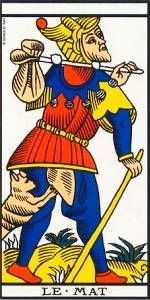
The theme is also found in such things as the Fool card of the Tarot, but I have already blogged about that in more detail in Notes from underground: On Tarot Cards and also at Notes from underground: Morehead's Musings: Symbolic Countercultures and Rituals of Opposition, so I will not say much more about that aspect of it here.

There has been some discussion about whether the fools for Christ were really mad, or were only simulating madness, to teach a lesson. Probably it was a little of both, and some were more mad than others.

John Saward, in his book Perfect fools makes a couple of interesting points. One is that the holy fools flourished in periods when the Church was comfortable and at ease. They were quite rare in times when the church was being persecuted. It seems that God called more people to holy folly in periods when the Church was in danger of being overwhelmed by respectability.

The second point is that fewer fools for Christ were recognised by the Church in the modern era. After the Enlightenment, there were far fewer fools for Christ canonised in the Orthodox Church. Perhaps this was because of modernity, which Peter the Great sought to impose on the Russian Orthodox Church by suppressing the patriarchate and controlling the Holy Synod through a Procurator appointed by himself. Whatever the reason, one of the very few fools for Christ recognised from this period in Russia was St Xenia of St Petersburg.

Perhaps one reason for this is the emaphasis modernity placed, especially in the Enlightenment period, on the importance of humnan reason. People may have had a greater horror of madness, or even the appearance of madness. Losing one's reason was no joke. And again, perhaps postmodernity opens the way for the fool for Christ again.

Some, though not all of the Beat poet Allen Ginsberg's poem Howl
I saw the best minds of my generation destroyed by madness, starving, hysterical, naked
dragging themselves through the negro streets at dawn looking for an angry fix
angelheaded hipsters burning for the ancient heavenly connection to the starry dynamo in the machinery of night
who poverty and tatters and hollow-eyes and high sat up smoking in the supernatural darkness of cold-water flats floating across the tops of cities contemplating jazz

In parts of that, one can see echoes of the lives of fools for Christ, but perhaps more important, it reflects a society that might be more open to the message of the fools for Christ.


This post is part of a synchroblog on God's calling and choice of what is weak and foolish. Here are links to the other Synchroblog contributions on this topic:

13 December 2007

The Santa boycott

'Tis the season to SMS boycott exhortations, it seems.

First it was the Deon Maas/Satanism affair: (see Notes from underground: Christian responses to "Satanism" and journalists who write about it). Then it was the film The Golden Compass. Now, in this month's Synchroblog, Matt Stone comments about Christmas in a pluralist society, and the demand for a politically correct Christmas, where he says:
To my way of thinking what we should be aiming for, as a democratic and pluralistic society, is not a blanding out of religious distinctiveness, but rather for the mutual respect of religious distinctiveness. I may not agree with everything Jewish or Pagan tradition stands for, or Hindu or Buddhist or Atheist for that matter, but I can surely give non-Christians space to express what they find meaningful in life in their own way. I see nothing in the New Testament that would justify compulsion.

But by the same token I feel no compulsion to water down my own tradition either, and I expect the same courtesy and respect I show to others to be returned to me.

And that reminded me of the Santa boycott, which had a huge influence on the way in which I see and celebrate Christmas.

No, not that Santa.

It was this one -- the South African National Tuberculosis Association.

It was a long time ago, when I was still at school, about 1958, I think.

Santa was (and still is) an NGO, and one of the ways that it raised funds was by selling Christmas stamps. These could be bought at post offices, and they urged people to buy them and put them on Christmas cards that they sent out. This would not only raise funds for Santa, but also publicise the work of the organisation. Its work is needed more than ever today, because TB is on the increase, as Aids weakens people's resistance to the disease.

In about 1958 their Christmas stamp showed the Virgin Mary holding the child Jesus, and the Dutch Reformed Church called for a boycott of the stamps, because they depicted the Virgin Mary with a halo.

Back in those days there were no cell phones, and so one couldn't call for boycotts by SMS, so it was done by press release instead. The Afrikaans press dutifully plugged it, and the sales of Christmas stamps dropped. And, as happens today, the English press commented on how bigoted and narrow-minded it all was.

My own response at the time was to react against it.

I resolved never to buy Christmas cards that did not show a nativity scene, preferably one showing the Virgin Mary with a halo. And I began, self-consciously and deliberately, to write "Christmass" with the double-s spelling.

The people who then called for a boycott of Christmass stamps were the same elements of society who have more recently been calling for a boycott of Deon Maas and The Golden Compass, and in that respect little has changed. But as Matt Stone points out in his blog, they have now been joined by other elements.

There was a reaction from other quarters as well.

The following year the Catholic Church brought out its own Christmass stamps, with the slogan "Put Christ back into Christmas", and sold them at Catholic Churches after their services. And many Anglicans I knew also went along and bought them.

Santa, on the principle of once bitten is not twice bitten, capitualted just as Beeld did in the Deon Maas affair, and produced entirely secular Christmas stamps the following year. I don't know whether Dutch Reformed Church members started buying them again, but by then many Catholics and Anglicans were buying the "Put Christ back into Christmas" stamps instead.

I've already posted my contribution for this month's synchroblog on Redeeming the season on my other blog, and tried to avoid the culture wars, and simply describe what the season means to Orthodox Christians, reckoning that most of the other synchrobloggers would not be familiar with that

But many of the other synchrobloggers did blog, directly or indirectly, about the culture wars, and Matt Stone's contribution reminded me of this episode in the past, so I thought I'd have a second bite at the cherry and blog about it here.

And the work of Santa is still needed.

01 December 2007

Entities in the land of echoes

I recently finished reading an interesting novel, Land of echoes by Daniel Hecht. It is a kind of ghost story, based on beliefs of the Navajo people in the south-western USA.

One thing I found strange and rather off-putting, however, was that the author kept referring to the ghost as an "entity". It seemed an odd sort of word to use in the context of the story. Apart from its use by database fundis, I've only seen "entity" used with such frequency in American atheist polemics. I wonder if "entity" has a meaning in American English that it doesn't have elsewhere.

One of the things I found interesting about the book, however, was that the plot revolves around possession by an ancestral spirit, the Navajo term for which is chindi.

At the moment I'm busy editing a book that deals with similar phenomena in Zimbabwe, where Shona-speaking people are often troubled by ngozi spirits. These are angry or vengeful spirits with a grudge, and could include the spirit of a murdered person, the spirit of a servant who was not paid, or the spirit of a relative who had been wronged, such as a mother who had been wronged by her children or a husband or wife who died unhappy.

This is not confined to Zimbabwe, however. A few months ago a woman I know told me of her half-sister and her daughter who were murdered by burglars who broke into their house. A few weeks later one of the murderers confessed to her, saying he could not sleep because the spirit of the murdered woman was haunting him, and she went to the police and the four murderers were arrested.

The parallels go even further, however. The book is a study of Christian healing ministries in Zimbabwe. One Christian healer in particular uses methods very similar to those of traditional (pagan) healers, and also very similar to those described in Land of echoes. This is the method of reverse possession, where the healer allows herself to become possessed by the spirit that is afflicting the victim, and the victim's family then engage in dialogue with the spirit (now inhabiting the healer). When the healer "returns" from this state, she offers prayers, but has to be told what happened while she was under the influence of the ngozi spirit.

While many Christian healers, especially those in African independent churches, have ways of dealing with the various kinds of evil spirits that people in local cultures believe in, very few seem to adopt this method of dealing with them.

I won't say too much about Hecht's novel, as I don't want to include spoilers for those who haven't read it. I found it improved towards the end. At the beginning, apart from the strange and frequent use of "entity", I was also put off by something that had annoyed me about The da Vinci code -- supposed experts who seemed remarkably ignorant of their own supposed field of expertise. In this case it was a parapsychologist who seemed to be ignorant of the phenomenon of "possession". But once those hurdles were over, it was quite an interesting story.

I'd be interested in knowing of any other instances of Christian healing ministries dealing with the same phenomenon, and how they deal with it.

08 November 2007

Persecution and tradition

Protestants often denounce "tradition" as something evil, and yet tradition is what keeps the church going in times of persecution.

Hat tip to A conservative blog for peace


In effect, among the victims of the atomic bomb in Nagasaki, two thirds of the small but vibrant Japanese Catholic community disappeared in a single day. It was a community that was nearly wiped out twice in three centuries.
In 1945, this was done through an act of war that was mysteriously focused on this city. Three centuries before, it was by a terrible persecution very similar to that of the Roman empire against the first Christians, with Nagasaki and its "hill of martyrs" again the epicenter.

And yet, the Japanese Catholic community was able to recover from both of these tragedies. After the persecution in the seventeenth century, Christians kept their faith alive by passing it on from parents to children for two centuries, in the absence of bishops, priests, and sacraments.

blog it


In the Orthodox Church one saw the same thing in the same country, though in the far north. Fr Nikolai Kasatkin went to Japan in 1861, officially as chapl;ain to the Russian consulate at Hakodate, but in his heart as a missionary to proclaim the gospel of Christ to the Japanese people.

He learnt the Japanese language, and gave lessons in Russian language and culture to Japanese who wanted to learn. As part of the lessons on Russian culture, he talked about the role of the Orthodox Church and the Orthodox Christian faith in Russian history, culture and society.

Some samurai (members of the military class) heard of this and one of them, Sawabe by name, went to see the Russian priest, accused him of "destroying Japanese culture", and threatened to kill him if he did not stop. Father Nikolai said, You have not heard what I have said to people. Should you not hear first, before making such accusations?

Sawabe agreed to hear, and, having heard, brought two fellow samurai to hear, and became the first to ask to be baptised. But then the Japanese government began to clamp down on Christianity, and so the three scattered to their homes in the country, but as they went they told friends and family about what they heard, and soon there was a flourishing Japanese Orthodox Church. Father Nikolai returned to Russia where he was consecrated bishop and by his death in 1914 there were more than 20000 Orthodox Christians in Japan. He is now known as St Nicholas of Japan.

His method of evangelism was simple, and was the same as that advocated by St Paul: "what you have heard from me before many witnesses entrust to faithful men who wil be able to teach others" (II Tim 2:2). That is the essence of tradition (paradosis), and that is how the Church has been able to withstand and survive through persecution at many different times and places.

24 October 2007

October Synchroblog - Christian responses to Halloween

The October Synchroblog is on Christian responses to Halloween. As usual, you will find a variety of views expressed by 24 bloggers from various places around the world. Here are links to the posts (revised 28 October, with links to actual posts):

Follow-ups and spin-offs

While not actually part of the October Synchroblogs, the following are posts that either linked to it, or followed up on the general theme. Notes and comments by Steve Hayes.

09 October 2007

Abandoned places of empire

In the Emergent Africa blog Carl Brook wonders about one of the twelve marks of a new monasticism, which is relocation to the abandoned places of empire.

What does it mean, and what does "empire" mean in that context?

I suppose the simplest thing might be to ask the people who created the "new monasticism" web site what they meant by it, and how they understood the phrase. But it might be more fun to let one's imagination run loose, because it evokes all kinds of romantic images, for all sorts of people. For example, some people have a fascination with the abandoned places of the Soviet empire. I saw many such places in Albania a few years ago, most notably the abandoned steel works at Elbasan, and the hundreds of abandoned concrete bunkers on the hillsides, monuments to the war psychosis of Enver Hoxha, where it could be said that the Orthodox Church has indeed relocated to the abandoned places of empire.

From the holy mountain : a journey among the Christians of the Middle East by William DalrympleAnother image that it evokes is the book From the holy mountain : a journey among the Christians of the Middle East by William Dalrymple. Dalrymple is a journalist and travel writer, and his journey follows in the footsteps of two monastic pilgrims centuries earlier. Western Christians are fond of talking about "The Constantinian Era", but often fail to realise that for many Christians the "Constantinian era" lasted less than 300 years, and ended in the 7th century. In AD 578 John Moschos and a companion set off on a similar journey, to monasteries of the Near and Middle East. Dalrymple follows them, but few of the monasteries they visited still exist. They are among the "abandoned places of empire".

There is also a fictional recording of an attempt to relocate to the "abandoned places of empire" in Rose Macaulay's novel The towers of Trebizond.

These are just a few of the images evoked by the phrase "abandoned places of empire". And perhaps everyone will have their own images so that there can be many more.

When linked with monasticism, it might be given another twist, and it could be understood as being places outside the ekoumene -- the wild and uninhabited places of the earth. The early monks left the cities and went to the deserts, and lived in caves and ruins, which could likewise be seen as abandoned places of empire. Could a neo-monastic community take root in the ruins of the steelworks at Elbasan?

But the phrase can also be seen to have a metaphorical sense. Abandoned places, not just in the sense of being uninhabited, but, from a Christian point of view, being culturally alienated from the Christian faith, and perhaps abandoned by the Church. At least one Christian writer sees it as referring to the inner city, which has often been abandoned by the Church. There is an example in Johannesburg, where the Orthodox Cathedral of SS Constantine and Helen (diagonally opposite the Roman Catholic Cathedral of Christ the King) has a congregation that has relocated to the outer suburbs, and commutes to the church on Sundays almost to a foreign country. Around the church are the inner-city suburbs of Joubert Park, Hillbrow, Doornfontein and Bertrams, cosmopolitan, with a high proportion of illegal immigrants, many of whom earn their living through crime, while others are poor and exploited. The church was built by immigrants of an earlier generation, whose grandchildren have prospered and moved to places of green lawns and swimming pools (and often gated communities, ghettoes surrounded by electric fences, like medieval castles).

Perhaps another book, written by another Orthodox priest (though before he was Orthodox), could give a hint of how to minister in such a situation. The book is A new way of living by Father Michael Harper, and describes how an Episcopalian parish in Houston, Texas developed urban Christian communities as members of the church began a reverse migration from the outer suburbs to the inner city to form urban communities. This too could be seen as relocating to the abandoned places of empire.

But if the Christian Church has physically abandoned geographical areas of cities, there is also a kind of cultural abandonment. A conservative blog for peace gives an example of reality TV shows, where sometimes the reality gets too real.

One of the first of these "reality" TV shows was Big Brother. There was a great deal of media hype about Big Brother before the first series here, and it struck me that the very concept was immoral. It was not "reality" -- it was a public experiment on live human beings, encouraging manipulation of others for public entertainment.

I'd like to have seen the result of introducing a hesychast monk into that setup.

But even if one had applied they would probably have been rejected, because the producers of such shows are not looking for people who reject the values of the virtual reality they are trying to create for voyeurist entertainment. But why not?

In the ancient world, the equivalent of reality TV was the gladiatorial games, where gladiators fought wild animals or each other for the entertainment of the public. But they didn't seem to object to having unarmed Christians facing the wild animals, on occasion.

Do reality TV shows create or reflect the values of our societies and cultures? And which aspects of culture constitute the abandoned places of empire?

07 August 2007

Harry Potter as a Christian allegory - gullibility as a horcrux

Sue has posted some interesting thoughts about the Harry Potter series in Abstractions: Harry Potter as a Christian allegory.

While I don't think it is really accurate to describe the series as an allegory, there are some allegorical tendencies within it, for example the satire on educational bureaucracy I pointed out in an earlier post on Zemblanity in Education. But satire is not necessarily allegory.

One of the things in Sue's post can be accurately described as allegorical though -- (warning, spoilers ahead) -- when Sue describes the process by which a satirical post in The Onion was believed as literally true by some Christians in the USA, and was propagated as truth.

The way in which Harry Potter himself turns out to be a horcrux in which part of Voldemort's soul is hidden is perhaps an allegory of the way in which the gullibility of some Christians led them to believe and propagate an urban legend that was not merely untrue, but harmful.

I was able to observe this at first hand because someone sent the piece from The Onion to me by e-mail, with no indication of its source, and urged me to pass it on to many others in a kind of spam operation. I read it, and suspected that it was probably satire, as it was too over the top to be true. I did a web search for Harry Potter and The Onion, and bingo - there it was. I wrote to the person who had sent it to me, warning them that they had been duped into accepting a satire as true. So yes, the way Harry Potter became a horcrux that contained part of Voldemort's soul is indeed an allegory of the way in which the devil gets a foothold in the souls of Christians, and incites them to do his work by spreading malicious gossip in the belief that by so doing they are serving God.

09 July 2007

Descent into hell -- Coinherence and substitution

This is a traditional blog post, mainly to link together some blog postings on a similar theme, and one I wrote myself, so it is literally a web log, a log of web sites seen.

They are linked by Charles Williams's notions of coinherence and substitution in his novel Descent into hell, some aspects of which are echoed in C.S. Lewis's novel That hideous strength.

In Losing my religion Father Stephen Freeman posts about how many small choices can hasten our descent into hell.

Iambic Admonit posts a review of Descent into hell.

The Inklings has a relevant excerpt from Descent into hell (and it's a blog well worth visiting for other Inklings stuff).

All these within the last few days.

In many ways Charles Williams has been the forgotten Inkling, not nearly as popular as C.S. Lewis and J.R.R. Tolkien, but suddenly lots of people are talking about him.

06 July 2007

The Scrivener: The Elephant in the Ivory Tower

The Scrivener: The Elephant in the Ivory Tower blogs about literary criticism, postmodernity, Mikhail Bakhtin, Christianity and literature, and a few other things.

It would be superfluous of me to try to add anything -- if you are interested in any of those things, just read it. I wonder if the Graham Pechey he refers to was the one who was at university with me.

LinkWithin

Related Posts with Thumbnails