Showing posts with label literature. Show all posts

17 July 2026

Amis and Son -- a literary biography

Amis And Son: Two Literary Generations

Amis And Son: Two Literary Generations by Neil Powell
My rating: 4 of 5 stars

I have known the names Kingsley and Martin Amis for years, decades even, but have never read any of their books. I have a science fiction anthology edited by Kingsley Amis, and started to read, but did not finish, The Information by Martin Amis, so why would I want to read a literary biography of both of them?

One reason is that I have often enjoyed literary biographies more than I've enjoyed the works of the authors themselves, and because I have heard so much about them over the years I thought I might learn something about how they fitted in to the 20th-century literary scene. I thought if I read more about their books and how they came to write them, I might find one or two that I might enjoy reading.

I found the biography interesting, but rather confusing in parts. Neil Powell deals with Kingsley Amis, but then when he starts telling the story of his son Martin he goes back to earlier periods of Kingsley's life, so the story is rather fragmented. He also looks for autobiographical hints in the characters in the books of both of them, and so sometimes it is difficult to keep track -- is this person mentioned someone they had met, or was it merely a character in one of their books?

Neither father nor son seem to be particularly attractive characters, or the kind of people I would like to hang out with, though I did feel that at times Powell's criticism of Martin Amis and his works was rather harsh.

At certain points, however, I did find the book very interesting, but this is more because of a particular interest of mine, and so might not be of the same interest to other readers. For a long time I have been interested in the Beat Generation, and I have a book, Protest: The Beat Generation and the Angry Young Men, which has an excerpt from Kingsley Amis, and is probably where I first heard his name. Powell gives the background to that book, and Kingsley Amis's contribution to it.

Powell's biography throws more light on this. It seems that in the US the British authors referred to as the "Angry Young Men" were regarded as similar to the Beat Generation authors in the US, hence their inclusion in the anthology.  That puzzled me back in the 1960s and it appears to have puzzled Kingsley Amis too. I recalled a a small informal gathering in Pietermaritzburg in 1965, of members of the small and persecuted Liberal Party. Some of us (then) younger members of the party were invited to meet Margaret Ballinger, the grand dame of the Liberal Party, and the only one ever to have been elected to parliament (by black voters). She asked me about the difference between beatniks and ducktails, which I tried to explain to her: that the ducktails' outlook was "we want it all, and we want it now". They shared the values of straight society, but didn't have the possessions and prestige that were valued. The Beats, on the other hand questioned the values of mainstream society.

Mods in the 1960s
The UK equivalent of Ducktails were the group of youth known as Rockers, who rode big powerful motorbikes and wore leather biker gear. There were reports in newspapers of pitched battles at British seaside resorts between Rockers and Mods. The Mods rode small underpowered motor scooters decorated with bling, numerous rearview mirrors and the like. Kingley Amis was a Mod. He was neither a Rocker nor a Beat. I didn't try to explain to Margaret Ballinger the difference between Beats and beatniks -- that the Beats were the genuine article, while the beatniks were the groupies and hangers on, in orbit around the Beats as sputnik was in orbit around the earth. 

The Angry Young Men were more akin to the Mods, Kingsley Amis certainly was. But Jack Kerouac, one of the better-known Beat Generation authors, was born in 1922, as was Kingsley Amis, though their literary schools were not the same. 

Another literary link that interested me was to an earlier generation -- the Oxford Inklings, who interest me even more than the Beat Generation.   Among Kingsley Amis's lecturers at Oxford were two of the Inklings, C.S. Lewis and J.R.R. Tolkien. Powell notes that:

When Kingsley Amis went to teach in the English department at Swansea University College, "Because he had experienced, or endured such widely varying standards of lecturing at Oxford, he was determined to emulate the best rather than the worst of them: his own style owed much to that of C.S. Lewis, from whom he had borrowed the useful trick of reading out important but hard-to-find quotations at dictation speed."
Lecturers, Kingsley later suggested,
could be divided into the hard and the soft, like policemen. The former imparted the necessary, if barely intelligible information which was likely "to appear in the relevant parts of the final examination"; the latter, more enjoyably but less usefully, offered "civilised discourse with perhaps some critical interpretation and ideas about the past"... Tolkien was, clearly, granite-hard; while the best of the soft -- indeed, "the best lecturer, in more than one sense, that I have ever heard" -- was C.S. Lewis.
View all my reviews

30 November 2024

Dean Koontz comes closer to Charles Williams

Brother Odd (Odd Thomas, #3)

Brother Odd by Dean Koontz
My rating: 4 of 5 stars

Odd Thomas can see dead people. His ability to see dead people has sometimes caused him to get into trouble in the past, which is why he is now a guest at a monastery in the Sierra Nevada of California, hoping to find some peace and tranquillity.

But, because his ability to see dead people allows him to see the ghost of a monk who is thought to have committed suicide, and now occasionally rings the church bells, Odd Thomas also has keys that allow him access to most parts of the monastery and the nearby school for disabled children. Odd Thomas also has the ability to see bodachs, shadowy harbingers of death, whose gathering in the rooms of some of the children in the school suggests that they may be under threat of death. As a snowstorm builds up, and a monk disappears, Odd must try to discern the nature of the threat, so that it can be neutralised.

Dean Koontz has written many books. I have read four of them, and of those four this is by far the best. This one is the third of a series of books featuring Odd Thomas, a young man who has had a difficult life, and earns a living as a cook in a fast-food restaurant in a desert town in the western USA, where he has helped the police chief to solve puzzling crimes with the aid of his ability to see dead people.

I read the second book of the series, Forever Odd, and was not very impressed (see my review here), but was intrigued by the description of this one, and the fact that it was set in a monastery. This setting, I thought, might give me a clue to the worldview of Dean Koontz, and to get an idea of where he was coming from, and what some of his theological presuppositions were, because those discernible in Forever Odd seemed rather strange.

Since the Jonestown massacre of 1978 there has been a tendency in fiction to portray Christian groups and organisations in a bad light. There was a precedent for this in early Gothic fiction of the late 18th and early 19th century, which often portrayed Roman Catholic monasteries in a very bad light, and since Dean Koontz write in a similar Gothic genre, I wondered about that. But his portrayal of most of the inmates of the monastery and its associated school is very sympathetic.

I wondered whether, in view of the religious setting, Brother Odd might be comparable with the novels of Charles Williams whose book All Hallows Eve featured two dead girls.

Koontz uses some of the same ingredients in his novels, so that his books could be described, like those of Charles Williams, as "supernatural thrillers". Some of the same tropes are there -- a supernatural blizzard, ghosts, the temptations of power. In most of Koontz's books, however, the ingredients seem to be clumsily put together, and the theological implications are obscure. Here they are much clearer, and one of the tropes is an interesting analogy with a current concern: just what is the nature of the "intelligence" that we debate about when we talk about Artificial Intelligence (AI)?

View all my reviews

22 October 2024

A Literary Mystery: Who was Elizabeth Charlotte Webster?


More than 60 years ago, while browsing the shelves of the Johannesburg City Library (in the days when Johannesburg actually had a city library) I came across a book with the rather odd title Expiring Frog, so I pulled it from the shelf, and discovered that it was written by Elizabeth Charlotte Webster, and was about a (fictional) community of Anglican nuns in the (fictional) City of Geldersburg, which could have been the whole Witwatersrand or any town or city within it. 

I knew of two communities of Anglican nuns in Johannesburg at that time: the Order of the Holy Paraclete (OHP), who ran the St Benedict's Retreat House, and whose mother house was at Whitby in England; and the Community of St Mary the Virgin (CSMV). who ran St Mary's Diocesan School for Girls in Waverley (and another similar school in the Diocese of Pretoria). The CSMV mother house was at Wantage in England, and they were sometimes known as the Wantage Sisters. 

The Anglican chaplain at Wits University, where I was a student, was Father Tom Comber, and he was also the chaplain of St Mary's School. Father Comber recruited male university students who lived in the vicinity of the school to function as altar servers in the school chapel on Sundays. Back in those days in the Anglican Church the girls could carry candles in processions as acolytes, but they could not serve within the altar. As servers, we were chastely clad in white albs and amices, and black shoes were obligatory, so our appearance was largely uniform, other than the fluorescent orange or green socks we wore, to the tittering of the girls in the congregation.

In reading Expiring Frog, however, I pictured neither the CSMV nor the OHP sisters, or their dwellings, but rather the Roman Catholic Convent of the Good Shepherd, whose grounds formed the view from our flat in Cheltondale. Expiring Frog begins with Sister Lilian who fed the fowls at the Convent of Serapha of Sicily, and the view from my desk was over a green field on which Friesland cows grazed, which were fed, and for all I knew, milked, by an ancient sister bent over double like the Greek capital letter gamma, carrying two buckets of feed for the cows. The sisters there also ran the Good Shepherd Home, a kind of orphanage, and that seemed closer to the function of the Convent of St Serapha of Sicily in providing a home for fallen women.

I read the book and thought it was OK, but nothing outstanding. I occasionally thought about it and the quite at the beginning, from The Pickwick Papers

Can I view thee panting, lying
On thy stomach, without sighing
Can I unmoved see thee dying
On a log
Expiring frog!

And clearly, in the book, the "expiring frog" was a symbol of the Anglican Church.

The book belongs in a general category of novels about the Anglican Church, its clergy and monastics, by authors like Anthony Trollope, Ernest Raymond and Susan Howatch. One of the best written in a South African setting is one I recently reviewed, A Sin of Omission by Marguerite Poland.

A few years ago I saw a street bookstall selling second-hand books, and found there a copy of Expiring Frog, and bought it, just in case I should ever want to read it again, because I'd never seen another copy anywhere. And it's sat, unread, on my shelves for the last 20 years or so. A previous owner was R.J. (or R.G.) Jabobs. There appears to have been another owner before that. but it has been rubbed out, and I can't read the name. But having the book, with publication details, I was able to enter it into GoodReads, and mark it as read.

But in GoodReads there is no information  about Elizabeth Charlotte Webster. She apparently wrote a couple of other books, one of which could be a different edition of this one, with a different title, and possibly other changes as well, but there seems to be no biographical information about her. Web searches reveal nothing. So who was she? That is something of a literary mystery.

There was an Elizabeth Charlotte Webster who married Richard Anthony Hulley in Trinity Church in Grahamstown, Cape Colony, on 17 November 1880, and her signature in the marriage register looks quite similar to that of the author of the book, and the differences could be explained by the gap of 46 years. But the Elizabeth Charlotte Webster who married Richard Hulley appears to have died in Southern Rhodesia in 1901.

There is also a Wikipedia article:

Mary Morison Webster (1894 – 1980) was a Scottish-born novelist and poet who came to South Africa with her family in 1920. She lived in Johannesburg, where she was an influential book reviewer for The Rand Daily Mail and Sunday Times for 40 years. She wrote five novels, including one in collaboration with her sister, novelist Elizabeth Charlotte Webster, and several collections of poetry.


09 March 2023

Urban Fantasy vs Rural Fantasy in Children's Books

Over the last few years I've taken to writing children's novels that could be broadly categorised as "rural fantasy". I've published three such books, all of them set in the mid-1960s. Two of them are set in apartheid South Africa, while the third has a more international setting.

One of the motivations for writing such stories was a conversation between C.S. Lewis and J.R.R. Tolkien, in which they concluded that if they wanted to see more of the kind of stories they liked, they should have to write them themselves. I liked some of the stories they had written as a result, and also stories by their fellow Inkling Charles Williams, and ones by Alan Garner.

Alan Garner's first two children's stories, The Weirdstone of Brisingamen and The Moon of Gomrath were rural fantasy, but his third, Elidor ventured into urban fantasy. They are set in Manchester and neighbouring Cheshire in England. I liked them, but Alan Garner moved on to other things, and Lewis and Tolkien were dead, so I thought I'd have to write some myself.

Another motivation was to give South African children an idea of what life was like under apartheid, and rural fantasy seemed the best vehicle for that. One reason for that is that, by the very nature of apartheid, black children and white children had few opportunities to meet in towns. White children sometimes had opportunities to meet black adults, though mostly as domestic servants and therefore as social inferiors. Black children had even fewer opportunities to meet white adults. So I chose to set my children's stories in rural areas of the southern Drakensberg, where there were white farming families, and also some independent black peasant farmers who were not employed by whites, and therefore not servants, though they were under threat of removal from what the apartheid government had declared as "white areas".

But now I'm trying my hand at urban fantasy, which is a more recognised genre than rural fantasy, but also in some ways more difficult to write. So I wrote about a group of white children, who have few or no opportunities of meeting black children. And in the 1960s the only black people that most urban white children had an opportunity to meet were clergy, and that only if they knew white clergy who would introduce them to black clergy.

I thought I'd try setting my story in Johannesburg, mainly because that was where I happened to be living at that time and so was most familiar with it. But there are also disadvantages. Many urban fantasy novels feature things like underground railways and underground tunnels. and there was a shortage of those in Johannesburg in my period. The only underground tunnels that I was aware of was stormwater drains. And, in the southern parts, mines. I suppose one could make something of those.

Are there any other urban fantasy novels, esecially ones for children, set in Johannesburg? Or indeed in any other South African city? I would like to know how they handled some of these things.

06 May 2022

A Dystopian View of the Generation Gap: The Midwich Cuckoos by John Wyndham

The Midwich Cuckoos

The Midwich Cuckoos by John Wyndham
My rating: 5 of 5 stars

When I first read The Midwich Cuckoos, sixty years ago, I thought it was one of the better sf novels I had read. That was so long ago that I'd forgotten most of it except the main plot outline. Now it reminds me of Arthur C. Clarke's Childhood's End -- both are about a strange generation of children appearing in the world.

I thought John Wyndham was one of the better science fiction writers, though in re-reading The Kraken Wakes I found it rather pedestrian. The Midwich Cuckoos is better, but still slower paced than I remembered.

What I liked about Wyndham's books, however, is the same thing that I liked about Charles Williams's books - they are set in this world. As with fantasy, so with science fiction, I'm not particularly interested in outer space -- the sf books I've enjoyed most have all been set in this world -- Brave New World, A Canticle for Leibowitz and so on. And I read them all in the early 1960s, and have reread most of them several times since.

But John Wyndham belonged to my father's generation, and now I notice that many popular British novels of the 1940s and 1950s have characteristics that strike me as odd now. Not Tolkien and C.S. Lewis, but John Wyndham, Nevil Shute and others. Apart from all their descriptions of people smoking, they are all conscious of class, and written from a self-consciously upper middle-class point of view, seeing themselves as the "educated class" and the others as uneducated. They often have a Sir Somebody-or-Other in them who is respected for his expertise in a particular field, almost as though one cannot be an expert in anything unless one is a Sir. Wyndham would have been at school during the First World War, and was in the army in the Second, and so in addition to the division between the "educated class" and the rest, there is also a "Service" point of view that the main characters identify with.

Wyndham also now appears to me as sexist, not overtly, but quite subtly so. One of the minor characters in The Midwich Cuckoos has a PhD, and I get the feeling that Wyndham sees her as an oddity. That is a perhaps a generational thing, and perhaps The Midwich Cuckoos and Childhood's End speak of how people of Wyndham and Clarke's generation approached the generation gap.

In my own life, the 1950s now seem a foreign world to me. That was when I was at school, and the adult world of "business" seemed strange and alien to me. My mother used to dress up to go to town, and to go to church, and I hated dressing up, from about the age of 11 onwards. I was most comfortable in khaki shirt and shorts, which we wore at Mountain Lodge school most of the time. Shorts were uncomfortable for riding horses, and at first I went for jodhpurs, because that is what one did, but Mr Groos, who taught me riding, wore riding breeches. But later I found jeans more comfortable. And perhaps our whole generation was like that, because by the late 1960s everyone was dressing as I had imagined I would like to dress when I was 11 or 12.

In 1962 when we went to church in casual clothes people stared at us, but now everyone dresses like that, and most people I know tend to speak rather disparagingly of "suits". The change came between 1962 and 1967, and has persisted ever since. But perhaps Wyndham and Clarke could see it coming in the 1950s, a strange and alien generation of children growing up to become flower children rather than "Service" children. Books written before 1962 have a different style. Nowadays people speak a lot of different generations, giving them letters, X, Y, Z and so on and I have little idea of what they mean. My own generation seems to have no name and no letter. Back in the day of Childhood's End and The Midwich Cuckoos we did have a name, however. Those born after The War were "baby boomers", and we were "war babies", but since the 1950s no one has spoken of that distinction much, yet for me, at least, that distinction is far more real than the XYZ one, which seem quite indistinquishable to me. If one wanted to give our generation a name today, I suppose it would be the Beat-Hip generation, falling between the Beat Generation and the hippies. Roughly the time when "hipster" got shortened to "hippie", and before it go lengthened again.


View all my reviews

06 January 2022

Wildwood, a novel in the tradition of Alan Garner

Wildwood

Wildwood by Helen Scott Taylor
My rating: 4 of 5 stars

More than fifty years ago I read The Weirdstone of Brisingamen by Alan Garner, and went on to read his other children's books, and wished he'd written more, or that someone else would, and now someone else has. This book is certainly in the same genre, though see below for a discussion of what exactly that genre is. The protagonist, Todd Hunter, is a teenager, but the story had more in common with Alan Garner's children's novels than his teenage ones like The Owl Service and Red Shift.

Todd Hunter's father has been missing for five years, and he doesn't get on well with his mother's new boyfriend, so when the rest of the family go to spend their holidays with the mother's boyfriend's family in France, Todd goes to stay with his paternal grandfather in a small Cornish fishing village. There he hopes to learn more about his father, and even perhaps to learn something about the mystery of his disappearance.

Todd's grandfather John runs a grocery shop, in which Todd helps out occasionally. There are few young people of his own age in the village. He meets a rather unpleasant boy of about his age, Andrew Bishop, who, like Todd, doesn't get on with his stepfather. But soon after Todd's arrival, Andrew disappears, and Todd discovers his body at the foot of a cliff. The police rule his death accidental, but Todd suspects that he was murdered by his stepfather, perhaps reflecting his dislike of his own stepfather, and decides to investigate Andrew's death on his own. He also meets a teenage girl, Marigold, whom he finds quite attractive, but is rather wary of, because he discovers that her mother is reputed to be a witch.

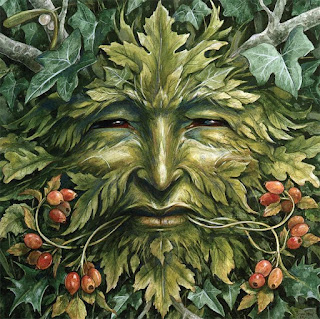
Before he has been in the village a week, Todd find himself investigating several mysteries -- his father's disappearance, Andrew's death, and a cult of the Green Man, which several people seem to be involved in. He also befriends an artist, Shaun, and his pet dog Picasso. Shaun, like Todd, is not originally from the village, and sometimes Todd finds his outsider's point of view refreshing. The longer he spends there, the more he feels he wants to get out, and the more he learns about the place and its history, and the activities of its present inhabitants, who seem determined to keep him there forever, the more he wants to leave.

I found it an exciting book, full of unexpected plot twists, though towards the end some of them became too inconsistent and inexplicable, with some characters shifting a bit too rapidly back and forth between loyalty and betrayal to be convincing.

The book seems to be only available on Smashwords,  and if you like juvenile books with adventure, mystery, ghosts and a touch of supernatural magic, it's definitely worth a read. You can see a fuller description on the Smashwords site here.

As I said at the beginning, I thought this book would appeal to people who liked Alan Garner's children's books. I would say that this one is roughly in the same genre. But what genre is that, and how does one describe it? On Smashwords, Wildwood is described as "Y/A Paranormal" and I don't think I've ever seen Alan Garner's books described as "paranormal" before. I have written a couple of children's books in the same genre, and described them as "children's adventure/fantasy", though one of my reviewers did classify one of them as "paranormal-fantasy". In adult books with similar themes, the novels of Charles Williams have been described as "supernatural thrillers", but never, as far as I am aware, as "paranormal".

The problem here seems to be that for many people "fantasy" implies that the story is set in a location out of this world, and these stories are not (with the partial exception of Alan Garner's Elidor). The problem with "paranormal", for me at least, is that it evokes images of movies like Ghostbusters, and rather misguided attempts to measure spiritual phenomena with material instruments, like using a photographic light meter to measure the light from the transfiguration of Jesus, or parlour tricks like Uri Geller bending teaspoons.

Anyway, whatever you want to call this genre, I like it, and am glad to see other people writing it, and hope to write some more in it myself.  Another book in the same genre is The Dark is Rising by Susan Cooper, which I had read a few months before reading this one. As I explained in my review of The Dark is Rising, one of the things I didn't like much about that book was that the protagonist was not really human, but had superpowers, and there is a hint of that in Wildwood, where we are frequently told that Todd Hunter has a "hunter's instinct" that makes him different from everyone else. It's one of the reasons I gave the book four stars rather than five, not because it makes it a bad book or anything, but the star rating is subjective, how much a particular reader likes a book, and I don't much like books where the protagonist has superpowers, even when, as in the case of Todd Hunter, they so often fail at a critical moment.

  View all my reviews

01 January 2022

The Plumed Serpent

The Plumed Serpent

The Plumed Serpent by D.H. Lawrence
My rating: 2 of 5 stars

Meh.

A long rambling waffling book about two men who found a neopagan religion in Mexico and an Irishwoman who marries one of them, and spends half the book trying to decide whether to marry him, and the other half wondering whether she ought to have done so.

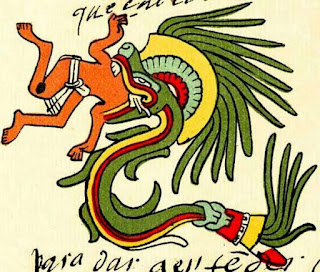
Kate Leslie, a wealthy middle-aged Irish tourist on holiday in Mexico, meets a Mexican general, and his friend, a wealthy landowner, and goes to visit their part of the country, where she extends her stay indefinitely. She helps to rescue the landowner from some would-be assassins, and is asked to marry the general and join the pantheon of their neopagan religion, in which the landowner is Quetzalcoatl, the eponymous plumed serpent deity, while the general is Huitzilopochtli. Kate is ambivalent about her assigned role as divine consort to Huitzilopochtli, and remains so to the end.

There are some good descriptive passages in the book, but they are spoilt by going on for too long, being repetitive, and eventually becoming boring. Lawrence seems to get carried away by his own verbosity, and doesn't know when to stop. And the descriptions of the neopagan religion also become very preachy, overdone and boring (see what I did there? That's one of Lawrence's little tricks -- as I repeated "boring", so Lawrence repeats key words in his descriptions).

So why, if it was so long-winded, preachy and dull, did I bother to buy and read this book?

The answer goes back to my youth in the early to mid-1960s, when I was a student at the University of Natal in Pietermaritzburg. The university English department had made its own literary neopagan religion, in which D.H. Lawrence was the chief deity, with a supporting cast of Joseph Conrad, Jane Austen, Charles Dickens, and Shakespeare, and their very own incarnate Huitzilopochtli, H.W.D. Manson, the greatest playwright since Shakespeare. I didn't earn any brownie points with my tuto, Christina van Heyningen, when I said that I liked Samuel Beckett, Harold Pinter and Eugene Ionesco better than Manson's The Counsellors.

But I still thought I ought to read at least one D.H. Lawrence novel to see what all the fuss had been about, and I picked this one because it was exotic, at least to Lawrence, and wasn't full of coal mines, the English Midlands, and the early 20th-century working class. 

 As Kate is indecisive throughout the book, Lawrence (or at least his characters) can't make up their minds and they often expound inconsistent ideas, as does Lawrence when giving his omniscient narrator's opinion. The white and the dark-skinned races should never meet, and should have their own religions, their own cultures, their own way of life -- "own affairs" as the old apartheid ideology used to put it. But this will eventually lead to a new man, with new blood and all will be one. Oh yes, there's lot about blood in this story. It's a very bloody book, starting from the opening bullfight scene and drifting off into the obscure philosophy about how white blood and black blood should never mix, but will eventually become one, or something.

White blood is superior to dark blood, but the time of supremacy of dark blood is coming. And aristocratic blood is better than the blood of peons. Lawrence appears to believe in a kind of Nazi uebermensch:

The star which is a man's innermost clue, which rules the power of the blood on the one hand and the power of the spirit on the other. For this, the only thing which is supreme above all power in a man, and at the same time, is power; which far transcends knowledge, the strange star between the sky and the waters of the first cosmos; this is man's divinity. And some men are not divine at all. They have only faculties. They are slaves, or they should be slaves.
Read it quickly, and it can sound profound. Read it paying more attention, and its profundities are as empty as those of the Unman in C.S. Lewis's Perelandra, and the only bit that actually says anything, other than meaningless symbols and abstractions, is the last sentence: Lawrence believes that some men are born slaves and others are born masters, and that's as it should be. It was probably passages like this that led some critics to say that Lawrence was being fascist here. But half the book is like this -- boring pretentious pseudo-spiritual twaddle.


View all my reviews

05 September 2021

King Arthur, Arthurian literature and the Holy Grail

King Arthur In Legend And History

King Arthur In Legend And History by Richard Barber
My rating: 4 of 5 stars

This is the second book on Arthurian literature I've read in the last month, and since I read them so close together, I can't help comparing them. The first one was King Arthur: the True Story, and you can see my review here.

This book is the earlier one (first published in 1961) and in my opinion the better one, though it gets a lower rating on GoodReads, perhaps because of the limitations of the 5-star rating system. In a 10-star system I would give King Arthur in Legend and History 7 stars, and King Arthur: the True Story only 6.

The books start at opposite ends of the story, and work in different directions.

King Arthur in Legend and History starts with what is known of the historical Arthur, and then follows the development of the legend in literature. King Arthur: the True Story starts with the developed legend, and works back towards the history. That is because its main purpose is to present its candidate for the true historical Arthur, and so, apart from a general survey of the literature at the beginning, its main argument is directed to that end.

Richard Barber, on the other hand, shows how scanty historical sources led to the growth of a rich literary legend. On the whole, I liked his book and his approach better. He also deals much more thoroughly with the later Arthurian literature, which is of little interest to anyone looking for clues to the historical Arthur. He also gives quite a bit of space to one of my favourite authors, Charles Williams, though he concentrates on his poetry, and not on his prose narratives.

Barber compares most of the major Arthurian writers, and compares the way in which they presented the stories and the characters, and also how people in different periods tended to present them differently.

I'm almost more interested in the history of the literary treatment of the legend than I am in the legend itself. For one thing, King Arthur himself seems to play very little part in the stories. Other than at the beginning, where he becomes king, and the end, with his rather enigmatic end, he seems to do little except announce that he will fast until one of his knights has an adventure and comes back to tell him about it. And the rest is the story of the adventure of this or that knight -- adventures that often seem to involve murder or adultery or both. 

One of the things I find most interesting, though, is the story of the Holy Grail, or Graal. This was introduced to the Arthurian story by Crétiene de Troyes about 1190, though he does not describe it in detail. Within ten to fifteen years (about 1200-1210) Robert de Boron had expanded this narrative, and the Graal had become the cup used by Christ at the last supper. brought to Britain by Joseph of Arimathea and taken to Avalon by Bron the Rich Fisher.


I don't think that it is mere coincidence that this was the very period in which the word "transubstantiation" was introduced into Western theology to explain the transformation of the Eucharistic elements of bread and wine into the body and blood of Christ. It was in 1215 that the Lateran Council declared that the doctrine of Transubstantiation was essential to the faith. For more details on this see Eucharistic theology and witchcraft.

Though Barber discusses Charles Williams's  Arthurian poetry, he does not mention his novel on the Graal, War in Heaven, which also introduces the figure of Prester John. It is a kind of 20th-century version of a Grail Quest, with the Duke of North Ridings playing the part of a questing knight, with his Roman Catholic Eucharistic theology, and the Anglican Archdeacon of Fardles having a somewhat more mystically real eucharistic theology. 

Now perhaps there is somewhere, mouldering on a forgotten shelf  in some university library, someone's doctoral thesis on the parallels between the development of Western Eucharistic Theology in the late 12th and early 13th centuries and the development in the legend of the Grail in Arthurian literature during the same period, and if so, I'd like to read it. But if there isn't one, I would love to see someone working on one, and someone suggesting that to potential students as a possible topic.


View all my reviews

21 August 2021

King Arthur: the True Story

King Arthur: The True Story

King Arthur: The True Story by Graham Phillips
My rating: 4 of 5 stars

King Arthur is a well-known figure in European romantic literature, but the historical character he is based on is vague and elusive. The authors of this book believe they have identified him as Owain Ddanngwyn, ruler of Powys in west-central Britain from about AD 488-520. "Arthur", they say, was not his actual name, but an epithet or nom de guerre meaning "The Bear", being a combination of the Brythonic "arth" and the Latin "ursus", both of which mean "bear".

I am in no position to evaluate the accuracy of their claims, because I am not sufficiently versed in the history of that period, which many historians have referred to as "the Dark Ages" because so little written history has survived from then, and so historians of the period are left feeling their way in the dark. It is like trying, in 2021, to find the biography of a ruler in southern Africa around 1390. There are no contemporary written sources, so that for us is the southern African "Dark Ages". 

I came to read this book in a strange way. I went to the library to renew some books I hadn't finished reading, and saw this one lying on a table. Someone had taken it off the shelf, decided not to take it out, and left it lying there for a librarian to reshelve. I wasn't looking for it, nor would I probably have found it if I had been, but it just appeared in front of me, as if it were saying "Read Me".

What I can say of the book by way of evaluation is that it starts off with a good summary of the Arthurian literature, and how the legends of Arthur were popularised (and in many instances created) in the 12th century by Geoffrey of Monmouth and subsequent writers. So I found the first few chapters very good as an account of how the Arthurian legend developed, and its early sources.

The further one goes into the book, however the more tenuous and speculative the story becomes, and the less convincing becomes the sub-title, "The True Story". The authors don't pretend otherwise. Their prose in the later chapters is extremely conditional, "if x happened, then y could have followed", "It is conceivable that...".

Much of the knowledge of the period comes from archaeology, which can tell us something of what life was like in a particular period, and what kind of people lived where, but it tells us very little of the actual events that led to those conditions. Pottery fragments can tell us whether the people who lived in a place were Angles or Saxons or British, but does not tell us their names, and whether they were ruled or led by someone called Arthur.

I also have to ask myself why I should be interested in Arthur or Arthurian literature. Most of the literature was written 600 years later, and tells us more about that period than about the time when Arthur lived, if he ever did live. One of the things that interests me about it is the intersection of history, myth, legend and theology, some aspects of which I have dealt with in an earlier blog post -- see South African Camelot.


View all my reviews

13 June 2021

The Dark is Rising

The Dark is Rising

The Dark is Rising by Susan Cooper
My rating: 4 of 5 stars

When a reviewer of one of my books, Of Wheels and Witches, compared it with this one, and suggested that it might have been influenced by the The Dark is Rising sequence, I thought I'd better read it. So I read Over Sea, Under Stone which I enjoyed a lot, and now have read this one, which I didn't enjoy quite so much, and in writing this I'm trying to work out why I gave the first book 5 stars, and this one only 4.

There is little to link the two books. Over Sea, under Stone was set in Cornwall, this one is set in Buckinghamshire, with a completely different set of characters. Will Stanton is the youngest of a family of nine children, and discovers , on the day before his 11th birthday, that he is an "Old One" and that he has a quest to perform, to collect six signs made of different materials.


He is helped in this by a more experienced Old One, Merryman Lyon, who is the only character who seems to have been in Over Sea, Under Stone, and another family who live on a nearby farm, whom he discovers are also Old Ones, and he is hindered in his task by a couple of characters called The Walker and The Rider.

*** Possible spoiler alert -- if you haven't read this book, and want to, you might want to stop reading at this point, as it has possible plot spoilers ***

The book never explains who the Old Ones are, but we are told that they have a lot of superpowers not accessible to ordinary people, and the young/old Will Stanton learns how to use these powers by instantly absorbing a magic book. And this is, I think, why I liked this story less than Over Sea, Under Stone. The children in that book, unlike Will Stanton, are ordinary children with no superpowers. As G.K. Chesterton puts it, in his book Orthodoxy:

...oddities only strike ordinary people. Oddities do not strike odd people. This is why ordinary people have a much more exciting time; while odd people are always complaining of the dulness of life. This is also why the new novels die so quickly, and why the old fairy tales endure for ever. The old fairy tale makes the hero a normal human boy; it is his adventures that are startling; they startle him because he is normal. But in the modern psychological novel the hero is abnormal; the centre is not central. Hence the fiercest adventures fail to affect him adequately, and the book is monotonous. You can make a story out of a hero among dragons; but not out of a dragon among dragons. The fairy tale discusses what a sane man will do in a mad world. The sober realistic novel of to-day discusses what an essential lunatic will do in a dull world.
Will Stanton, however
... wondered how to explain to an elder brother that an eleven-year-old was no longer quite an eleven-year-old, but a creature subtly different from the human race, fighting for its survival

That makes Will Stanton seem like something out of The Midwich Cuckoos other than being on the side of the good guys. It cuts him off from normal human relations with his family, but not for normal human reasons, but rather for inhuman ones.

The reviewer of my book also detected the influence of Charles Williams, whose novels I have read, and whose influence I freely acknowledge. Interestingly enough The Dark is Rising has several scenes which are reminiscent of Charles Williams's novel The Greater Trumps. In both books the family goes to church on Christmas day for Anglican Mattins, and on the way home rescue a homeless wanderer from a snowstorm which turns into a supernatural blizzard. The difference is that in The Greater Trumps the characters are normal human beings, though they do have access to magical objects. In The Dark is Rising, however, there is a deus ex machina in almost every chapter, and sometimes more than one.

At one point Will Stanton does face a moral choice where his decision could make a difference, when the bad guys have kidnapped his sister Mary, and they threaten to kill her if he does not hand over the signs he has gathered. He refusesw, but Mary is in no real danger, because she is rescued by a deus ex machina.

I did enjoy reading the book, but I don't think it was as good as the first one.

And then, going beyond simply reviewing this book, I come to the comparison with my own. If there were some things I didn't much like about this book, how did I do it differently (or try to -- it is for the reader to judge whether I succeeded) in my books?

In my children's book Of Wheels and Witches and its sequel The Enchanted Grove the child characters are normal human beings, with no superpowers. Some of their opponents are human, and some have magical or supernatural powers, so there is a fantasy element in the books, but I have tried to give the children moral agency, so that their choices do make a difference, and do have consequences, some of which could be foreseen and others not. But as I said, it's up to the reader to judge how well I succeeded.

View all my reviews

30 May 2021

The Madonna of Excelsior

The Madonna Of Excelsior

The Madonna Of Excelsior by Zakes Mda
My rating: 5 of 5 stars

A novel that has a little bit of everything, almost -- a sex scandal, sibling rivalry, political chicanery, and believable characters. And so much of it is true, I read it in the newspaper 50 years ago.

It is set in a real small town in the Free State province of South Africa, and is based on real events, so the usual disclaimer about the characters not resembling any real persons, living or dead, is somewhat differently worded. Though the events are a matter of public record, the characters are fictitious. I've written a few books set in a small South African town, but having lived in a small town myself, I didn't dare to use a  real town as the setting, but Zakes Mda boldly does so, and his book is all the more realistic as a result.

But the fictitious characters do resemble real people. And the book gives a microcosm of South Africa in the last three decades of the 20th century. Excelsior is a real town, and it really was rocked by a sex scandal in the early 1970s. The neighbouring towns, mentioned in the book, are real and I have been to, or through some of them.

And at least one of the characters is real, Father Frans Claerhout, a Roman Catholic and artist who lived at Tweespruit just south of Excelsior, and descriptions of whose paintings at the beginning of each chapter form a linking motif for the story.

Popi Pule has two half-brothers; one, Viliki Pule, is black, and the other, Tjaart Cronje, is white, and all three were born in apartheid South Africa, much of whose legislation was calculated to prevent precisely those kinds of relationships. Viliki and Puke's mother Niki had been Tjaart's nanny when he was small, and she is the eponymous Madonna of Excelsior, and had been a model for some of Father Frans Claerhout's paintings.

People sometimes ask, what was South Africa like during apartheid, and during and after the end of apartheid, and in this book Zakes Mda nails it. He tells it like it is, and was. He has written several books set in South Africa, and each of the ones I've read gives an accurate picture of some or other aspect of South African life. There are links to some of my reviews of them here,

If but someone from another country was coming to South Africa from another country, and wanted an introduction to South African life, and history, and social relations, this is the book I would recommend to them. Since it is fiction, it doesn't have all the facts, but it does tell the truth about South Africa, the unvarnished truth. If you want to know what South Africa is really like, read this book!

View all my reviews

25 May 2021

Missiology and the colour of fish

One Fish, Two Fish, Red Fish, Blue Fish

One Fish, Two Fish, Red Fish, Blue Fish by Dr. Seuss

I haven't read this, but GoodReads recommended it to me, based on the books in my Missiology shelf. That intrigued me. I see most of my GoodReads friends who have rated it gave it a high rating, -- perhaps they can tell me what it has to say about missiology. 

Here are some of the books on my missiology shelf, and I'm not sure how the Dr Seuss book fits in with these:

  • Allen, Roland 1962 [1912]. Missionary methods: St Paul's or ours.
  • Allen, Roland 1960. The spontaneous expansion of the church and the causes which hinder it.
  • Bosch, D.J 1991. Transforming mission.
  • Davies, John D. 1983. The faith abroad.
  • Kaplan, Steven 1984. The monastic holy man and the Christianization of early Solomonic Ethiopia.
  • Stamoolis, James 1986. Eastern Orthodox mission theology today.
  • Bosch, David 1980. Witness to the world: the Christian mission in theological perspective.
  • Veronis, Luke 2009. Go forth: stories of mission and resurrection in Albania.
  • Griffiths, Michael 1980. Shaking the sleeping beauty: arousing the church to its mission.
  • Ajayi, J.F. Ade 1965. Christian missions in Nigeria, 1841-1891: the making of a new elite.
  • Anderson, Gerald; Stransky, Thomas F. 1976. Mission Trends No 3: Third-World Theologies.
  • Becken, Hans-Jurgen (ed) 1973. Relevant theology for Africa.
  • Beeching, Jack 1979. An open path: Christian missionaries, 1515 - 1914.
  • Beidelman, T.O 1982. Colonial evangelism.
  • Bevans, Stephen B. & Schroeder, Roger P 2004. Constants in context: a theology of mission for today.
  • Bhebe, Ngwabi 1979. Christianity and traditional religion in western Zimbabwe 1859-1923.
  • Bonk, Jonathan 1989. The theory and practice of missionary identification 1860-1920.
  • Burridge, Kenelm 1991. In the Way: a study of Christian missionary endeavours.
  • Carter, John 1963. Methods of mission in Southern Africa.
  • Cnattingius, Hans 1952. Bishops and societies: a study of Anglican colonial and missionary expansion 1698-1850.
  • Dvornik, Francis 1970. Byzantine missions among the Slavs.
  • Ellanna, Linda J. & Balluta, Andrew 1992. Nuvendaltin Quht'ana: the people of Nondalton.
  • Farmer, Edwin 1900. The Transvaal as a mission field.
  • Fraser, Donald 1970 (1914). Winning a primitive people.
  • Gerber, Vergil 1979 [1974]. God's way to keep a church going and growing.
  • Hesselgrave, David J 1988. Today's choices for tomorrow's mission.
  • Jarrett-Kerr, Martin 1961. African pulse: scenes from an African hospital window.
  • Kraemer, Hendrik 1956. Religion and the Christian faith.
  • Linney, Barry W. 2000. 21st Century Faith: Radical Living in a new Millennium.
  • Luzbetak, Louis 1988. The church and cultures: new perspectives in missiological anthropology.
  • McGavran, Donald A 1979. Ethnic realities and the church: lessons from India.
  • Milner, Clyde A. & McNeil, Floyd A 1985. Churchmen and the Western Indians.
  • Nemer, Lawrence 1981. Anglican and Roman Catholic attitudes on missions.
  • Niles, D.T. 1963. Upon the Earth.
  • Oleksa, Michael (ed.) 1987. Alaskan missionary spirituality.
  • Oswalt, Wendell H 1990. Bashful no longer: an Alaskan Eskimo ethnohistory, 1778-1988.

I used quite a number of them for writing my doctoral thesis in missiology, but I seem to have missed the Dr Seusss one. Was my missiology thesis any the worse for that?

Actually one of my favourite missiology books doesn't seem to have made the list, so I'll give it a plug here -- it's Orthodox Alaska by Father Michael Oleksa, and you can read more about it here: Orthodox Alaska: A Theology of Mission by Michael Oleksa | Goodreads.

It too seems to have a rather strange list of "readers also liked" books -- only one of those in the top ten seemed to have anything to do with missiology, but some of them nevertheless seemed quite interesting.

So here;s a challenge to fellow missiologists on GoodReeds. Look at the books on your missiology shelf, and share what the top one is, and how many missiology books appear in your top ten. Perhaps it will show how widely-read missiologists are.

And perhaps it ought to show that, because missiology is an interdisciplinary  field of study, covering theology, history, sociology, anthropology and several other things as well. But fish?

View all my reviews

22 October 2020

Supernatural fiction

I recently finished reading The Supernatural Omnibus Vol 2, edited by Montague Summers, and wrote the review that follows for GoodReads, but there are also some observations and responses that go beyond a review, and it led me to compare the approach of Montague Summers and Charles Williams.

The Supernatural Omnibus Being A Collection Of Stories Of Apparitions, Witchcraft, Werewolves, Diabolism, Necromancy, Satanism, Divination, Sorcery, Goety, Voodoo, Possession, Occult, Doom And Destiny

The Supernatural Omnibus Being A Collection Of Stories Of Apparitions, Witchcraft, Werewolves, Diabolism, Necromancy, Satanism, Divination, Sorcery, Goety, Voodoo, Possession, Occult, Doom And Destiny by Montague Summers
My rating: 4 of 5 stars

Thirteen stories of supernatural fiction edited by Montague Summers. It is the second volume of a two-volume set first published in 1931. Volume 2 is described as stories dealing with diabolism, witchcraft and evil lore.

The introduction is a long rambling catalogue of literature of the "ghost story" genre, which sometimes overlaps with horror and sometimes doesn't. Many parts of it are little more than lists of authors, titles or publications.

The stories themselves are a mixed bag. The one I liked best was the werewolf story, "The White Wolf of the Hartz Mountains" by Frederick Marryat, told in Joseph Conrad style, of a tale within a tale, though that format is often found in ghost stories by other authors too.

Another one I liked was the novella Carmilla by J. Sheridan le Fanu, one of the few vampire stories I've enjoyed after reading Dracula, perhaps because it was written before Dracula and therefore not influenced by it.

Most of these stories are from the 19th and early 20th centuries, and it seems to be almost a convention of the genre in that period to write in an obscure and complex style, rather as a lawyer would. This fooled me in one of the stories by Richard Harris Dalton Barham, from the Ingoldsby Legends. The convolutions of style caused me to lose track of the plot altogether. There was a second story by him, with a far simpler plot, and so I was able to appreciate his literary allusions.

If I ever find Volume 1, I'll buy it and read it, so perhaps that is my overall evaluation.

View all my reviews

So  much for the book itself, but the selection of stories seemed to say something about the selector, and his approach to what is commonly called "the occult". Many of the stories featured Roman Catholic priests as either the narrator or the protagonist, and a few featured clergy of other denominations.  I recalled that Montague Summers was a Roman Catholic writer who had written some books on the history of witchcraft and related phenomena. 

I also recalled that when I was writing a journal article on Christian responses to witchcraft and sorcery I had listed several books and articles as possible sources of background information, including some by Montague Summers, but rejected them in favour of ones written by Charles Williams. In following this up someone reminded me of the preface to Williams's book Witchcraft:

There are two authors who have laid the most casual student of the subject under heavy debt--Dr. Montague Summers and the late Dr. Henry Charles Lea; the first chiefly by his various translations, especially of the Malleus Maleficarum, ... Both Dr. Summers and Dr. Lea express fixed views; those views, it is true, are in absolute opposition. I am not myself convinced either by Dr. Summers's belief or by Dr. Lea's contempt. But they express the views of two sincere and learned men, neither of whom would willingly alter a single fact in order to support his own view.

For me the important difference was that Montague Summers appeared to endorse the view of witchcraft and witch hunting taken by the Malleus Maleficarum (the "Hammer of Witches"), while Williams did not.

My article was written 25 years ago at a time when several people were being killed in witch hunts then current in South Africa. It was apparent then that the burning of suspected witches by lynch mobs was a pagan response to witchcraft, and not a Christian one, as my article points out. Yet in Early Modern Europe thousands of people were similarly treated in what was alleged to have been a Christian response, and one which Montague Summers apparently endorsed, while Charles Williams showed that it was an anomalous departure from Christian tradition, based on a conspiracy theory.

The idea of a satanic conspiracy to destroy the Christian Church was not entirely misplaced, however. It appears that there was such a conspiracy, and it was remarkably successful. It just didn't work in the way that the conspiracy theorists thought. They thought it was a conspiracy of witches who made a pact with the devil to destroy the church. In fact it was a conspiracy of conspiracy theorists to make accusations of witchcraft against people, and to encourage others to do so. It was this that was most truly satanic, because the satan is above all the Great Accuser, and making accusations, and especially false accusations, is the most characteristically satanic activity. Satan must have had a good laugh when he got Christians making accusations against each other left right and centre, and casting suspicion on people who failed to make accusations against their neighbours, or did so with less enthusiasm than was expected of them.

It was witch hunting, and the accusations that incited it, and not witchcraft, that was the truly satanic activity.

This doesn't mean that every story chosen by Montague Summers for his anthology made this ideological point, but rather that he would be unlikely to have chosen a story that contradicted it. 

Charles Williams pointed out that the attitude of earlier generations of Christians was very different. They should not fear the power of witches to harm, but should rather fear the malice that actuated the desire to harm, and should first of all combat such malice within themselves. 

And Charles Williams himself wrote supernatural fiction which conformed to this premiss: those who suffered spiritual destruction were conquered by their own servile fear or malice, rather than by that of other people.

18 October 2020

The life and opinions of Tristram Shandy, Gentleman

The Life and Opinions of Tristram Shandy, GentlemanThe Life and Opinions of Tristram Shandy, Gentleman by Laurence Sterne
My rating: 3 of 5 stars

This book has been on our shelves ever since I remember; I think it belonged to my mother, though I don't know if she ever read it. Sixty years ago a friend at university who was doing English II said he was reading it, and remarked on its peculiarities, especially its extreme discursiveness, and the diagrams that appeared at various points in the narrative to illustrate this.

I tried to read it but lost interest, and so it sat on our shelves unread through several moves from one house to another, until the Covid19 epidemic came along, and with all the public libraries closed I turned to the unread books on our shelves and this was one of them.

The title tells us that it concerns "the life and opinions of Tristram Shandy, Gentleman", but there is little of his opinions and even less of his life. There are nine Books, each with over 30 chapters, and he only gets born in Book 4. The preceding books recount the lives and labours of the midwife and the obstetrician who attended his birth, and how the latter's use of new-fangled obstetrical forceps flattened his nose.

We learn a great deal about his Uncle Toby, whose hobby is playing soldiers since he was wounded at the siege of Namur, and about how Uncle Toby fell in love with and wooed the widow Wadman, with plenty of digressions along the way. It is said that Laurence Sterne pioneered the "stream of consciousness" novel which was popular in the early 20th century, and that could be so, as he tells the story the way most people think, jumping from one topic to another for no particular reason.

Though it was first written and published in the 18th century, it seems surprisingly modern. Much of the usage is still current today, and at several points I was surprised that usages I thought were quite recent seem to have been current 250 years ago.

I also think of all the books and articles and courses on creative writing, and how to write a novel, and what is acceptable to publishers' editors and what is not. And I think if I had been a publsiher's editor I would have rejected this one for its very discursiveness, it's failure to get to the point. Dammit, the protagonist has no goals! And a protagonist without a goal, we are told, is the biggest no-no in novel writing. Yet 250 years later Tristram Shandy is still in print, and a lot of novels published 10 years ago are not.

View all my reviews

14 May 2020

A Brief Guide to J.R.R. Tolkien

A Brief Guide to J.R.R. Tolkien: A Comprehensive Introduction to the Author of the Hobbit and the Lord of the Rings. by Nigel CawthorneA Brief Guide to J.R.R. Tolkien: A Comprehensive Introduction to the Author of the Hobbit and the Lord of the Rings. by Nigel Cawthorne by Nigel Cawthorne

My rating: 5 of 5 stars


I liked this book a lot better than I thought I would. I picked it up cheap in the first book shop I found open since the corona virus lockdown began, and having just re-read the first three Harry Potter books for third or fourth time I wanted to read something I hadn't read before, even if it was about books that I had read before.

It does what it says it does in the title.

If you have read The Hobbit and The Lord of the Rings and you want to know a bit more about the books and their author, and how they came to be written, then this is the book to read. It's not a book for Tolkien scholars, or for people who are studying the place of Tolkien's work in 20th century literature. It's an introduction, a brief guide, though its brevity runs to 278 pages. It has an index, a bibliography of books by and about Tolkien, but no journal articles.

Perhaps the best way to indicate what it contains is to list the Table of Contents.

Introduction: The man and the myth
Portrait of the Artist as a Young Hobbit
Journey to Middle-earth.
The Inklings
Major Works
Posthumous Publications
Living in Middle-earth
The inhabitants of Middle-earth
The Characters of Middle-earth
The Languages of Middle-earth
Filming Tolkien
Bibliography
Index

The one thing it doesn't have is maps, for those you must go to the books themselves.

Flaws? Yes there are some.

One, which is not the fault of the author or publisher, is that an undergraduate student of English literature who had one of Tolkien's major books as prescribed reading could easily get away with reading the plot summaries in this book rather than the works themselves.

The second fault, for which I do blame the author and publisher, is that there are numerous typographical and spelling errors, especially in the names of the characters. The author himself makes the point that Tolkien was

...scrupulous about names. They needed to make sense and have some reasonable derivation no matter how obscure. He was always critical of earlier fantasy writers, such as Edward Plunkett, Lord Dunsany, who seemed to pick names at random. For Tolkien names had to be fashioned by sound linguistic rules.

In view of that the publishers could at least have tried a bit harder to get the spelling of the names right.

Another thing I wasn't sure what to make of was the disclaimer on the front and back cover and the title page:

The Unauthorised Guide to the Author of The Hobbit and The Lord of the Rings.

I wasn't sure what message this is meant to send to the reader. Could it be saying that it gives the real information that the authorised editions all suppress, or that it doesn't, because only authorised writers are allowed access to that material? At any rate the information it give seemed generally pretty good to me.


View all my reviews

16 March 2020

Supernatural superheroes in literature

Lovecraft Country: TV Tie-InLovecraft Country: TV Tie-In by Matt Ruff

My rating: 4 of 5 stars


Set in 1950s racist America, this is magic realism at its best.

The title is slightly misleading; it might lead one to expect a pastiche of Lovecraft and the Lovecraft school of horror, but though the story begins with a journey to Lovecraft country , its style is altogether different. I don't recall seeing a single "eldritch". Most of the action takes place in and around Chicago, with a couple of side trips to distant galaxies and supernatural realms.

Atticus Turner, his uncle George Berry and friend Letitia travel to the Lovecraftian town of Ardham in Massachusetts where they discover that Atticus's father is being held prisoner by a coven of white occultists. George is a travel agent, and editor of The Safe Negro Travel Guide, and it soon becomes apparent that it is safer for Negroes to travel to the farthest reaches of the galaxy or to demonic realms than it is on the roads of 1950s America.

Most of the main characters are related to each other, and even to the chief villain, Caleb Brathwhite, a white man with ambitions to become the chief witch in America.

Neil Gaiman fans, among others, might enjoy it.

View all my GoodReads reviews

Going beyond a review of the book itself, however, there is also the social milieu in which it is written and set.

Two years ago we saw the film Black Panther, which featured a black comic-book superhero, and it sparked several discussions at the time. Comic-book superheroes were a product of America of the 1930s, and probably reached their zenith in the 1940s and 1950s. But at that time the characters in them were all white Americans. Lovecraft country shows that in that period there were many black Americans who enjoyed reading about comic-book superheroes with science-fiction type powers, and Lovecraft-type horror stories, dealing with supernatural powers. But all the characters were white.

This book depicts black fans of such literature, in the social milieu of the time, who then themselves have the kind of adventures depicted in the superhero comics and in Lovecraftian stories. In my review above I said that if you liked Neil Gaiman, you would probably like this book. I'll extend that by saying that if you liked Black Panther the movie you'll probably also like this book.

In the 1950s, when Lovecraft Country is set, black American fans of such literature were on the outside looking in, but what about Africa? African culture is different from American culture, and most of the literature of that kind that we have to read is from overseas somewhere. I was once reading The Lion, the Witch and the Wardrobe to some black South African children, and there were many foreign cultural references that needed to be explained. The only African literature that seems to me to be comparable is Amos Tutuola's My life in the bush of ghosts, but I think that is more for adults than for children.

But I'd be interested in seeing this kind of magic realism in southern African literature, in books for both adults and children.

25 February 2020

In The Beauty Of The LiliesIn The Beauty Of The Lilies by John Updike

My rating: 4 of 5 stars


A 20th-century USA family saga.

A couple of months ago I asked in the Inklings forum about suitable books for teaching theology through literature, and David Levey, a former professor of English literature at Unisa, said,
For the essential text I would recommend anything by John Updike, a celebrated novelist and believing Christian who dealt with matters of sexuality as well as issues of faith. His 'Rabbit' series should still be obtainable.
So I started reading books by John Updike, though I have to admit that I can't see how either the first one I read, BrazilBrazil by John Updike nor this one, would be suitable for the purpose I had in mind.


In this book John Updike follows four generations of an American family through the 20th century, concentrating on one member in each generation, showing how their lives changed as the century progressed.

It begins in 1910, with the moment that Clarence Wilmot, a Presbyterian minister, loses his faith and becomes an encyclopedia salesman. His son Teddy (named after US president Theodore Roosevelt), has no faith at all, and becomes a postman. Teddy's daughter Esther becomes a film star, a screen goddess and so an object of worship for some, in the heyday of Hollywood of the big studios. Like many stars of that era, she has numerous marriages and divorces.

Esther's only son, Clark, drifts rather aimlessly until he inadvertently joins a Seventh-Day Adventist breakaway sect living in a commune in Colorado, where a personality cult develops around the leader, who is clearly modelled on David Koresh, and from that point on the story becomes rather predictable. There is a stand-off with the local police, a siege, and in the end the buildings burn and a lot of people die.

At the beginning and the end there is quite a bit of theology.

As Clarence Wilmot wrestles with his faith, or lack of it, contemporary Presbyterian theological trends are cited. John Updike seems to have done quite a bit of research into this, but I don't really know enough about Calvinism at that period to know whether he got it right or not.

I do, however, know enough about Seventh-Day Adventism to think that he got some aspects of their theology seriously wrong. Updike portrays the dwellers in the commune as willing to die because they believe that they will go straight to heaven after suffering martyrdom, but this contradicts a key point of Seventh-Day Adventist theology. They explicitly and emphatically do not believe that Christians, even Seventh-Day Adventist Christians, go straight to heaven when they die. Rather they believe that all men will rot in their graves when they die, and at the second coming of Christ they will be resurrected to face judgement. In this, Updike appears to have got it wrong.

Of course he could possibly, as part of his plot, have this sect in his story diverge from bog-standard SDA theology, but in that case he owes it to the reader to explain this divergence. He does not shy away from some of the obscurer details of Calvinist theology at the beginning of his story, so why does he skip it with SDA theology at the end? Or perhaps if I knew more about Calvinist theology, I would see that he got that wrong too.

Apart from the theological background, however, I think Updike gives a portrait, through his four main characters, of 20th-century America, which was to lead, 30 years later, to the America of Donald Trump.


View all my reviews

04 April 2012

The Times Literary Supplement's 100 Most Influential Books Since the War

Someone posted a link on Facebook to a list of the most influential books since the Second World War.

The Times Literary Supplement's 100 Most Influential Books Since the War

I found it interesting to see how few I had read, yet I have probably seen the thought of many of them retailed by other writers. It doesn't say whether the influence was good or bad -- that's probably a "readerly" decision, as the postmodernists might say.

The ones I have read are:
  • Albert Camus: The Outsider
  • Arthur Koestler: Darkness at Noon
  • George Orwell: Animal Farm
  • George Orwell: Nineteen Eighty-four
  • Norman Cohn: The Pursuit of the Millennium
  • Boris Pasternak: Doctor Zhivago


That's not much out of a list of 100, only 6%, but I suppose "influential" means that the thought of those books has also permeated other books. I have, for example, read many books that cite Thomas Kuhn's The Structure of Scientific Revolutions, though I haven't read Kuhn's book myself.

I also don't know how the list was compiled, or who compiled it, though perhaps it says that elsewhere on the site.

LinkWithin

Related Posts with Thumbnails