Showing posts with label South Africa. Show all posts

27 April 2026

32 Years of Freedom

Today marks 32 years of freedom -- 32 years ago South Africa held its first democratic election. I described that quite fully in a blog post 12 years ago -- click here to see it.

This time I fell to wondering what I was doing 32 years before that. I was working as a bus conductor in Johannesburg, and having just reached the age of 21 years, I was eligible to be trained as a driver as well. And this is what I wrote in my diary for that day, Friday 27 April 1962: 

I did one Highlands North for scab and then went to the driving school and got a lot of instructions on how to get a learner's licence and then came home. I got 5c pay, which I spent on a cup of coffee. For bird's sake!

On my shift I read "Out of the silent planet" by C.S. Lewis, and then slept all the way home on the caboose.

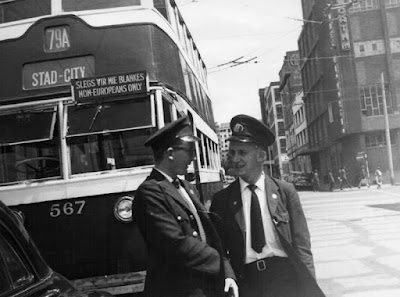
My shift that day, which had been mine since the previous January, was four trips to Bellevue East in the evening rush hour in an old AEC Regent Mark III diesel bus, "Non-Europeans" only -- "Non-Europeans" got all the rattly old buses, the new shiny ones were reserved for white people. They were heavy work, because the trip was quite short, the buses were full, and so a lot of fares had to be collected in a short time. 

Steve Hayes as a bus conductor in 1962
Then there was a break, followed by 7 trips, in the same kind of bus, alternately to Crown Mines and Mayfair, for "Asiatics and Coloureds" only. There were usually only 5-10 passengers on the outward trip, and 1-3 going back to town, so once I had collected the fares, which I had usually done before the bus had travelled a block, there was plenty of time to read a book. Why did Johannesburg municipality run a bus service for so few passengers? Probably because, in those days of apartheid, the working-class white residents of Mayfair and Homestead Park did not like "Asiatics and Coloureds" riding on "their" buses, and the city councillors, elected only by white voters, took such things seriously, lest they not be reelected.

When not reading, I would stand on the rear platform on the bus and look at the passing scene. First Fordsburg, home of a lot of old buildings, with balconies and iron railings. home of Indian businesses, mostly "general agents" with names like Dhirubhai C. Desai and Dhadubhai P. Naik. Past the trolleybus garage in the dip, and up the other side, where, at that time of night, the only shops open were corner cafes or "tea rooms" (convenience stores), and most of them had closed by 9:00 pm. I finished work after the last bus that could have taken me home had gone, so went home on the caboose, a staff bus, which dropped me about a mile from home, and I walked the rest of the way, getting home about 1:30 am. 

In case anyone was wondering about why my pay was only 5c, that was the week in which deductions for the pension fund and the thrift fund were made. The savings in the "thrift fund" were so I could go to university the following year.

What else happened in 1962?

Balthazar Johannes Vorster, who had become Minister of Justice the previous year, presented a General Laws Amendment Bill in parliament, nicknamed by the media the "Sabotage Bill" because it provided for much heavier penalties for malicious damage to property if it could be shown to have been done with a political purpose. But it had lots of other provisions for administrative action against opponents of the government's apartheid policy, including house arrest. The first person to be put under house arrest was Helen  Joseph, who lived quite close to me, and though I did not know her personally, the fact that she lived nearby made the encroaching police state feel very real, and the freedom achieved on 27 April 1994 was, and is, very real also.

22 August 2025

Burying the Typewriter: under the Eye of the Secret Police

Burying the Typewriter: Childhood Under the Eye of the Secret Police

Burying the Typewriter: Childhood Under the Eye of the Secret Police by Carmen Bugan
My rating: 4 of 5 stars

A memoir of a family living under the eye of the Romanian secret police in the time of the dictator Nicolae Ceaușescu.

Carmen Bugan's father was a political activist, protesting against the dictatorial communist regime in Romania, and was imprisoned as a result of his protests. During his imprisonment his family was under constant surveillance by the Romanian secret police, the Securitate, and Carmen Bugan describes the life of their family in those circumstances. When her father was eventually released from prison he wanted to leave Romania and the family emigrated to the USA shortly before the fall of Ceausescu.

The story is well told - Carmen Bugan is a poet, and many of her descriptions are poetic -- and I found it well worth reading.

It may be just me, but one of the things that I found most interesting was comparing her experience with the Romanian Securitate and my own experience (and that of other people I have known) with the South African Security Police in the time of apartheid.

The main difference seemed to be that the Romanian secret police were far less secret than the South African ones. In Romania much of the surveillance was open. The family were told that they were being watched, they saw the microphones being installed in their house, and were told to leave their curtains open so that the police could see what was going on inside. The children were followed to school, and the friends and relatives who visited them often wrote notes to warnher and her parents them to be careful what they said, because they had been asked to report conversations to the police. In South Africa, even reports to the Minister of Justice did not name informers but referred to them as as "'n delikate bron" (a sensitive source). 

But in most other respects they seemed to be very similar, and rather familiar. Reading the book I was reminded of the feeling that one could not really trust anyone, because you never knew who might be a police spy. She writes of

Sofica, our neighbour, who is in her late thirties and single, is called to the Securitate to give information about us. Does she have a choice? We can't tell the difference between her being 'interrogated' about us and her being asked to 'inform' on us... When she returns home it is her and her parents job to prepare meals for the Securitate comrades who turned the front room of their house into a surveillance residence from which they could watch us day and night.

I was rather disappointed that the story did not tell more of their emigration and life in exile, and how they adapted to life in a new country. It did, however, tell of her later return to Romania and reading the files kept on her family by the Securitate. That paralleled my own experience of going to the archives in Pretoria and reading the reports the South African Security Police made on me and my activities. As Carmen Bugon writes

...it's knowledge that comes as a sort of exile from Eden. Am I worthy of gaining this knowledge? Am I entitled to have this knowledge because I am a part of it? Will my life make sense without this knowledge now that I know it exists?
I found it interesting to see what they knew, and also what they did not know; what they saw fit to record, and what they did not see fit to record. They said I had been to places I had never been to, and did not say anything at all about places I had been to. Their "total onslaught" mentality made them see conspiracies where there were none, and often to misinterpret what they did see because of the distorting lens through which they looked at the world. In that respect there was little difference between the Romanian secret police and the South African secret police, or the secret police of any other place or time. As W.H. Auden writes:
Obsession with security
in sovereigns prevails
'His Highness' and 'The People' both
choose islands for their jails.
And that goes for other security measures too.

View all my reviews

09 January 2023

Early Days of the Internet in South |Africa

There's an interesting article here on How the Internet got started in South Africa

 I found it particularly interesting as I played a small part in that history.

On 24 October 1988 I attended a Uninet conference. Uninet was the nascent Universities Network of South Africa, much of the work on the founding of which is described in the article linked above. 

The Uninet Conference was held at the Council for Scientific and Industrial Research (CSIR) in Pretoria. The plan was apparently to set up a high-speed link between the universities, but it seemed to me that it was a bit like trying to build a freeway without access roads, because the networks within the universities were not sufficiently developed to enable us to gain access to the existing networks, such as SAPONET and the rudimentary Uninet.

I was there representing the Editorial Department of the University of South Africa, and we were concerned to gain access to library and terminology resources as well as being able to consult with colleagues in the field on questions of language and usage. 

But I also participated in amateur BBS (Bulletin Board System) networks of which the main one in South Africa at the time was Fidonet. It was run by a system of private enterprise socialism in which sysops (system operators) of individual BBSs shared their resources with anyone who cared to phone them, and shared the expense of passing messages around the country and around the world over dial-up landlines. All you needed to start a BBS was a computer with the right software (mostly freeware), a modem, and a phone line. People could call in, leave and read messages, and participate in discussion forums, called "conferences", some of which were local to a particular BBS, some national, and some international. Through the ASIAN_LINK conference some of us had first-hand accounts of the Tianamnen Square demos and massacre in China. 

One of the things discussed at the Uninet conference was the difficulty of international communication, including such things as JANet (the Joint Academic Network in the UK) using a different form of domain name addressing to everyone else. Instead of university.ac.uk they used uk.ac.university. But that was a purely theoretical problem if we could not actually connect. 

On the second day of the conference I managed to talk to some interesting people, like Mike van der Linde, of Pretoria University, and Neville Spicer of the Council for Scientific and Industrial Research, and Francois Jacot-Guillarmod of Rhodes University. I suggested that they set up a Fidonet-Uninet gateway, and route international traffic through it. Francois Jacot-Guillarmod took the bait, and within a couple of months had set up a gateway at Rhodes University in Grahamstown, which connected to Randy Bush's BBS in Oregon, USA. He ran the Fidonet Echogate for Africa there.

Fidonet and its members benefited in that Rhodes University paid the phone bills for all the international traffic, both Uninet and Fidonet, that went through their line over a 9600 bps modem. That carried the whole of South Africa's international internet traffic for the next few years.

30 December 2021

The day Desmond Tutu rode on my bus

When Anglican Bishop Desmond Tutu died at Christmastide 2021, lots of people were sharing their memories of him on social media, and I hope those memories are preserved, at least for the use of a biographer, for someone like Desmond Tutu surely needs a biography. The life and times of Desmond Tutu are the most critical in South African history. He saw the whole period of apartheid, and more than 25 years of what followed, and much in his life illustrates and epitomises that period. 

I had already written most of my memories of him when he retired, and I've mentioned him quite a lot in my blogs, but there is one incident that perhaps deserves to be told in a little more detail, as illustrating his life and the times he lived in. It was Tuesday 5 December 1961, the day Desmond Tutu rode on my bus.

In 1961 I began working as a bus conductor for the Johannesburg Transport Department,. It was the year when South Africa switched to decimal currency in February, became a republic at the end of May, and held a general election in October, the fourth since the coming of apartheid, in which the National Party increased its majority. For the National Party it was a triumphant year. Not only had they achieved their Republic, but they had had the first general election since Union in which black voters had no say at all, because the "Natives Representatives" had been abolished the previous year.

In 1961 the Johannesburg Transport Department had three-way apartheid. There were buses for "Europeans Only", buses for "Non-Europeans Only" and buses for "Asiatics/Coloureds Only".  

And on 5 December 1961 Desmond Tutu got on the Parktown North bus on which I was conductor. The bus was a two-man operated BUT 6-wheeler trolley bus, with a staircase at the back leading to the top deck, and long sideways seats  over the back wheels, where Desmond Tutu was sitting. When I had finished collecting the fares, I stood on the back platform, because there were few new passengers whose fares needed to be collected, and my job was simply to give the right-of-way signal to the driver (two rings of a bell), when all the passengers had safely disembarked. So when I wasn't doing that, I chatted to Desmond Tutu. 

I had known him for a little over two years then, mainly from Shoe Parties at St Benedict's House in Rosettenville. In 1959 Desmond Tutu had been a student at St Peter's Theological College in Rosettenville, and as it was just over the road from St Benedict's House, many of the students came to the monthly Shoe Parties, as did people from Anglican parishes all over Johannesburg. We had also both been members of the Postulants Guild, for those in the Anglican Diocese of Johannesburg who thought they might be called to serve in the ordained ministry of the Anglican Church. 

He was then a deacon, and was on his way to see the bishop, Leslie Stradling, to discuss his ordination as a priest, which took place 12 days later, on 17 December. 

The bus trip to the stop for the bishop's house, near the Johannesburg Zoo, only took about 20 minutes, of which we only chatted for about 10 minutes, when I'd finished collecting fares. Our chat was mainly about church things -- his impending ordination as a priest, what Leslie Stradling was like as a bishop (he was relatively new at the time, having been enthroned as bishop only two months before). Neither of us envisaged that within 25 years Desmond himself would be Bishop of Johannesburg. 

What was significant about our conversation was not what we said, but that it took place at all, especially in the year of the triumph of the Spirit of Apartheid. 

When Desmond got off the bus and we waved goodbye and I said I would see him at his ordination, and as soon as the bus pulled away from the stop, the other passengers began asking me "Who is that man? How do you know him? Why were you talking to him? Where does he come from? Where do you come from?"

If I had had foresight I could have said "That man is the future Anglican Archbishop of Cape Town," but of course I didn't and I just said that he was a deacon going to see the bishop about his future ministry as a priest. 

But where did he come from? Where did I came from?

I said we both lived in Johannesburg, but he was originally from the Northern Cape, and I was originally from Durban. 

The passengers didn't believe me. We must have come from overseas somewhere. 

"Where are you from? France? Germany? America? Is that man an American Negro?"

It was simply inconceivable to the man on the Parktown North omnibus that a black South African and a white South African could have a normal human conversation in Johannesburg in 1961, the year of the triumph of apartheid. In 1961 South Africa was indeed a very strange society, in which normal behaviour seemed abnormal, even to normal people. But that was the society in which Desmond Tutu lived half his life, a society in which we used to sing at the time:

When I'm walking down the street
I must be careful not to greet
people of a different pigmentation
lest the government suspect
or the Special Branch detect
a dark affiliation -- to a communist organisation
I

07 September 2021

The Mission: A Life for Freedom in South Africa, by Denis Goldberg

The Mission: A Life for Freedom in South AfricaThe Mission: A Life for Freedom in South Africa by Denis Goldberg
My rating: 4 of 5 stars

A very readable autobiography of a South African political activist.

Denis Goldberg was born and grew up in Cape Town. His parents were communists, and imparted to their children a desire for social justice. He went to university and studied engineering, and became a civil engineer. In the 1950s he joined the Congress of Democrats which was part of the Congress Alliance of organisations opposed to apartheid, with separate organisations for black, white, coloured and Indian South Africans. The Communist Party had been non-racial, but when the National Party came to power in 1948 one of their first acts was to ban the Communist Party of South Africa, which then went underground as the South African Communist Party.

The Congress Alliance sponsored the Congress of the People in 1955, which in turn adopted the Freedom Charter, which put forward the vision of a democratic non-racial South Africa. But those the National Party government regarded as the organisers were arrested and charged with treason, though after four years they were all acquitted.

In 1960 all the parties in the Congress Alliance were banned and they too went underground, and decided that, since peaceful protest no longer seemed a workable political activity, they should move to armed struggle. Denis Goldberg was among those arrested and tried in the Rivonia Trial of 1962, and was sentenced to life imprisonment, though he was released after 22 years. He describes the events leading up to his arrest, the trial, and his time in prison.

After he was released he went overseas and joined his wife Esme in the UK, where he worked to publicise the African National Congress (ANC) and its cause in Britain, Europe and elsewhere. After the ANC was unbanned in 1990 he worked to gain support for community development projects in South Africa. When his wife Esme died he married again and returned to South Africa, where he used his engineering training to advise successive ministers of Water Affairs and Forestry.

The parts of the book describing his personal and family life and his time in prison are very clear and readable, but his descriptions of the political situation and political activities are less so. These parts of the book could be confusing to readers who do not have prior knowledge of the political history of the times. In some places, when describing the political scene of the 1950s, he mentions the Non-European Unity Movement, but seems to assume that his readers will know that it was, what its policies were, and how it differed from the Congress movement.

In other parts, he gives the impression that he is writing an apology to defend himself from criticisms by his colleagues in the ANC. This is no doubt because he was criticised in some quarters, but exactly for what is only hinted at and not stated explicitly. In these parts of the story one gets the impression that he is writing for his colleagues to defend his own actions, and not for the general reader.

I do not agree with all his views, and there were some attitudes that seemed alien to me. As a pacifist, I was never too taken with the idea of the armed struggle and the use of violence, though I recognise that not everyone is a pacifist and most people are unlikely to be. And as a liberal I felt a bit uncomfortable with the top-down authoritarian structure. Of course that was partly because they saw themselves as an army, and so developed along military lines with a top-down command structure. Nevertheless, the need for getting approval for everything from the next level of command in the rather rigid hierarchy seemed strange to me, especially when the movement was underground. I would have expected more flexibility, and expecting members to do things on their own initiative rather than passing everything up the command chain and waiting for permission to come back down.

It would make more sense to me to ensure that people are familiar with the general principles and policies of the organisation, and apply them in ways that are possible in particular circumstances of time and place. But Goldberg writes in such a way as to give the impression that he is trying hard to preclude or counter accusations that he was acting on his own initiative.

Later, however, when the ANC was in power, he accuses civil servants of being dull and unimaginative and obstructive of changes that would better the life of the people. I think his criticisms are justified, but it might be the authoritarian structure of the ANC that has caused it.

View all my reviews

04 September 2021

Zionist origins in South Africa

The Daily Maverick recently published an interesting article about Wakkerstroom, the birthplace of Zionist Christianity in South Africa -- if you are not sure about the difference between Zionist Christianity and Christian Zionism, see here.

The Daily Maverick article, with the title Letter from Mpumalanga: Listening to history’s whispers by the river of enlightenment, has some interesting pictures of the places where Zionist Christianity started in South Africa at the turn of the 20th century. It has since split into numerous different denominations, the largest of which, the Zion Christian Church, is the biggest single denomination in the country.

Around 1900, a Dutch Reformed missionary living in Wakkerstroom, Pieter Le Roux, became interested in the Christian Catholic Apostolic Church in Zion, Illinois. Zion was a utopian community dedicated to two chief propositions, both radical in their time: one, that doctors were unnecessary because Jesus could heal all ailments; and two, that all races were equal in the eyes of God.

Both propositions resonated with Le Roux, who spoke fluent Zulu and seems to have had unusually egalitarian ease with black Africans in that era. Le Roux tried to resign from the Dutch Reformed church, but they asked him to delay his departure until after the Anglo-Boer war.

The article is misleading in some respects -- first, while the church in Wakkerstroom was the first Zionist church in South Africa, it was not the first African independent church (AIC). There were several earlier AICs, such as the Ethiopian Church which started in Marabastad, Pretoria, about ten years earlier, and a movement started by Nehmiah Tile even earlier than that in the Eastern Cape. Secondly, the early history of Zionism has been fairly well documented in numerous books, including some by my erstwhile colleague Allan Anderson -- see, for example: Zion and Pentecost

zionist baptism

 What is significant in this article, though, is the description of the physical sites of early Zionist history, which should surely be declared historical monuments, and the Daily Maverick article is illustrated with some interesting photos of these.

There is also something that puzzles me, and I hope someone familiar with the sources of early Zionist history will be able to enlighten me. This article, and most of the books I have read on the topic, say that the first Zionists were baptised in the river that runs through Wakkerstroom -- the eponymous wakker stroom (wakeful or lively stream). But some mention the Slang River, which is over the mountains, and indeed, in those early days over the border in a different country, the then Natal Colony. The photo in the article clearly shows the same bridge in Wakkerstroom as appears in the old photo, So I wonder about the source of the mention of the Slang River, as something in the early history of Zionism that needs to be clarified. Did Le Roux and his flock flee across the mountains to Natal at some point -- and if so when, and for what reason? I am curious, partly because I was at one time quite familiar with Groenvlei in the Slang River valley and I used to visit the Anglican church there once a month for services, but that's another story, which you can read about here, if you are curious.

Anyway, I was pleased to see this article, and to see that some are beginning to take an interest in preserving the history of one of the most significant movements in South African Church history, and from which the largest group of Christians in South Africa spring. 


30 May 2021

The Madonna of Excelsior

The Madonna Of Excelsior

The Madonna Of Excelsior by Zakes Mda
My rating: 5 of 5 stars

A novel that has a little bit of everything, almost -- a sex scandal, sibling rivalry, political chicanery, and believable characters. And so much of it is true, I read it in the newspaper 50 years ago.

It is set in a real small town in the Free State province of South Africa, and is based on real events, so the usual disclaimer about the characters not resembling any real persons, living or dead, is somewhat differently worded. Though the events are a matter of public record, the characters are fictitious. I've written a few books set in a small South African town, but having lived in a small town myself, I didn't dare to use a  real town as the setting, but Zakes Mda boldly does so, and his book is all the more realistic as a result.

But the fictitious characters do resemble real people. And the book gives a microcosm of South Africa in the last three decades of the 20th century. Excelsior is a real town, and it really was rocked by a sex scandal in the early 1970s. The neighbouring towns, mentioned in the book, are real and I have been to, or through some of them.

And at least one of the characters is real, Father Frans Claerhout, a Roman Catholic and artist who lived at Tweespruit just south of Excelsior, and descriptions of whose paintings at the beginning of each chapter form a linking motif for the story.

Popi Pule has two half-brothers; one, Viliki Pule, is black, and the other, Tjaart Cronje, is white, and all three were born in apartheid South Africa, much of whose legislation was calculated to prevent precisely those kinds of relationships. Viliki and Puke's mother Niki had been Tjaart's nanny when he was small, and she is the eponymous Madonna of Excelsior, and had been a model for some of Father Frans Claerhout's paintings.

People sometimes ask, what was South Africa like during apartheid, and during and after the end of apartheid, and in this book Zakes Mda nails it. He tells it like it is, and was. He has written several books set in South Africa, and each of the ones I've read gives an accurate picture of some or other aspect of South African life. There are links to some of my reviews of them here,

If but someone from another country was coming to South Africa from another country, and wanted an introduction to South African life, and history, and social relations, this is the book I would recommend to them. Since it is fiction, it doesn't have all the facts, but it does tell the truth about South Africa, the unvarnished truth. If you want to know what South Africa is really like, read this book!

View all my reviews

27 July 2020

Anglican Students Federation -- 60th Anniversary

Today, 27 July 2020, is the 60th anniversary of the Anglican Students Federation of South Africa (ASF), whose founding meeting was held on 27 July 1960 at Modderpoort in the Free State.

The ASF has had a considerable impact on the life of the Anglican Church of Southern Africa, though that impact has rarely received public attention. Many clergy and lay leaders have been influenced during their student years by the ASF, and it has given many of them valuable experience in leadership.

Germ of an Idea

To my knowledge, the idea of the ASF began on the Wits University Campus in 1959. At that time the Chaplain to the University was Fr Tom Comber, and the Chairman of the Anglican Society was John Daines, who later became a military chaplain, while Tom Comber was later arrested for participating in peace demonstrations in the UK.

Anglican Society activities at Wits then consisted of a weekly Mass in one of the lecture rooms, a weekly lunch-time meeting, with a speaker, and informal gatherings in the chaplain's office, which was a prefab hut. The Anglican Society, led by John Daines and Brian Gannon, was aggressively Anglo-Catholic, and the fact that Roman Catholic students had a "National Catholic Federation of Students" seems to have been the spur which led to the formation of the ASF.

Revd Tom Comber, Wits chaplain
Tom Comber, John Daines and Brian Gannon formed an ad hoc committee to arrange a national Anglican conference in July 1960. Invitations were sent to other Anglican Societies at universities and teacher training colleges and theological colleges. The venue was to be the St Augustine's Test School at the priory of the Society of the Sacred Mission (SSM) at Modderpoort in the eastern Free State.

Tom Comber found that the parents of many of the female students would not allow them to attend the conference unless there was a chaperon, and he persuaded my mother, Ella Hayes, to attend in that capacity.

The conference almost had to be cancelled because of the State of Emergency that followed the Sharpeville Massacre, but he somehow managed to get a paper with the necessary permission for such a gathering. So students converged on Modderpoort from all over the country. I travelled by car with my mother, and we took a couple of theological students from St Peter's College, Rosettenville, Benjamin Photolo and Jacob Maleke, whose homes were in Sharpeville, so they knew people who had been killed or injured in the shooting there,

I'll tell most of the story of the conference from the diary I kept at the time, with occasional explanatory notes.

DIARY

Saturday 23 July 1960

We left for Modderpoort at about 8.30 am, and picked up Jacob Maleke at Amen Court (next to St Mary's Cathedral, Johannesburg) at 9.00 am, and went on to Vereeniging where we picked up Benjamin Photolo at 9.45 am, and then went on through Parys and Brandfort. Between Brandfort and Kroonstad Mr (Rex) Simpson passed us, with Mike Quail, Louise Hesselman, Margaret Edwards and Pam Lowick. We stopped at Kroonstad to fill up with petrol - 150 miles on nearly 4 gallons. At 12.30, ten miles out of Kroonstad, we stopped for lunch - cold chicken and sandwiches. Graham Tremeer passed us in an Austin while we were stopped.

We set off again, and I nearly fell asleep driving over the flat Free State countryside. We passed through Winburg, and continued on a gravel road. On the other side of Winburg Fr Tom Comber was stopped, having lunch. We stopped for a short while to chat, then went on to Modderpoort through Marquard and Clocolan. We were the first car to arrive at Modderpoort, and were greeted by John Daines, who had arrived that morning by train.

We had tea in the refectory, and then went to the station to meet people who had arrived on the train from Durban. Among them was John Greig, a student from St Paul's College, Grahamstown.

After supper, we joined the SSM fathers for Compline in the priory chapel, and then went to bed, shivering, in dormitories below the dining room. (My mother, who had been persuaded by Fr Comber to come as a chaperone for the girls, stayed with Miss Minnie Wright, sister of one of the SSM fathers, in a cottage some distance away)

Sunday 24 July 1960

We got up, still shivering, at 6.30 am, and went to Mattins and Mass (in the Priory Chapel). The Bishop of Bloemfontein, Bendyshe Burnett, celebrated. After breakfast we made our beds, and then went to a classroom for the first address, by the Bishop of Bloemfontein, on The Theological Roots of Anglicanism.

He said that the church roots were the Old Testament patriarchs and prophets, the three creeds of the undivided church, the sacraments and the threefold ministry. A non-papal Catholic church emerged from a political settlement, which became the Anglican Communion. Political influence enabled it to retain its Catholic nature. Today most Anglican Churches have no state connections. It has been shown that papal supremacy is not necessary to church order. The Anglican Communion has no objection to papal primacy which is quite different from papal supremacy.

The Roman Church has attacked episcopacy as much as the Protestants - the Holy Spirit is virtually replaced by a ruler ex-cathedra. Episcopacy in the Anglican Church reminded the English that it was not a merely English institution, but the utterance in England of the universal Christian Church. The Pope describes himself as the ``Vicar of Christ'' - it is a false conception that the ministers are deputed to do what our Lord did years ago. They regard themselves as representing a sometimes present Christ - a practical loss of faith in the Holy Spirit. Anglican ministers are representatives - they represent to the church the ever-present Christ. The ministry is a divinely ordained order. The Protestant view is too subjective.

The Anglican Communion has no faith in itself. We are concerned with the Church of God. The words used at the consecration of a Bishop - ``receive the Holy Ghost for the office and work of a Bishop in the Church of God'' are alone sufficient evidence of this.

The use of Scripture to establish doctrine must be done in the Church. Scripture in the context of the Church is the standard for doctrine. The appeal to Scripture by Anglicans is different from that of Protestants who approach Scripture in a vacuum. Because the Anglican Communion is both Catholic and Reformed some make the Bible and some make Tradition the more important. The liturgy preserves us from ultimate loss by pressure from the spirit of the age.

The Anglican Church became too tolerant, liberal, and thus worldly until the late 18th and early 19th centuries. The reaction from this led to the formation of three streams - Liberal, Catholic and Evangelical, basing their ideas on reason, tradition, and scripture respectively. The church must not be tied down by the spirit of the age, but some latitude is necessary.

The Reformers liberated us from Medieval thinking by the emphasis on Justification by Grace, rediscovering the social nature of the Church. Until recently the Roman Church has been thoroughly individualistic and Protestant in their approach to the Mass. The whole Church is the people of God, a priestly body. With Protestantism the evangelical principles become too vague and pietistic.

The Catholic stream emphasizes the fact that the Church, Sacraments etc. are all given. The Church mediates Christ to the world. All members of the Church are becoming more and more into the full manhood of Christ into which they have already been baptized.

These three are all necessary to the Catholic Church of God, although sometimes we do not appreciate all of them. Even Rome is now catching up on the positive insights of the Reformation.

The mistake of Evangelicals is that they think baptism gives no status. They emphasize conversion and think that one must be able to state how and when it happened. The Romans also, for all practical purposes, regard their members as unbaptized, and emphasize repentance and a series of penitential acts. The West thinks of the dying Christ - the East thinks of the risen Christ, but the Anglican Church has a structure which embraces both.

In the afternoon several of us climbed the mountain behind the Priory, and walked along the top for a while, before coming down a gully, with Liz Tucker leading the way like a mountain goat. We had tea, and Evensong in the Priory chapel at 6.00 pm with the SSM, which was followed by supper.
The SSM Priory and Test School at Modderpoort, from the hill behind


After supper the Bishop of Bloemfontein gave another address, on The Church of the Future.

Bishop Bendyshe Burnett of Bloemfontein
He said that people are generally unsuccessful in relating the rapid advance in technical knowledge to what really matters. The Church must bring a theological basis back to the centre of our lives. Intellectuals are out of touch with modern theologians. People must become more aware of the theological purpose of what they do in everyday life.

Many church buildings in this country are mock-Gothic and out of touch with reality. This could be rectified if architects knew what a church is for. The church should use modern skill, knowledge and materials to build more functional buildings.

In music we wallow in Victorian slush - as far as art is concerned, the church is wearing clothes which are out of date. Modern art is symbolic, and ideally adapted to the use of the church. In the experimental liturgy there is no blessing - the congregation is told to go out into the world and "be the church."

The Church of the future must be reunited, and the Ceylon scheme of reunion is a good pointer in this direction. Denominational apartheid is an evil which must be remedied. The Ceylon scheme will keep the ancient scheme of Bishops, Priests and Deacons.

The Church must become indigenous in each locality, but this must not be paramount, as the word ``Anglican'' seems to suggest. The emphasis is often too much on ``Anglican'' and too little on ``Communion''. The church over the whole world is too ``Anglican'' - too ``English''. How can we be indigenous and yet remain Catholic ? Nationalism must not cause us to lose our Catholic principles.

We must really BE the people of God. The Church must be built around the altar, font and pulpit as the buildings are. We must live as if we really are in the dying and rising community which is the Church. You do not become a Christian and then join the Church. We are baptized into a body, a community - the Church, which is the Body of Christ. We must become what we are by virtue of our baptism. The altar and pulpit enable us to do this. We are Christians, and we must become what we are. We neglect the Holy Spirit too much. One cannot see God and live - our preaching must say this, but because we are dying with Christ, we must also rise with him.

Worship is not merely one of the things the Church does - the Church is a worshipping community. We place our lives and all that we have on the altar, and receive all this back to become the Body of Christ. The perfect union with Christ will come at the Last Day - at the consummation. At every Mass we are waiting for the bridegroom.

Monday 25th June 1960 - St James the Great

We got up early and went to Mattins and Mass at 6.45 am. Fr Gregory (Wilkins) celebrated, and Fr Austin Masters was the server.

At 10.00 am Fr Victor Ranford, SSM, delivered a paper on Empirical Knowledge and Revealed Truth. He said Christians must become scientific, and make an experiment with their lives, trying out Christianity to see if it worked.

In the afternoon Brother Roger, of the Community of the Resurrection, spoke on Pilgrims of the Absolute He gave as his subtitle The Unrespectability of our Religion - he said we make our religion too respectable, and so we do not really show people how urgent it is to know God. None of us is really aware of the desperate necessity of some of the things our Lord said:-

  1. Pray for those who persecute you, so that you may be sons of your heavenly Father
  2. Forgive others - and be forgiven.
  3. It is very difficult for a rich man to enter the Kingdom of Heaven.

He said that beatniks got their name from beatific, meaning sanctified and that beatniks were true pilgrims of the Absolute, not hidebound by convention, as so many respectable church people are.In passing he mentioned a Frenchman who converted Simone Weil, and lived in absolute poverty (Leon Bloy). (The full text of Brother Roger's paper can be found here:  Pilgrims of the Absolute).

Discussion followed, mainly about Holy Poverty. Fr Comber said that poverty was one of the wickedest things he knew. Fr Gregory Wilkins, SSM, with better insight into what Brother Roger had said, remarked: Our Lord said it was difficult for a rich man to enter the kingdom of Heaven, and here we go about raising the standard of living and making people richer.

Brother Roger said beatniks are looking for what St Francis was looking for - only the beats look for God to get a kick out of it, while St Francis looked for God because he thought God wanted him. The dregs of the beatniks have a flavour of holiness.

After supper the discussion was on boring topics such as the character of people who picked up hitch-hikers and the merits of private and government schools.

Tuesday 26 July 1960

Fr Comber celebrated Mass at 7.15, and at breakfast I sat next to Br. Roger. He must have had plenty of interesting things to say, but unfortunately he did not get much chance because Mr Simpson sat on the other side making infallible pronouncements on the character of the Afrikaner and similar topics. I found it rather annoying.

At 10 am Alan Paton spoke to us on Christianity and Communism. He told us about the beginnings and spread of communism, and its idea that society is more important than the individuals living in it. He said that we must remember that Christ was crucified for individual human beings and not their society. We must believe in morality for morality's sake, and for God's sake. The end, for a Christian, cannot justify the means.

In the afternoon Alan Paton spoke again on Ourselves and the African Continent. "All things whatsoever ye would that men should do unto you, do ye even so unto them" - he said that white people did not follow this rule in their treatment of black people of South Africa, but substituted "fear" for "would'' - do to others what you fear they will do to you. Our Lord never promised that kindness would be repaid.

In the evening Fr Gregory Wilkins spoke on Vocation - he said that vocation could come as an invitation or command - if there was a choice of two or more courses it was an invitation, and if there was no choice, it was a command. God calls us to do what we are doing. Desire, ability and opportunity are all necessary for vocation.

Wednesday 27 July 1960

Mattins and Mass at 6.45 am in the Priory Chapel as usual, and Fr Ranford, the inveterate hitch-hiker, celebrated.

Mr Simpson delivered a paper on The Contemporary and Christian Attitude towards Sex - it was what one would expect to hear from a man like him, largely factual, with some old-fashioned "gentlemanly" touches, like saying (of the view that Christian sexual morality is bad because it gives people inhibitions) "Of course I have inhibitions. I have inhibitions against spitting on the carpet."

In the afternoon a group of us climbed Spitzkop, a little koppie in the middle of the poort, between the river and the priory. Benjamin Photolo, who had been up yesterday, led the way, and we sat at the top discussing the Bishop of Johannesburg (Ambrose Reeves), and his problematic return. John Daines hoped that he would return, and resign immediately (Bishop Reeves had fled the country immediately after the Sharpeville massacre, fearing he would be arrested. He did return a few months later, and was deported).

When we left to go down Brian Beattie stayed behind with Anne Page, and on the way down we lost John Blythe and Margaret Edwards, who went off courting. Rex "the Sex" Simpson obviously had an influence.

After tea Mr Ferrandi, Headmaster of St Andrew's School®X7St Andrew's School¯ in Bloemfontein, spoke on Christian National Education®X7Christian National Education¯.

In the evening there was preliminary discussion on the formation of a National Federation of Anglican Students. After finally deciding that it would be formed we spent such a long time arguing over the constitution that a committee was appointed, representative of all universities and theological colleges present, to draw up a draft constitution, and the rest of us went and had tea and said compline in the Priory Chapel. Back in the dormitory I had an interesting discussion with John Greig, who claimed to be a Prot, but was actually more Catholic than any spike.

Thursday 28 July 1960

We had Mattins and Mass in the Test School Chapel, with the altar in the middle, and the congregation around it. Fr Austin Masters celebrated.

After breakfast we had a symposium, at which the Chairmen of the Anglican Societies of Wits, Rhodes and Natal reported on the work of their respective societies. Brian Beattie, of Rhodes, gave the best report.

After morning tea we discussed two questions on Christianity and Communism, and then Alan Paton gave a brief talk on the future of South Africa. He said there were three possibilities :

  1. That the Government kept control by force, until there was a revolt, which would probably be crushed at the cost of great bloodshed and suffering.
  2. There would be outside intervention, probably from Ghana, followed by United Nations intervention.
  3. The Government might alter its policy.®IP¯

In the afternoon I bought a number of books from the Adams Mission Library, and then we had a discussion on the function of an Anglican Society in a University. Shirley Silverthorne (SCA Travelling Secretary) gave as a reason for poor Anglican Society/SCA relationships in most universities that the SCA in South Africa consisted mainly of fundamentalists. After tea we passed the draft constitution with a few amendments.

After supper we elected a provisional committee, with John Greig as President. Then we had a party. Fr Austin and Fr Gregory came in later and drank down a quart of beer while we sang to them. Fr Comber also had to do the same.
Peter Bowen managed to work out that five or six of us looked like famous people: John Daines was like Robert Mitchum, I was George Cole, Tim Cartwright was Burt Lancaster, John Greig was Orson Welles and Richard Hawkins was Caryl Chessman - a few film stars and a convicted murderer.

We also played a game called "Hedgehog", where one member of a group had to draw something, and the others had to guess what it was. Later in the evening the lights were turned down and most of us went to bed, while the lovers stayed up till three thirty.

Friday 29 July 1960

Once again we had Mass in the Test School Chapel, with Fr Comber celebrating, and everybody standing around. We stood most of the time, even during the prayer of consecration. That arrangement certainly did make it seem like a meal.

After breakfast we said goodbye to everyone, and then left to go home. We returned through Ladybrand and Maseru (where we had been before on Monday, just before Brother Roger's talk.)
----------------
I have reproduced my diary largely as it was written, editing only to avoid repetition, or bad grammar. Some additional comments and recollections, coming many years later, might also be appropriate.

Liturgical Renewal

For many students, the conference was a first exposure to liturgical renewal®X7liturgical renewal¯. In an informal discussion with Fr Gregory Wilkins, someone asked why Austin Masters did not genuflect and elevate the host and chalice after the words of institution at the Mass, and Fr Wilkins replied that the whole Eucharistic Prayer effected the consecration, and not just the words of institution, and this included the Lord's prayer which followed.

For the first few days, the students joined the SSM in the priory chapel for their worship, Mattins and Mass in the morning, evening prayer before supper, and compline late at night. Walking up from the dormitories early in the morning in the Free State winter produced a move to the local style of dress. The fishpond below the priory was frozen over during the morning, and on the second or third morning of the conference, John Blythe, an engineering student from Durban, simply stood up from his bed, wrapping the bedclothes around him, and set off for the Chapel. Stores in Modderpoort, Ladybrand and Maseru did a brisk trade in Basotho blankets and blanket pins over the next few days.

The Test School Chapel (later converted to sleeping accommodation), had a central altar, with benches around thee sides, and students asked Fr Austin Masters to demonstrate its use, so Mass was celebrated there for the last few days of the conference.

Black and White

For many students, too, the Conference was a step out of the isolation of apartheid society. Wits and Cape Town, it is true, had been "open" universities until the previous year, but generally speaking there was not much contact between black and white students on campus, and what little there was generally superficial.

At the conference, however, there were students from the three Provincial theological colleges, as well as from the universities, and in a week-long residential conference, ideas were exchanged, and relationships formed. Among those present were Victor Mkhize, who later became Principal of St Peter's College, and Mcebisi Xundu, who in the 1980s was very active in the United Democratic Front (UDF). Benjamin Photolo, a student at St Peter's (then in Rosettenville), lived in Sharpeville, where four months earlier nearly 70 people had been shot while demonstrating against the pass laws.

It was a time of political ferment and change. Independence for many of the former colonies up North led to the expectation that in Southern Africa too, freedom might just be around the corner. The ANC and PAC had just been banned. Verwoerd had been shot at the Rand Show, there was a State of Emergency, and the Republican Referendum was just around the corner.

At the conference, there was a great deal of input and discussion, ranging from ``The Theological Roots of Anglicanism'' by the Bishop of Bloemfontein, with its look at where we had come from, to an examination of the current situation in the light of the Christian faith. Brother Roger gave a challenge, little understood by many, to develop a radical alternative Christian lifestyle.

At that first conference in 1960, all the speakers were white males. Black students were present, but not chaplains, and the conference was the result of white students' initiative. But those things soon changed, and the next couple of conferences were more representative.

Student control

A couple of years later the Students' Christian Association (SCA) split into four seperate racial organisations, mainly at the instigation of the Afrikaans section. Some in the ASF felt that there needed to be some inclusive organistion for Christian students of all denominations and after a few interdenominational conferences the University Christian Movement (UCM) was formed, but disintegrated after a few years.

The vision that ASF had caught hold of in that, for an interdenominational, rather than a non-denominational umbrella organisation, which would act as a coordinating body between the NCFS (Catholic) ASF (Anglican) and SCA (Protestant) did not materialise. This vision was shared regionally in Natal, and a coordinating body was set up at the University of Natal, and at the University of Zululand. What ultimately emerged, however, was the University Christian Movement, which became itself another undenominational body like the SCA, the only difference being that it was non-racial.

Unlike the ASF and NCFS, however, the UCM was not a student-controlled body. It had offices and a paid permanent staff. This proved to be its downfall, as the permanent staff used it to push their own theological fads. The ASF survived because it was a student controlled body, with students arranging the conferences, inviting the speakers, and avoiding the trap of paid officvers and a bureaucracy.

Continued at Notes from underground: Anglican Students Federation -- 60th Anniversary (Part 2: 1963/64).

19 April 2015

Bright Saturday: a chaotic, exhausting, exhiliarating holy day

Yesterday was Bright Saturday, probably better known to Western Christians as Easter Saturday, and it was the day we had arranged to have a farewell service for Fr Athanasius Akunda, who was returning to Kenya after 13 years in South Africa, and a kind of mission rally at the same time, at the Monastery of the Descent of the Holy Spirit at Gerhardsville, west of Pretoria.
We had arranged to take Grace and Hellen Malahlela, from our Mamelodi congregation, out to the monastery on Friday evening, to prepare to feed the masses. We had no idea how many people might be coming, so we estimated about 100, and hoped that if 5000 turned up, we'd be able to feed them. So on Friday afternoon we set out shopping. Five bags of potatoes, 2 boxes of tomatoes, one box of beans, carrots and spinach for Africa, etc etc. How would we get it all in the car?
We looked at gas plates, knowing there was only a small electric stove at the monastery, but in the shop we went to, all the ones displayed were ones that had been returned as defective. We were on our way to another shop when Hellen suggested that they cook it at home, where they had all the equipment and knew what they were doing. We still had no idea of how many pots and pans and serving dishes were at the monastery. So we took Grace and Helen home. They'd had their load shedding in the afternoon, so hoped to be able to cook all night.
At 5:50 am we set off to Mamelodi to fetch them, and there were rows of plastic serving dishes, with rice, potato salad, macaroni and tuna salad, spinach and all other kinds of good things. No meat, because though it was Bright Week, when there was no fasting, it was also a monastery, and monks don't eat meat. There were no monks, but Fr Elias had urged that we respect the nature of the once and future monastery by observing the monastic fast.
Then the chaos began. We were trying to get the church ready for the Divine Liturgy while all the time there were frantic phone calls from people who were coming and had got lost. I had just returned to the vestry from dealing with one of those calls and getting vested when Fr Elias started the Liturgy, and it also became apparent that half the St Nicholas Choir, who were supposed to lead the singing, were lost too. Val had been asked to read the Hours and was about to start when the Liturgy started. So I took off my vestments and went out to join the few who were singing, and trying to negotiate their way to the right places in the service books.

Fr Athanasius, the guest of honour, was also not there. His car had broken down, and he had been up half the night repairing it, and it had broken down again in the morning. He was also binging Deacon Pascal Luse, so in the end the service had about five priests, and no deacons. The bishop phoned to say there was an accident on the road and he was delayed, so start without him. Georgia and Azar Jammine arrived in time for the Epistle, which Azar read, and Georgia was able to lead the singing, which immediately improved.

But the lost were found, and the church was filled, and we made a joyful noise to the Lord. I hope he forgave our imperfections.

Brunch followed. It went quite slowly, in a tent that Fr Elias had hired, and those who had eaten were milling around and thinking of leaving while others were still queuing for food,.We decided to split the speechifying, so Fr Elias spoke first to those who had already eaten, and explained the grand vision for the monastery.

The church where we had had the Divine Liturgy, dedicated to St Demetrius, was just the first of many. It had been built in 2003, and was a kind of parish church, where ordinary people would come. The monastic church would be over the wall to the south, where, for the moment, the donkey Mussolini was making his presence heard by occasional braying. There would be a coenobitic monastery, and a number of small sketes, which could represent different Orthodox traditions -- Russian, Greek, Serbian, Bulgarian, African etc. Over to the west would be a mission, training and retreat centre. And a women's monastery. And somewhere near that would be a seminary.

His Eminence Archbishop Damaskinos added a few words, saying that he was already familiar with the vision, and that things were moving forward to achieve it.

The thing most urgently needed to fulfil this vision is some actual monks. And a kitchen. Start with a properly-equipped kitchen, to feed the 100 before they grow to 5000.

As Fr Elias began to repeat this inside the tent to the second lot of people who by then had just finished eating, I managed to grab some of the delicious food that Grace and Hellen had been up all night cooking. They had truly worked a miracle.

Father Athanasius then gave his farewell address, which reminded me of St Paul's exhortation to the elders of Ephesus at Miletus (Acts 20:15-38).

I think, like St Paul, that he could fairly say that he had been among us for 13 years, and had held nothing back, declaring to us the whole counsel of God, that he served us in humility of mind and taught everything that was profitable. We hope that a better fate awaits him in Nairobi than that which awaited St Paul in Jerusalem, and that those he teaches at the seminary there, as well as those he taught here in South Africa, will heed the advice that St Paul gave to Timothy: And the things that thou hast heard of me among many witnesses, the same commit thou to faithful men, who shall be able to teach others also (2 Tim 2:2).


Fr Athanasius characteristically exhorted us to love one another, and be caring Christian communities who would see that no child was left without education, that we should care for one another and so show the love of God.

Father Athanasius was asked to come and help when Archbishop August Thamaga of the African Orthodox Episcopal Church, an uncanonical African independent church, asked to be received into canonical Orthodoxy in the Patriarchate of Alexandria. There were no clergy in the Archdiocese of Johannesburg and Pretoria who could teach them in English, so the then bishop, Metropolitan Seraphim, asked Fr Athanasius, then a deacon, who had just completed his studies at Holy Cross Seminary in Brookline, Massachusetts, USA, to come and help. He arrived arrived in May 2002, and was ordained priest a couple of months later.


Fr Athanasius worked first in Soshanguve, where Archbishop Thamaga became first a Reader, and later was ordaned, as Fr Simon Thamaga. Archbishop Seraphim then asked Fr Athanasius to set up a Catechetical School, to train leaders, and two of the students, Simon Shabangu and Deacon Pascal Luse, also attended the farewell service. The Catechetical School closed in 2009, and after that Fr Athanasius was priest in charge of St Nicholas of Japan Church in Brixton, Johannesburg.

South Africa has been in the news laterly in connection with xenophobia, but the turnout at the farewell service shows that a lot of South Africans, from various communities, loved their Kenyan priest, and Deaconb Pascal Luse came as a refugee from the Democratic Republic of Congo. By no means all South Africans are xenophobic and the majority are kind and welcoming.

On the way home we discovered why so many had got lost. There are road works along the M26 from Laudium to Gerhardsville, and for the first time the new section through Erasmia was open to traffic. After that we went on detours and sections of the old road to the Gerhardsville turn-off, and one landmark was a narrow bridge with a stop sign, which we had crossed in the morning. But by the time we returned in the afternoon the new section of the road had been opened, and the narrow bridge had been closed off, so those who came after us might never have seen it, and we were referring them to a non-existent landmark.

12 July 2012

Liberalism and old liberals revisited

Yesterday, while on holiday in Pietermaritzburg, we visited old friends Colin and Mary Gardner, whom we had not seen for a long time, and one of the things we talked about was a proposal by Paul Trewhela for a new history of the Liberal Party of South Africa, and also Paul Trewhela's notion that the Liberal Party ought to have gone underground in 1968, instead of disbanding when the Improper Interference Act became law.

(the picture shows Val Hayes, Colin & Mary Gardner)

I've blogged about Paul Trewhela's proposals before, so I won't repeat everything that I said there, but Colin Gardner came up with a new slant on it. He was a member of the national executive of the Liberal Party at the time the decision was made to disband, and he said that they had considered ignoring the Improper Interference Act (which prohibited multiracial political parties) and just carry on as if nothing had happened, and decided not to. One of the reasons for that, that I had not been aware of, was that some Liberal lawyers, who were in touch with some National Party lawyers, said that that was what the government was expecting, and if it happened, they would declare the Liberal Party a "white" party, and prosecute the black members for contravening the Improper Interference Act. Basing political decisions on what was, in effect, idle gossip over tea at a Law Society meeting, or something similar, may seems strange, but that was one way of gaining intelligence of the intentions of the government.

And as for Paul Trewhela's idea, which he still seems to be pushing, that the Liberal Party ought to have, or even could have, gone underground, it would have been impossible, for reasons I have already noted (Notes from underground: A liberal underground in South Africa), namely that, having operated openly and publicly for 15 years, all active Liberals were known to the SB (Security Police), and any such activity would have been reported to them immediately by their izimpimpi.

Colin Gardner also remarked that one of the things that followed the passing of the Improper Interference Act, though not necessarily caused by it, was the rise of Black Consciousness. At first the National Party government welcomed BC, because they saw it as their policies bearing fruit, but it didn't take them long to realise that it was independent of their control, and not at all what they had in mind by "own affairs". Steve Biko's declaration of himself as a "non-nonracialist" could initially be mistaken for what the National Party government had in mind when it passed the Improper Interference Act, but eventually they learned that it wasn't.

Colin also thought that Steve Biko was using "non-nonracialism" as a tactic, and would, if he had lived, become nonracialist, though whether he or his ideals would have survived in the current South African political climate might be questionable.

Steve Biko didn't have a good word for what he called "white liberals" (which continues to be a swear word in South Africa), but I suspect that what he had in mind when he used the term "liberal" was Nusas (the National Union of South African Students), rather than the Liberal Party. And, as have pointed out in Notes from underground: A new history of the Liberal Party?, the word "liberal" is still misused, and still misunderstood, as much as, if not more than, it was 45-50 years ago.

21 May 2012

Politicians' genitals: private or public parts?

In the same week controversy has erupted in both Canada and South Africa over the depiction of the genitals of politicical leaders of those countries in works of art.

In Canada 'Well hung' nude Harper painting sparks mixed reactions | Toronto SUN:
A nude painting of Canada's prime minister has politicians and Tim Hortons employees cracking jokes, pundits crying foul and one federal department reportedly offering up cash.

Titled Emperor Haute Couture, the portrait hanging in a Kingston, Ont., public library shows a full monty Stephen Harper, leaning back on a chaise lounge chair surrounded by a doting team with a terrier at his feet, about to sip a steaming Tim Hortons coffee.
In South Africa, on the same day, came the news that ‘Portrait of Zuma is below the belt’ - Politics | IOL News:
The ANC is outraged at a portrait that shows President Jacob Zuma, in the pose of Lenin, with his genitals hanging out. And the party is headed to court to force the artist Brett Murray, the Goodman Gallery and the City Press newspaper to remove the portrait.

The Goodman Gallery said Murray will not comment and will let the art “speak for itself”.

The 1.85m-high piece, priced at R136 000 and titled The Spear, was first reported on by City Press and a picture of the portrait was printed and displayed on its website.
Perhaps conspiracy theorists will see something significant in the fact that both the above newspaper reports were published on the same day.

In South Africa attempts to have the Zuma painting removed have been criticised as attacks on the constitutional right to freedom of speech.

The Bill of Rights states:

16. Freedom of expression
  1. Everyone has the right to freedom of expression, which includes ­
    1. freedom of the press and other media;
    2. freedom to receive or impart information or ideas;
    3. freedom of artistic creativity; and
    4. academic freedom and freedom of scientific research.

  2. The right in subsection (1) does not extend to ­
    1. propaganda for war;
    2. incitement of imminent violence; or
    3. advocacy of hatred that is based on race, ethnicity, gender or religion, and that constitutes incitement to cause harm.
But in this case there is an earlier section of the constitution that might be in conflict:

10. Human dignity

Everyone has inherent dignity and the right to have their dignity respected and protected.


So if the matter ever gets as far as the Constitutional Court, it will be interesting to see which constitutional principle prevails.

But it is certainly not the first time that politicians' genitalia have been the subject of political satire. Back at the time of the Rainbow Warrior affair a newspaper cartoon depicted French President François Mitterrand with his fly open and a very erect nuclear missile protruding. He was flanked by the leaders of other nuclear powers, and I think the caption was "Mine's bigger than yours." I forget which newspaper it was in.


And of course in South Africa there is the political cartoonist Zapiro, who for a long time depicted Jacob Zuma with a shower protruding from his head, after Zuma had said that having a shower was his way of taking precautions against HIV/Aids.

But last week's art offerings seem to have been of a somewhat different order.

And, like the Bill of Rights, I find myself in two minds over the whole thing.

On the one hand, I think that both as the State President and also as a human being, Jacob Zuma has the right to dignity and privacy guaranteed by our constitution. Even though he holds public office, he has the right not to have his private parts treated as public and exposed to public view.

And this is akin to the principle behind the recent phone hacking scandal in the UK, in which the former newspaper executve, Rebekah Brooks, has been charged with perverting the course of justice.

Can one by-pass this principle by calling it "art"? And where does one draw the line between the work of artists and that of paparazzi?

On the other hand, I recall the trial of Johannesburg artist Harold Rubin for "blasphemy" back in 1963. The Wikipedia article, however doesn't do either him or his work justice, and omits to mention that his exhibition was opened by Brother Roger, CR, an Anglican monk of the Community of the Resurrection, who was later pulled off a train to give evidence at his trial, and whose evidence probably played an important part in his subsequent aquittal. The picture in question, with the title "My Jesus", did not, as the Wikipedia article claims, have the head of a monster, but showed a human being on a cross undergoing extreme suffering. This is not the way Orthodox Christian ikons depict Jesus Christ on the cross, but Harold Rubin was not a Christian, but a Jew, though the life and death of Jesus possibly had more significance to him than it did to most Jews, something that he tried to express in his picture.

The legal system at the time certainly did try to curtail Harold Rubin's freedom of expression, but then at that time we had no Bill of rights. And the Bill of Rights we now have explicitly guarantees the freedom of artistic expression. But Harold Rubin was no paparazzo, and I believe, as did Brother Roger (who knew much more about art than I do), that it was a genuine work of art. I'm not so sure about last week's offerings.

24 January 2012

Seeking asylum: varying views from five continents

Asylum seekers seem to keep on making news. In some places, like Australia, asylum seekers are regarded as criminals, and the media sometimes refer to "suspected asylum seekers", as though seeking asylum was a crime one could be suspected of committing.

The Universal Declaration of Human Rights, which has been signed by most countries, says:
Article 14.

(1) Everyone has the right to seek and to enjoy in other countries asylum from persecution.
(2) This right may not be invoked in the case of prosecutions genuinely arising from non-political crimes or from acts contrary to the purposes and principles of the United Nations.

In Canada, it seems, this right has been respected even when it seems contrary to Section (2) above: Row as Canada gives asylum to white South African | World news | The Guardian
Asylum seeker Brandon Huntley claimed he had been persecuted, abused and repeatedly stabbed. But it was the reason he gave for his ordeal that caused a diplomatic rift today. Huntley is South African – and white.

Canada's decision to grant him refugee status because of his colour prompted accusations of racism from the South African government and a fresh bout of soul searching in a country still scarred by the legacy of apartheid. Some South African whites say they have become a persecuted minority.

But France refused asylum to Vladimir Popov, Yekaterina Popova and their two children, who claimed that they were persecuted in Kazakhstan because they were Orthodox Christians and ethic Russians. French authorities kept them in detention for two weeks and repeatedly tried to deport them to Kazakhstan. That seems to be in line with the treatment of asylum seekers in Australia and, in some cases, South Africa.

But in this case the European Court of Human Rights disagreed Interfax-Religion
reports:
The European Court of Human Rights found France guilty of violating Article 3 (prohibition of inhuman or degrading treatment), Article 5 (right to liberty and security) and Article 8 (right to respect to private and family life) of the European Convention on Human Rights, and ordered France to pay the family 13,000 euros.
So here are five different countries -- Australia, Canada, France, Kazakhstan, and South Africa -- on five different continents, with very different attitudes to asylum seekers and asylum seeking. For some seeking asylum is a human right, for others it is a crime.

08 January 2012

The ANC centenary

The African National Congress, which has ruled South Africa for nearly 18 years, is having a big bash in the Free State to celebrate its centenary.

ANC parties in Bloemfontein | News24:
An ANC centenary torch was lit at midnight in Bloemfontein on Saturday, while party leaders, members, heads of state and guests celebrated until early hours on Sunday.

ANC president Jacob Zuma and Archbishop Desmond Tutu lit the torch at the Wesleyan Church in the company of various party elders including former President Thabo Mbeki and guests. The ANC was founded at the church.

Fourteen heads of state, five former heads of state and four heads of governments in Africa and elsewhere were welcomed at the presidential gala dinner at the Vista campus during the night.


Coming home from Vespers last night we heard Namibian President Hifikepunye Pohamba speaking on the radio. "We didn't know we were making history, but we were making history," he said.

And history was what it was all about.

At that meeting 100 years ago, history was made -- but who realised it at the time?

Therr or four years before an all-white National Convention was held, which hammered out a racist constitution for South Africa. Those blacks in the Cape Colony who had qualified to vote before Union continued to be able to vote, but the new constitution gave all white males the right to vote. And in 1936 the right of blacks to votes was severely reduced, and in 1960 it was abolished altogether.

When the ANC started, as the then South African Native National Congress, its aim was to reverse that process, and to strive for a society with more equal rights. It was a long, hard and uphill struggle. And it was a struggle in which history was made. And it is good to celebrate it.

For 80 years, from Union in 1910 until 1990, freedoms in South Africa were gradually whittled away, and they weren't all that great to start with. Though for a long time the ANC only had black membership, it fought for freedom for all of us. And that is something worth remembering, and worth throwing a party for.

But I also feel ambivalent about it.

President Pohamba said "We didn't know that we were making history, but we were making history."

And the history is there, though there were bad moments as well as good in it.

But there is also a sense in which history is all it is.

The ANC today is not the ANC of Albert Luthuli, Oliver Tambo, and Nelson Mandela, two of whom won international recognition as Nobel Peace Prize winners. And many people who are involved in the celebrations recognise this, realising that the motives of amy who are joining and seeking office in the ANC today are very different from those who led the organisation before 1994. Back then the dangers were many, and the rewards few.

Well, it is still true today that the dangers are many, but the dangers are different from what they were in the glory days of the treason trial. Today the dangers are of being caught with one's fingers in the till, and for those who are not, the rewards are great too.

So perhaps one can hope that in recalling the history, the current crop of leaders, especially those at provincial and municipal level, will be inspired with something of the vision of the leaders of yesteryear. But I'm not counting on it.

As Lord Acton said, "All power tends to corrupt..."

LinkWithin

Related Posts with Thumbnails