Showing posts with label beat generation. Show all posts

17 July 2026

Amis and Son -- a literary biography

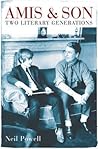
Amis And Son: Two Literary Generations

Amis And Son: Two Literary Generations by Neil Powell
My rating: 4 of 5 stars

I have known the names Kingsley and Martin Amis for years, decades even, but have never read any of their books. I have a science fiction anthology edited by Kingsley Amis, and started to read, but did not finish, The Information by Martin Amis, so why would I want to read a literary biography of both of them?

One reason is that I have often enjoyed literary biographies more than I've enjoyed the works of the authors themselves, and because I have heard so much about them over the years I thought I might learn something about how they fitted in to the 20th-century literary scene. I thought if I read more about their books and how they came to write them, I might find one or two that I might enjoy reading.

I found the biography interesting, but rather confusing in parts. Neil Powell deals with Kingsley Amis, but then when he starts telling the story of his son Martin he goes back to earlier periods of Kingsley's life, so the story is rather fragmented. He also looks for autobiographical hints in the characters in the books of both of them, and so sometimes it is difficult to keep track -- is this person mentioned someone they had met, or was it merely a character in one of their books?

Neither father nor son seem to be particularly attractive characters, or the kind of people I would like to hang out with, though I did feel that at times Powell's criticism of Martin Amis and his works was rather harsh.

At certain points, however, I did find the book very interesting, but this is more because of a particular interest of mine, and so might not be of the same interest to other readers. For a long time I have been interested in the Beat Generation, and I have a book, Protest: The Beat Generation and the Angry Young Men, which has an excerpt from Kingsley Amis, and is probably where I first heard his name. Powell gives the background to that book, and Kingsley Amis's contribution to it.

Powell's biography throws more light on this. It seems that in the US the British authors referred to as the "Angry Young Men" were regarded as similar to the Beat Generation authors in the US, hence their inclusion in the anthology.  That puzzled me back in the 1960s and it appears to have puzzled Kingsley Amis too. I recalled a a small informal gathering in Pietermaritzburg in 1965, of members of the small and persecuted Liberal Party. Some of us (then) younger members of the party were invited to meet Margaret Ballinger, the grand dame of the Liberal Party, and the only one ever to have been elected to parliament (by black voters). She asked me about the difference between beatniks and ducktails, which I tried to explain to her: that the ducktails' outlook was "we want it all, and we want it now". They shared the values of straight society, but didn't have the possessions and prestige that were valued. The Beats, on the other hand questioned the values of mainstream society.

Mods in the 1960s
The UK equivalent of Ducktails were the group of youth known as Rockers, who rode big powerful motorbikes and wore leather biker gear. There were reports in newspapers of pitched battles at British seaside resorts between Rockers and Mods. The Mods rode small underpowered motor scooters decorated with bling, numerous rearview mirrors and the like. Kingley Amis was a Mod. He was neither a Rocker nor a Beat. I didn't try to explain to Margaret Ballinger the difference between Beats and beatniks -- that the Beats were the genuine article, while the beatniks were the groupies and hangers on, in orbit around the Beats as sputnik was in orbit around the earth. 

The Angry Young Men were more akin to the Mods, Kingsley Amis certainly was. But Jack Kerouac, one of the better-known Beat Generation authors, was born in 1922, as was Kingsley Amis, though their literary schools were not the same. 

Another literary link that interested me was to an earlier generation -- the Oxford Inklings, who interest me even more than the Beat Generation.   Among Kingsley Amis's lecturers at Oxford were two of the Inklings, C.S. Lewis and J.R.R. Tolkien. Powell notes that:

When Kingsley Amis went to teach in the English department at Swansea University College, "Because he had experienced, or endured such widely varying standards of lecturing at Oxford, he was determined to emulate the best rather than the worst of them: his own style owed much to that of C.S. Lewis, from whom he had borrowed the useful trick of reading out important but hard-to-find quotations at dictation speed."
Lecturers, Kingsley later suggested,
could be divided into the hard and the soft, like policemen. The former imparted the necessary, if barely intelligible information which was likely "to appear in the relevant parts of the final examination"; the latter, more enjoyably but less usefully, offered "civilised discourse with perhaps some critical interpretation and ideas about the past"... Tolkien was, clearly, granite-hard; while the best of the soft -- indeed, "the best lecturer, in more than one sense, that I have ever heard" -- was C.S. Lewis.
View all my reviews

21 July 2021

On The Road With Al and Ivy: A Homeless Literary Chronicle

I never much liked the published version of On the Road by Jack Kerouac, but the original "scroll" version, described in this blog post, sounds much more interesting. I'll be on the lookout for a copy. On The Road With Al and Ivy: A Homeless Literary Chronicle: On The Road With Al and Ivy: A Homeless Literary Chronicle - May 2021:
In 2009, the unpublished 1951 version of Jack Kerouac's book, "On The Road" was released and gave many of the admirers of the 1957 version a chance to revisit the work and it's legacy.

Allen Ginsberg, the legendary Beat poet and close friend, felt that the 1957 version of the book had removed much of the "mad energy" and life of Kerouac's story. Which is true, the Original "Scroll" version, which was typed out on eight long sheets of drafting paper and taped together into a single scroll, differs in some important ways.

The 1957 version was toned down, particularly in sexual details like the sexuality of some of the characters and all of the people in the book were given fictitious names. Which given the straight laced atmosphere of the 50s era, wasn't surprising, and using the real names of living persons can make any book risky to publish.

The Original Scroll (like it's later published version) had an episodic approach to story telling, moving from one scene to another as it appeared in Kerouac's head, as opposed to events tied to a linear time frame. He spends time in the San Francisco Bay Area, for example, yet describes very little of what he saw. Days or weeks are often covered with a single sentence, yet many pages are devoted to conversations with a friend or friends, and if he's waiting for money to come via mail (or wages on payday), he'll just skip over to it's arrival and then the narrative becomes full again.

The first book of Jack Kerouac's that I read, back in 1960, was The Dharma Bums, and I liked it a lot better than On the Road and indeed most of his other books. When I first heard of Jack Kerouac, he was presented to me as a pilgrim of the Absolute, and a symbol of a counterculture. I could find those easily in The Dharma Bums, but not so easily in On the Road. But perhaps reading the original scroll version will give a different view.

10 July 2020

Hippies in the Church


I was very excited to see that there is a new Russian web site called Hippies in the Church. It has a list of monks and clergy who were at one time involved in the hippie movement of the 1960s and 1970s.

Here is a rough translation of its introductory blurb:
In December 2018, the Metropolitan of Belgorod and Stary Oskol, John rather favorably spoke about youth subcultures of the second half of the twentieth century. But even more interesting is the last phrase:

“In the 20th century, as a protest against a consumer society on Russian soil, under the influence of the West, subcultures developed that acquired a special social orientation, at the same time it was a search for spirituality. The first subcultures are dudes, hipsters in the early 60s, then there is a period of the sixties. There appear hippies who belong to different religious directions. They even had the slogan: "Christ was the first hippie because he was protesting against the existing system." I must say that this subculture is very close to the Orthodox Church: in the USSR, the Church was persecuted, and hippies sympathized. Many clergymen and mothers sitting here have gone through this subculture. ”

The recognition of Metropolitan John is worth a lot. However, there was no list of hippies (rockers and punks added) who became Orthodox priests and monks (lay people also added) until recently. A small list was published by historian Irina Gordeeva on Facebook. Based on this list, a much more extensive one has arisen, which I quote below. It continues to be replenished and refined (last updated July 1, 2020)

My interest in this topic goes back 60 years, to July 1960, to the founding conference of the Anglican Students Federation (ASF) of South Africa, which was held at Modderpoort in the Free State in July 1960. It was held in rather inauspicious circumstances, during the State of Emergency that followed the Sharpeville Massacre, and I travelled to it with two students, Benjamin Photolo and Jacob Maleke, who actually lived in Sharpeville, and who, though they were not themselves witnesses of the shooting, knew several people who had been affected by it. For more on the background, see Tales from Dystopia VI: 1960 was a very bad year | Khanya.

One of the speakers at the was Brother Roger, of the Community of the Resurrection, who spoke on Pilgrims of the Absolute. He spoke of a number of counter-cultural figures, some Christian, some less so. Among them were Leon Bloy, Benedict Joseph l'Abre (one of the few Western "fools for Christ") and Beat Generation authors like Jack Kerouac.  He said they were all looking for something that was not found in the conventional and respectable values of their society, and that, whether they knew it or not, they were looking for God, and he asked why the Church had so often hidden God from them behind a camouflage of respectability.

Brother Roger, CR


It made quite an impression on me and others there, and Brother Roger was asked to speak again on the same topic the following year, and I have posted a combined version of both papers here: Pilgrims of the Absolute. For the next couple of years Brother Roger guided my reading, lending me books from the Community of the Resurrection's well-stocked library (which was also the library for St Peter's Theological College, which they ran, and among the students there at that time was Desmond Tutu, who later became Anglican Archbishop of Cape Town. Brother Roger introduced me to authors like Samuel Beckett, Jean Genet, Charles Williams and others, and also to the Beat Generation authors like Jack Kerouac and John Clellon Holmes.


It was mainly the Beat Generation who took the technical term "cool" from jazz and applied it to everyday life, and in doing so brought it quite close to some technical terms in Orthodox spirituality -- see Coolness and dispassion | Khanya. Brother Roger referred to Francis of Assisi as "God's cool cat", or God's hip cat. , and one of the beat poets referred to their generation as "Angel-headed hipsters burning for the ancient heavenly connection to the starry dynamo in the machinery of night". Jack Kerouac never realised the ideal of a Zen Catholicism he sketched in his novel The Dharma bums, but his friend Gary Snyder, a Buddhist (Japhy Ryder in The Dharma bums), spoke of a "rucksack revolution" of young people leaving the rat race of the acquisitive society and wandering around spreading a message of love and peace. Brother Roger rather hoped that some of the youth at the Anglican Students Federation conferences might catch a similar vision, but few did.

By the end of the 1960s "hipsters" had got shortened to "hippies" and happily accepted the label "freaks" applied to them by straight society. Among them were some Jesus freaks, and for a time they locked as if they might represent a real Christian counterculture, but many were coopted by suit 'n tie evangelical Christians, who turned many of the symbols of the movement into kitsch merchandise.

One of the evangelists who got involved with the movement came closer to the "rucksack revolution" idea. He was Dave Berg, who founded the Children of God, who lived in Christian hippie communes throughout the world, and saw themselves as colonies of the Kingdom of God. They produced an interesting handbook for members, Revolution for Jesus: how to do it. Unfortunately Dave Berg, who called himself Moses David, or just Mo, succumbed to a temptation common in such movements -- he allowed himself to become the object of a personality cult, and the emphasis gradually shifted from leading people to Jesus to leading them to himself, and that particular branch of the Jesus movement went off the rails. I believe there is still a remnant somewhere, calling itself "The Family".
The Durban colony of the Children of God, 1974: Deborah, Jonathan, Stephen, Shemaiah, Sharon
 Another of these evangelists, however, Jack Sparks, followed a different path. He became became involved in the Christian World Liberation Front (CWLF), which produced a Christian underground newspaper called Right On. Jack Sparks was led to Orthodoxy, and became an Orthodox priest, and died a few years ago in Alaska.

So I am interested in the Christian arm of the Hipster-Beat-Hippie movement, and I think it would be rather good if the project of documenting "Hippies in the Church" was not confined to Russia only, but should become a worldwide one. So if anyone has any biographical information on hippies in the Church, or anecdotes of such a movement, please send them to me and I'll make a preliminary collection, and pass them on to any official collectors, should any appear. My contact info here Steve Hayes - personal links.

12 March 2012

Jack Kerouac's American journey (book review)

Jack Kerouac's American Journey: The Real-Life Odyssey of On the RoadJack Kerouac's American Journey: The Real-Life Odyssey of On the Road by Paul Maher

My rating: 4 of 5 stars


On the road is not my favourite book by Jack Kerouac so I might not have bought this book if it had not been going cheap on a sale. I'm glad I did buy it, though, because I found it more interesting than On the road, and it explains how that book was written.

I recently read Neal Cassady: the fast life of a beat hero (review here), and found several details in this book that threw more light on Cassady's character and behaviour than his biography did. Perhaps Paul Maher had access to more sources. After reading the biography, I was at a loss to know why people like Jack Kerouac and Allen Ginsberg were attracted to Cassady, though in Ginsberg's case the initial attraction was sexual. Maher manages to explain it better, though he still does not portray Cassady as a particularly attractive character.

That still doesn't explain why I liked this book better than On the road itself. Perhaps it is because the real life of authors is often more interesting than the characters they write about. My favourite among Kerouac's books is still The Dharma bums, and perhaps that is because it is more about the influence of Gary Snyder than that of Neal Cassady, and Snyder is a more sympathetic character.

One thing that almost put me off reading the book was odd errors in language. I suppose having been an editor makes me rather intolerant of slip-ups (even though I make plenty of my own). One of the more egregious ones was on page 133, "Carolyn Cassady received a letter from her husband, postmarked January 11. In it he promised her regular installments of cash from working two jobs in New York, neither of which he had yet to procure." I presume the author intended to say either "both of which he had yet to procure" or "neither of which he had yet procured", but as it stands it is a strange piece of nonsense. There are other similar errors, writing "principal" where "principle" was meant and so on. But I'm glad that these didn't put me off, because the book is worth reading, at least to anyone who has enjoyed reading any of Kerouac's books.

View all my reviews

20 August 2010

The time of my life

Up at 5:25. I borrowed my son Jethro's bakkie and went out to get a new battery for the Subaru, and had to pay R900.00 for it, though they said they would give me R114.00 back if I brought in the old one. When I were a lad you could buy a whole car for that. My first "real" car was an 8-year-old Peugeot 403 station wagon, which I bought in Durban in 1969 and paid R300 for it. I sold it 3 years later to a witchdoctor for R60, and in the mean time it had taken me to Namibia and back a few times.

Then I went to Brooklyn Mall, to the Exclusive Books sale, where they have reduced the prices still further. I had hoped to get a copy of and the hippos were boiled in their tanks by Jack Kerouac and William Burroughes, but they seemed to have been all sold out, which quite surprised me, as the last time we were there they had about 8-10 copies and I wondered who in Pretoria might buy them. But I found a book on the peace movement, to commemorate 50 years of the peace sign. So in the end the books I bought were:
  • Leland, John. 2007. Why Kerouac matters: the lessons of On the Road.
  • Matthiessen, Peter. 2003. End of the earth: voyages to Antarctica.
  • Miles, Barry. 2008. Peace: 50 years of protest 1958-2008.
And they cost R70.00, but if they had not been on sale they would probably have cost almost as much as the battery.

I got home and looked at the books. I blogged about the peace symbol on the anniversary, at Peace symbol – 50 years on | Khanya, and the book, though a bit coffee-tableish, was a good reminder of a history that coincided with my own life. In 1958, the year the peace symbol was first used to protest nuclear disarmament, I was still at school. The "peace symbol" was then primarily used in protests against nuclear weapons, and it was only some years later, with growing American involvement in Vietnam, that it became a general peace sign. In 1961 I joined the Anglican Pacifist Fellowship, and I'm now associated with the Orthodox Peace Fellowship, so the book is in a way the story of my life and times.

One of the other books, the one on Kerouac's On the road was also in a way a symbol of my life and times, though On the road was never my favourite book by Kerouac -- I much preferred his The Dharma bums. Kerouac, however, was the same age as my father-in-law, so he was a different generation. But Leland's book seems to be trying to turn On the road into a self-help book. I must be really out of touch with pop culture, because I have no interest in self-help books, nor books about misunderstood sexy teenage vegetarian vampires. I prefer my vampires evil and bloodthirsty and they are coming to kill you and steal your soul.

Then, while I was pondering these books, which provoked a lot of reminiscences, the TV started reporting on Jimmy Reid's funeral. I'd never heard of Jimmy Reid, or if I had heard of him, I couldn't remember him. He was a trade union leader in the shipbuilding industry in Scotland, and was apparently famous for leading a work-in when Edward Heath's Conservative government wanted to close down the British shipbuilding industry. They recalled two speeches he made, one on the occasion of the work-in, and another when he was made Rector of Glasgow University and said, "A rat race is for rats. We're not rats. We're human beings." It was hailed by the New York Times as the greatest speech since Abraham Lincoln's Gettysburg Address.

I found it strangely moving, and also linked to my life and times in a way. I went to the UK in January 1966 to study at St Chad's College, Durham. I left in a hurry, because a Detective Sergeant van den Heever phoned me at 4 pm and said he wanted come and see me. I was about to leave for work, and said I'd have to see him in the morning. But then I consulted friends and decided it would be wiser to leave for the UK right away, so left at 10:00 pm and drove through the night to Beit Bridge. My mother told me that her cousin Willie Hannan was a Scottish MP, and might be able to help me get advice on finding a job and getting residence permits and the like.

I drove to Bulawayo, and got a plane to Salisbury (now Harare) and from the airport phoned more cousins. It was just after UDI in Rhodesia, and the Rhodesian cousins did not have a good word for cousin Willie, and portrayed him as a wild-eyed socialist revolutionary, betraying his own kith and kin in Rhodesia and all the rest of the Rhodesian rhetoric.

When I got to London I made contact with cousin Willie, who was MP for Girvan, in Glasgow. He was terribly respectable, and anything less like a wild-eyed revolutionary I could not imagine. My mother had also told me that Willie's father had been jailed as a conscientious objector during the First World War, not because he was a pacifist, but because he was a socialist and regarded it as an imperialist-capitalist war. I regarded any conscientious objector as something of a hero, and so I asked cousin Willie about it, but he was clearly embarrassed, and said that at the time the police came for his father he was just a child, and they didn't understand it, and that things were different in those days. He was, in my view, what we then called a "square", altogether respectable. But he was a very nice bloke, and kind hearted, and was all in favour of peace, though he believed peace could be achieved by international cooperation and friendship, primarily in things like the European Union. He had no opinion about Rhodesia at all, other than being mildly unhappy about all the unpleasantness over it, and wanted to know what I thought of it, though I had spent less than 24 hours there on my way to the UK.

But he probably knew Jimmy Reid, and probably thought of him as a wild-eyed socialist revolutionary.

16 September 2009

It's cool to be hip but not hip to be cool

A couple of days ago there was some discussion about the following article in some Usenet newsgroups. I was interested in it because of the use of the word "hipster". It seemed to be used with a meaning very different from the meaning I understood.

I'm interested in words and how they are used, partly because it used to be my job as an editor for several years, though it would probably be truer to say that I got into the job because of my interest in language and usage rather than the other way round.

Anyway, the article was The Daily Cardinal - Song causes local hipster to self-destruct:
MADISON, WI—Tens of twenties of Madison’s hippest are gathered in mourning this afternoon following the news of the tragic death of local hipster Charles “Wayne” Duchene, 22, who died a horrific and most likely cliche death late Monday evening at a Foo Fee Foe concert.

Duchene’s body was found in a puddle of his own PBR at approximately 11:15 p.m. Monday night at the entrance of The Dank Bank, an obscure venue located just off the Capitol Square.

Now this is a student publication and it's obviously satire, but they have to be satirising something. I had to ask about PBR, which I at first took to be one of those three-letter abbreviations for various medical conditions that hypochondiacs sprinkle their conversations with and expect the rest of us to understand. It transpired that it did not stand for something like Personal Bodily Refuse, but was an allusion to a local beer, though I gather many people who know the brew think there is little difference, but more of that later.

So what is a hipster?

As I understand it, a "hipster" was orginally a jazz fan, and especially a fan of "cool" jazz, a "hip" or "hep" cat.

In Beat Generation circles it was extended to mean someone who was hip to the lies of mainstream culture, and who disaffiliated from it and rejected its values, who did not get over excited over the things pimped by the advertising industry and so on, who was detached from all the frenzy about brands and fashion. That was the essence of "cool" in those days.

As Lawrence Lipton put it in his book "The holy barbarians" (Lipton 1959:150):
The New Poverty is the disaffiliate's answer to the New Prosperity. It is important to make a living. It is even more important to make a life. Poverty. The very word is taboo in a society where success is equated with virtue and poverty is a sin. Yet it has an honourable ancestry. St. Francis of Assisi revered poverty as his bride, with holy fervor and pious rapture. The poverty of the disaffiliate is not to be confused with the poverty of indigence, intemperance, improvidence or failure. It is simply that the goods and services he has to offer are not valued at a high price in our society. As one beat generation writer said to the square who offered him an advertising job: 'I'll scrub your floors and carry out your slops to make a living, but I will not lie for you, pimp for you, stool for you or rat for you.' It is not the poverty of the ill-tempered and embittered, those who wooed the bitch goddess Success with panting breath and came away rebuffed. It is an independent, voluntary poverty.

So the hipster, or the beat, had a cool and detached attitude to the frenzy of the striving for success in mainstream society.

"Beatniks" were groupies or wannabes. The word was coined by a journalist by analogy with "sputnik" -- beatniks were those who were in orbit around the beat movement, but were not central to it.

By the late sixties "hipster" had got shortened to "hippie", and while the hippies were successors to the beats as a countercultural movement, they were a little less cool. To be "cool" suggested being detached, laid back, not excited by the constant changes of fashion and the striving for success. It was the role of a passive and cynical observer.

Hippies were more active, and more positive in trying not merely to disaffiliate from mainstream culture, but to try to create an alternative to it, an alternative culture and an alternative society.

But the impression I got from the article that sparked off this post is that the writer was using "hipster" in an entirely different sense, to mean something almost opposite from what it meant in the 1950s and 1950s.

I wondered how widespread that usage is -- can anyone explain the writer's usage, and do they share that understanding of the word today, and how did it get to mean almost the opposite of what it meant 50 years ago? "Cool" seems to have changed its meaning a lot in the last 50 years, so I wonder if "hipster" has likewise changed, so that it no means nearly the opposite of what it did back then.

I watch "Top Gear" on TV, and there they discuss what constitutes a "cool" car, and it is clear that their idea of "cool" is very different from mine. My 1961 Peugeot station wagon, with rusty door panels and empty cold-drink cans rolling around on the floor, bought cheap from an open air used car lot where a rickety wooden shack was the "office", bought on the "zero maintenance" plan, was my idea of a "cool" car, but I doubt very much if the "Top Gear" people are using "cool" in that sense.


Another thing that illustrates the change in the meaning of words like "cool" is Levis jeans. They were cool back then and they are regarded as cool now, for entirely different reasons, and for entirely different values of "cool". When I bought my first pair of Levis there was only one shop in Johannesburg that sold them, imported them from the USA. It was not advertised and nor were Levis. You learnt about it by word of mouth. It was also a decidedly unfashionable shop in a decidedly unfashionable part of town, Jeppestown, which seems to have escaped the gentrification that has transformed other run-down suburbs. Levis were the opposite of fashionable, tough working clothes that one bought a couple of sizes too big because they would shrink to fit. No one with any fashion sense would be seen dead in Levis. How have the mighty fallen!

But the guy whose death was described in the article in question sounded anything but "hip" to me, the very opposite of "hip", in fact. So I still wonder what the writer meant by "hipster", and whether other people understand "hipster" in the same way, and can explain what they mean by it.

To get back to PBR briefly, the Urban Dictionary defines it as:

PBR

abbreviation for pabst blue ribbon beer, which is simultaneously the best and worst beer ever brewed. it is typically on special at bars for twelve cents a pint. also doubles as a laxative.

Pabst Blue Ribbon is a lot like the band Bright Eyes,
Hipsters love it, but everyone else thinks its liquid shit.

Hipsters again. It's got to mean something in Wisconsin that is different from what it means in the rest of the world... or does it?

Perhaps I should retreat into the past, to when I was a wannabe hipster, and a wannabe beatnik (and if a beatnik is a wannabe beat, then a wannabe beatink is a wannabe wannabe). My twenty-year-old self went to visit Brother Roger, an Anglican monk of the Community of the Resurrection, whom I regarded as the authority on all things hip and cool (he lent me books by Jack Kerouac, and the Lipton book I quoted above, and many others besides). So I wrote in my diary for 23 June 1961

... later went to see Brother Roger. There he sat, outside the priory in jeans and sweatshirt, on the library steps, luxuriating in the sun studying Lipton's Holy Barbarians. Studying, yes, truly it is the text book, and he said that he had a book by Clellon Holmes, The horn, about a jazz man, and he says it in that zestful rapturous way of his, which makes me think he gets the utter limit of enjoyment out of everything he does. "It's wonderful," he says, "simply wonderful." And when he says it you know he really means it. He told me about what he is going to say at Modderpoort, and he isn't giving them Bloy this year, but Jean somebody. The Observer calls him the poet of evil, who has spent half his life in jail, and is something of a misanthropist and hates society, patron saint of the Beats. He gave me a play for the AYPA, by Charles Williams, called House of the octopus, and there was a boy there called Abel, a black boy studying for his matric, and says he is a cat and loves jazz, and Bach, and plays a clarinet which got broken. So I talked a bit to Abel and found he lives in Orlando where he goes to AYPA meetings and is staying at the priory during the vac to study. He is a nice cat, a hip spade cat.

The AYPA was the Anglican Young Peoples Association, a youth organisation with branches in various parishes. Modderpoort was the venue of the annual conference of the Anglican Students Federation, where Brother Roger was going to read his paper about the Jean somebody, who was actually Jean Genet (that was the first time I'd ever heard of him), and you can read his paper, Pilgrims of the Absolute, here.

Yes, I've written about this stuff before, sorry if anyone was bored, but I suppose those who have seen it all before wouldn't have got this far anyway.
13 March 2007

The unrespectability of our religion

I was transcribing some of my old journals this morning, and came across what I had written when I was 19 in response to reading about Leon Bloy.
When I got home I finished reading Leon Bloy and marvelled at his faith and devotion. He had been prepared to live nearly all his life in poverty -- nay, in destitution -- for the sake of Jesus.

Like Clement of Alexandria, like St Francis of Assisi, he gave up all for love. "How hardly shall they that have riches enter into the kingdom of God." The beatniks are looking for what St Francis was looking for; they are after the absolute values of God rather than the relative values of this world. "A saintly clergy means a virtuous people; a virtuous clergy means a respectable people; a respectable clergy means a godless people."

Christians must never become respectable. Respectability is the curse of true religion. The slavish following of convention and the mediocrity it leads to, or springs from, are the enemy of all true Christianity. People become indistinguishable, they merge into the mass of the respectable, conventional mass of unthinking semi-morons that people this globe; they have no variety, and variety is the spice of life. They are tasteless, "and if the salt hath lost its savour, wherewith shall it be salted?" Most Christians do not take their faith at all seriously -- in one sense -- they are prepared to live with it, but only just. They will not live for their faith, and certainly will not die for it. Saints were too unconventional, too unrespectable, to be imitated. People pay lip service to the examples of the saints, But if anyone should try to follow their example he is denounced, and they say, "Religion is a good thing, but that is taking it too far." The person against whom such an accusation is levelled has probably just begun to take religion at all seriously. Christians are a lot of hypocrites people say, but if they try not to be hypocrites, then they are fanatics. The unrespectability of our religion! (Journal entry: 17 August 1960)

That was over 40 years ago. I had been introduced to Leon Bloy by Brother Roger, of the Anglican Community of the Resurrection. Bloy's ideas were more than 60 years old then, and yet they seemed equally relevant to the 1960s. And now I keep reading about similar ideas in emerging church circles, including such things as urban monasticism. I look back at and cringe a little at the teenage arrogance, and wonder if our generation turned out any better than those we so self-righteously denounced.

Things have not changed much since then, it seems. A recent survey shows that most Christians in many countries see themselves first of all as citizens of this world rather than as citizens of the kingdom of God. Our citizenship is in heaven, says St Paul, but most have other gods. This is perhaps not so surprising in Russia, where atheism was the official state-sponsored religion for two generations, but it is a little more disturbing in other countries.

There also seems to be an anomaly in the case of the USA, where a higher proportion said that they saw themselves as Christians first, and citizens of their country second. But I wonder -- I suspect that many of those who said that would respond to their country's recent wars of aggression in Yugoslavia, Afghanistan and Iraq by saying "My country, right or wrong".

17 January 2007

The vanishing hitchhiker

Phil Wyman has blogged about the vanishing hitchhiker here: Square No More: The Death of Hitchhiking, the Death of Trust?

Phil was talking mainly about the American scene, but I think the same applies here in South Africa, and in lots of other places. As I commented in Phil's blog, I think an important reason for the death of trust is the increase in vehicle hijacking. Drivers see a hitchhiker and wonder if it is hitchhiker or a hijacker, decide to play it safe and drive on.

And like Phil, I think it's rather sad.

In my youth I went to a Christian student conference at Modderpoort in the Free State, which must be one of the coldest places on earth (in winter). There was a priory of the Society of the Sacred Mission (an Anglican religious order) there, and one of the SSM Fathers was Victor Ransford. We were told that at one time he hitchhiked halfway round the country with a Christmas tree. One man who gave him a lift said "I wondered if you were Anglican or Roman Catholic, and then when I got close, I knew you were Anglican."

"How could you tell?" asked Fr Victor.

"By your socks."

At the same student conference one of the speakers was a member of another Anglican religious order, Brother Roger, of the Community of the Resurrection. He spoke on Pilgrims of the Absolute, and extolled the beat generation vision of a rucksack revolution, of the Dharma bums who would hitchhike from place to place to find out if I had a vision or you had a vision or he had a vision to find out eternity.

I never really realised my ambition to be a Dharma bum, but it is sad to think that it is that much harder for anyone to realise such a vision nowadays, or at least the hitchhiking part of it. But some parts of the vision are still alive. There are people who have a vision of urban monasticism and similar things. In the mean time, let's pray that the vanishing hitchhiker will reappear.

08 July 2006

Pilgrims of the Absolute

In various blogs I have been reading about and the , and discovered that quite a lot of people had been talking about these in various forms.

This led me to review and revise a web page on which I had posted a paper called Pilgrims of the Absolute by Brother Roger of the Community of the Resurrection.

Brother Roger read his paper at a conference of the Anglican Students Federation of South Africa. It had the sub-title of "the unrespectability of our religion", and was aimed at shaking Christian students our of the complacency of their bourgeois upbringing.

Back in the early 1960s Christianity in South Africa was a good deal more bourgeouis and respectable than it is now, and Brother Roger gave examples of countercultural figures like the Beat Generation authors Jack Kerouac and John Clellon Holmes, the playwright Jean Genet and others.

Pilgrims of the Absolute blew my mind, and I began reading Beat Generation authors, especially Jack Kerouac's The Dharma bums (which was soon afterwards banned in South Africa). Brother Roger kept me supplied with reading matter from the well-stocked library of the Priory of the Community of the Resurrection in Rosettenville, Johannesburg, and became a kind of guru, sharing his vision with me.

I was not a particularly apt pupil, and the vision remained a more or less unattainable ideal for me. One consolation is that it also remained unattainable for Jack Kerouac. It was the vision of a , in which young people would give up the security and comfort of home, and the dominant values of an acquisitive society, and become Pilgrims of the Absolute, similar, in a way, to the kind of life described in The way of a pilgrim, which is a prime example of a pilgrim of the absolute, and it could also be seen as a vision for a new monasticism. One could find more examples in recent times, like , zine and .

I wrote something about this in my LiveJournal so won't repeat it all here, but I was moved by the discussions in various places to revamp the Pilgrims of the Absolute web page, in the hope that some might find it interesting and useful, and that it might contribute to the discussion about a .

----
Note: I also posted this on my blog over at MySpace, where the Technorati tags seem to work, though they don't seem to work here.

Technorati tags: , , , , , .

21 June 2006

Beats, Inklings, Christian literature and paganism

When I first started making my own web pages ten years ago, these were some of the themes that interested me, and that I hoped I'd be able to discuss with other people. Now, for the first time, it really does seem to be happening.

For the last few days I've been having a very interesting discussion with Luthienofold on LiveJournal, which echoes some of the thoughts I wrote in an unfinished article on Christianity, paganism and literature.

We were discussing what it was that made good fantasy literature, and what was so attractive about Beat generation authors, and I think we agreed that it was that the heroes were on a human scale. I had a vague recollection of Chesterton having said that fairy tales were appealing not because they were about extraordinary people, but because they were about ordinary people having extraordinary adventures. I have since looked it up, and here it is:
... oddities only strike ordinary people. Oddities do not strike odd people. This is why ordinary people have a much more exciting time; while odd people are always complaining of the dulness of life. This is also why the new novels die so quickly, and why the old fairy tales endure for ever. The old fairy tale makes the hero a normal human boy; it is his adventures that are startling; they startle him because he is normal. But in the modern psychological novel the hero is abnormal; the centre is not central. Hence the fiercest adventures fail to affect him adequately, and the book is monotonous. You can make a story out of a hero among dragons; but not out of a dragon among dragons. The fairy tale discusses what a sane man will do in a mad world. The sober realistic novel of to-day discusses what an essential lunatic will do in a dull world.

And in another post in this blog, Notes from underground: Jack Kerouac I noted that the Beats usually write not only about ordinary people, but even their adventures are quite ordinary -- a mountain-climbing expedition where they fail to reach the top of the mountain, boozy parties, a hiking expedition -- but they manage to see them as imbued with extraordinary significance. They help use to see the ordinary things with new eyes.

So I'm posting this mainly to try to draw some of the threads together, and to invite people to perhaps continue the discussion (if you want to) in my Bravenet Forum, which you will find on most of my Christianity and literature pages, where comments are less ephemeral and easily lost than on blog pages.

See also: Christianity, paganism and literature.


Technorati tags: , , , , , ,

LinkWithin

Related Posts with Thumbnails