Showing posts with label monasticism. Show all posts

03 February 2021

The REAL Benedict option

In This House of BredeIn This House of Brede by Rumer Godden
My rating: 5 of 5 stars

When I started reading this book, I did not expect it to be so good. But when bookshops and libraries were closed during the Covid lockdown I began making a list of books on our shelves that I had not read. I don't even know how this one got there -- I think it may have been one I inherited when my mother died. Bit I had no hesitation in giving it five stars.

It's about a fictitious Benedictine monastery in England, and gives what seems to me a remarkably accurate picture of Christian monastic life. I knew some things about Benedictines. I knew a few people who had entered Benedictine monasteries, but found the monastic life wasn't for them. I have even visited the female Benedictine monastery at Inkamana near Vryheid in KZN, and a male one at Egmont in the Netherlands. I knew that male Benedictine monks were addressed as "Dom". But I did not know that professed female Benedictines were addressed as "Dame". nor that they had "claustral" sisters. That I learnt from this book.

In spite of its informativeness, however, it is not simply an "info dump" (that bane of would-be fiction writers), but it is a human story, and the characters stand out as real human beings.

It also brings out clearly how the monastic life, though more intense, is not essentially different from the Christian life in general. One scene that brought this out particularly strongly was when a novice nun receives letters from a man who had been in love with her for a long time. He addressed her by her secular name, pleading with her to leave the monastery, abandon the monastic life and marry him. She would not reply to his letters, saying she would only do so if he addressed her by her monastic name, thus acknowledging her decision and her right to make it. She asked the Abbess if that was not right. "It's right," said the Abbess, "but is it kind?"

That reminded me of the saying, quite commonly uttered in the time that the story is set (the 1950s and 1960s), that it is better to do wrong for the sake of love than to insist on doing right because of my lack of it.

There is sometimes a perception that it is easier to be a Christian in a monastery, because one is protected from the temptations of the world, but this book does nothing to promote that view. Orthodox monastics I have known have often spoken of the monastic life as "my repentance", and that is more its distinguishing feature. In the monastic life it is no easier than anywhere else to become perfect. It is, however, easier to become aware of one's imperfections.

Western monasticism, or perhaps one should rather say "religious life", differs from Orthodox monasticism in having many different forms. There are monks, sisters, canons regular, mendicant friars and a whole lot of others.

By contrast, Orthodox monasteries all work more or less on the same lines. Most, however, seem to agree that Benedictines are monks, and they seem to be the closest to Orthodox monasticism. It is therefore rather strange to see Orthodox Christians advocating something called the Benedict option when it is very un-Benedictine. If you are Orthodox, please read this book to understand what the Benedict option really means. And it might also give some insight5 into Orthodox monasticism too, though I would be interested in hearing the views of Orthodox monastics who have read this book.


View all my reviews

31 March 2011

Geoff Moorgas RIP

I've just learned of the death of an old friend. Geoff Moorgas died on Saturday 26 March 2011, according to a brief message just received from another old friend, Mark Ramsden. Both Geoff and Mark were originally from Durban, and both were recently living near Oxted in Surrey, England.

I first met Geoff when, as a student in Pietermaritzburg, I visited some friends in Durban one weekend and went to a gathering of Durban Anglican Youth (DAY), on 4 August 1963, where young people from parishes all over Durban gathered for a kind of sports day. We first went to a service at St Raphael's Church in Sydenham, which was then one of the High Church parishes of Durban, and it was followed by hockey and soccer matches between the various parishes. Geoff Moorgas was one of the organisers.

I didn't really get to know him until 1969, when I was living in Durban, and, at the urging of Beyers Naudé, had formed some Christian Institute youth groups. Geoff became involved in these, and mentioned at one meeting that he had been asked by a group of young people in the parish of Greenwood Park to help them form a band. He agreed, and helped them to get instruments and became their manager. Then I was asked by the priest at St Columba's, Greenwood Park, to lead a couple of services there while he was on leave. He said they didn't have traditional Anglican Evensong, but had, with the permission of the bishop, "experimental services." I asked if would be ok if the Christian Institute youth groups got involved in planning and leading the services. He agreed, so we got the band youngsters to take part as well, but they were not accomplished musicians and it took a great deal of practising in Geoff's house to get them ready for the service, which was also their first public gig.

One result of the service (which you can read about at Notes from underground: Psychedelic Christian Worship -- thecages if you are interested) was that I got fired by the Anglican bishop of Natal and lost touch with Geoff again for a while when I went to Namibia. Three years later I saw Geoff again, after being deported from Namibia and banned to Durban, but he was then very busy running a shoe factory, so I did not see a great deal of him.

Several years later I heard from Geoff again -- a letter arrived out of the blue, saying that he was in Namibia -- an Anglican priest in Luderitz. He wanted to live a monastic or semi-monastic life, but he suffered from ill-health and went to England, where he lived as a hermit of sorts, and Mark Ramsden, whom I had known from Durban North days, visited him a few times.

It would be good it people who knew Geoff write some of their memories of him as comments.

May his memory be eternal.

08 September 2010

The financial journalist and the monk

Some years ago the author Arthur Koestler wrote a book called The Yogi and the Commissar, about two very different worldviews. This article could be called "The financial journalist and the monk".

What makes a rather worldly financial journalist visit a monastery, not as a break form the rat race, but to find out the story of what's going on in the world where he earns his bread an butter. And it seems that Vatopedi Monastery has had quite a big influence in worldly affairs.

Read the story to find out.

Beware of Greeks Bearing Bonds | Business | Vanity Fair:
After an hour on a plane, two in a taxi, three on a decrepit ferry, and then four more on buses driven madly along the tops of sheer cliffs by Greeks on cell phones, I rolled up to the front door of the vast and remote monastery. The spit of land poking into the Aegean Sea felt like the end of the earth, and just as silent. It was late afternoon, and the monks were either praying or napping, but one remained on duty at the guard booth, to greet visitors. He guided me along with seven Greek pilgrims to an ancient dormitory, beautifully restored, where two more solicitous monks offered ouzo, pastries, and keys to cells. I sensed something missing, and then realized: no one had asked for a credit card. The monastery was not merely efficient but free. One of the monks then said the next event would be the church service: Vespers. The next event, it will emerge, will almost always be a church service.

Read the rest of the story here. It's long, but quite illuminating.

17 November 2008

Reviving the Russian Soul

One of the most popular recent films in Russia is Ostrov (The Island) which indicates that despite the dominance of the communist and capitalist visions of materialism, interest in spiritual life continues to grow. As the authors of this review point out, "Ostrov’s story of repentance and faith in God hardly seems to be the stuff that blockbusters are made of" -- at least not in the West. I noted my own response to the film here, but this article describes the effect on Russian culture, and the response of the actor who played the protagonist is also interesting, since he is apparently a hermit in real life.

Reviving the Russian Soul, by Mike Kauschke and Elizabeth Debold.:
The story of the film’s principal actor Pyotr Mamonov may offer some explanation. Back in the eighties and nineties, Mamonov was the lead singer in an avant garde Russian rock band that reached cult status. But these days, he lives as a religious hermit near Moscow, and apparently it took a great deal of effort to get him to commit to make the film. Ostrov director Pavel Lungin says: “In a certain sense, this is also a movie about Mamonov’s life. He transformed from being a rock star embroiled in scandals into a deeply religious man.” Lungin realizes that both Mamonov’s life and the life of the monk he plays are resonant for Russians today. “The times of perestroika are over and we need to think about things like eternity, sin, and conscience,” he observes. “These have disappeared from our lives in the rat race for success and money. But people can’t just live for material things alone.”

18 October 2008

Forcing priests to wear robes 'absurd', says theologian - Telegraph

Forcing priests to wear robes 'absurd', says theologian - Telegraph:
Clergy should not have to wear robes during services because such rules are 'absurd in the 21st century', according to a leading theologian.

Garments such as the cassock and surplice are a form of 'power dressing' which reinforce class divisions and prevent the wearer getting the Lord's message across, said the Rev Andrew Atherstone.

In a report titled Clergy Robes and Mission Priorities he called on the Church of England to allow ministers and parishioners to decide what dress code was appropriate.

[schori_technicolor_yawn.jpg]Hat (aye, well, mmm) tip to Father David MacGregor of Port Elizabeth, who adds, in his own blog Contact Online Weblog: "And when, O when, will we see the last of those absurd hats ?"

Anglican Priest Father David Heron comments: "It is well known that evangelical clergy don't like wearing clerical robes because they don't believe in the priesthood, and they like to pretend they're laymen. Now a raving Protestant says they should be abolished altogether! Crazy"

And I think, crikey, the 21st century? Have we reached it already? What a surprise!

And my mind goes back 40 years to a previous generation who said much the same thing as the Rev. Andrew Atherstone. The only difference was that it was the 20th and not the 21st century, and they weren't British Evangelicals, but Dutch Roman Catholics.

When I was studying in the UK in 1966-67 I spent the Christmas vac with some Dutch Augustinians in Breda and Nijmegen. And one of the ways in which I thought they were quite kinky was that they held views like those of the Rev (isn't Rev a bit 19th century?) Andrew Atherstone -- that their religious habits were a bit passe in the 20th century, and so they got all up to date by wearing business suits.

A friend of mine from England came and joined me for a week, and remarked that as the Dutch religious were abandoning habits for business suits, just the previous week he's seen a DJ on a British TV show wearing a monastic habit. These Dutch monastics were so desperately trying to be with it that they were quite without it.

We persuaded one of the Dutch Augustinians to put on his habit specially for a photo.

The previous summer the British satirical magazine Private Eye was advertising T-shirts with "Jesus saves" and "God is Love" printed on them, and John Lennon appeared on the front page of the Daily Mirror wearing one. I ordered a few, and persuaded the Dutch Augustinians to wear them with their business suits.


Oh yes, and the "Karl Marx" one I was wearing also came from Private Eye

But as for John Lennon and the Beatles, by the time I was staying with the Dutch Augustinians, they looked like this:


As we used to say back then: Dress happy.

As for me, I'm just glad that Orthodox clergy are not required to wear that most ludicrous of articles of attire, the dog-collar.

14 January 2008

Blessed are the foolish -- foolish are the blessed

The foolishness of God is wiser than men, the weakness of God is stronger than men... For God chose what is foolish in the world to shame the wise, God chose what is weak in the world to shame the strong (I Cor 1:25, 27).

In this chapter of the New Testament we come across one of the most countercultural aspects of Christianity. The original Greek says that the moron of God is wiser than men. For the world, for "mainstream" culture, "moron" is an insult, something undesirable. No one in their right mind wants to be moron. But St Paul turns worldly values on their head.

What the world despised, Christians regard as badges of honour. One of the taunts that the world often uses is "loser" (though, ironically, many of those who use it often spell it "looser"). But Christians follow a loser. As St Paul is at pains to point out, there is nothing that looks more like a loser than Christ crucified. For that reason, any Christian who uses the word "loser" as a taunt for others has quite simply forgotten who his Lord is.

The Beatitudes, too, show how the Christian faith turns the values of the world upside down. "Blessed are the meek", but for the world, "Blessed are the pushy, for they shall get what they want".

In recent years there has been a tendency for some to overlook this aspect of the Christian faith. There are some Christian groups that unashamedly appeal to the opposite tendency, going so far as to call their churches Winners Chapel, to give but one example.

In the Orthodox Church, perhaps as a reminder from God that we should not be seduced into that kind of worldly thinking, there is a whole class of saints called "Fools for Christ" (in Greek, sali, in Russian, yurodivi). Sali is one of the words that means "blessed"; and it is also the origin of the English word "silly". The sali are blessed fools, silly fools.

In our age, "moron" is a term of abuse, as are similar terms like "loser", "cretin" and others. In a more faith-filled age (which the secularists might call "credulous and superstitious"), however, these were often terms of awe and respect. "Cretin" is derived from the French word "chretienne", meaning a Christian. An important part of being Christian is remembering that God chose the weak and foolish things of the world, and indeed chose to become weak and foolish himself, as unconvincing in appearance as the crucified.

The calling to be a holy fool is often found within monasticsm, which is itself a call to a countercultural life. The monk renounces much that the world regards as valuable -- riches, fame and power. Yet even within monastic society, power struggles can make themselves felt, and in such a situation the holy fool can call the community back to its original vision and purpose.

One of the most revered of the holy fools is St Basil of Moscow. St Basil's Cathedral in Red Square, with its fantastic domes, is an international symbol of the city. It was built, not to honour St Basil, but in honour of a victory by Tsar Ivan the Terrible over the Tatars. Basil denounced the Tsar for his bloodthirsty battles and oppressive rule as he wandered half-naked around the Kremlin, but when he died he was buried in the Cathedral, and the people went to his tomb there to seek his prayers, and eventually it became known as St Basil's Cathdral. Jim and Nancy Forest have written a good description of St Basil and other fools for Christ.

Many of the holy fools have appeared mentally unbalanced, But Leon Bloy, a French writer, when asked about this, replied:
Balance? The devil take it! He has indeed taken it long ago! I am a Christian who accepts the full consequences of my Christianity. What happened at the Fall? The entire world, you understand, with everything in it, lost its balance. Why on earth should I be the one to keep mine? The world and mankind were balanced as long as they were held fast in the arms of the Absolute. What the average man means by balance is the most dangerous one-sidedness into which a man can fall... the renunciation of his heavenly birthright for the pottage of this sinful world (see Pilgrims of the Absolute).

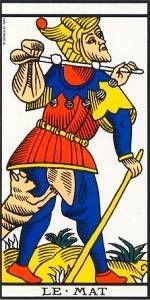
The theme is also found in such things as the Fool card of the Tarot, but I have already blogged about that in more detail in Notes from underground: On Tarot Cards and also at Notes from underground: Morehead's Musings: Symbolic Countercultures and Rituals of Opposition, so I will not say much more about that aspect of it here.

There has been some discussion about whether the fools for Christ were really mad, or were only simulating madness, to teach a lesson. Probably it was a little of both, and some were more mad than others.

John Saward, in his book Perfect fools makes a couple of interesting points. One is that the holy fools flourished in periods when the Church was comfortable and at ease. They were quite rare in times when the church was being persecuted. It seems that God called more people to holy folly in periods when the Church was in danger of being overwhelmed by respectability.

The second point is that fewer fools for Christ were recognised by the Church in the modern era. After the Enlightenment, there were far fewer fools for Christ canonised in the Orthodox Church. Perhaps this was because of modernity, which Peter the Great sought to impose on the Russian Orthodox Church by suppressing the patriarchate and controlling the Holy Synod through a Procurator appointed by himself. Whatever the reason, one of the very few fools for Christ recognised from this period in Russia was St Xenia of St Petersburg.

Perhaps one reason for this is the emaphasis modernity placed, especially in the Enlightenment period, on the importance of humnan reason. People may have had a greater horror of madness, or even the appearance of madness. Losing one's reason was no joke. And again, perhaps postmodernity opens the way for the fool for Christ again.

Some, though not all of the Beat poet Allen Ginsberg's poem Howl
I saw the best minds of my generation destroyed by madness, starving, hysterical, naked
dragging themselves through the negro streets at dawn looking for an angry fix
angelheaded hipsters burning for the ancient heavenly connection to the starry dynamo in the machinery of night
who poverty and tatters and hollow-eyes and high sat up smoking in the supernatural darkness of cold-water flats floating across the tops of cities contemplating jazz

In parts of that, one can see echoes of the lives of fools for Christ, but perhaps more important, it reflects a society that might be more open to the message of the fools for Christ.


This post is part of a synchroblog on God's calling and choice of what is weak and foolish. Here are links to the other Synchroblog contributions on this topic:

09 October 2007

Abandoned places of empire

In the Emergent Africa blog Carl Brook wonders about one of the twelve marks of a new monasticism, which is relocation to the abandoned places of empire.

What does it mean, and what does "empire" mean in that context?

I suppose the simplest thing might be to ask the people who created the "new monasticism" web site what they meant by it, and how they understood the phrase. But it might be more fun to let one's imagination run loose, because it evokes all kinds of romantic images, for all sorts of people. For example, some people have a fascination with the abandoned places of the Soviet empire. I saw many such places in Albania a few years ago, most notably the abandoned steel works at Elbasan, and the hundreds of abandoned concrete bunkers on the hillsides, monuments to the war psychosis of Enver Hoxha, where it could be said that the Orthodox Church has indeed relocated to the abandoned places of empire.

From the holy mountain : a journey among the Christians of the Middle East by William DalrympleAnother image that it evokes is the book From the holy mountain : a journey among the Christians of the Middle East by William Dalrymple. Dalrymple is a journalist and travel writer, and his journey follows in the footsteps of two monastic pilgrims centuries earlier. Western Christians are fond of talking about "The Constantinian Era", but often fail to realise that for many Christians the "Constantinian era" lasted less than 300 years, and ended in the 7th century. In AD 578 John Moschos and a companion set off on a similar journey, to monasteries of the Near and Middle East. Dalrymple follows them, but few of the monasteries they visited still exist. They are among the "abandoned places of empire".

There is also a fictional recording of an attempt to relocate to the "abandoned places of empire" in Rose Macaulay's novel The towers of Trebizond.

These are just a few of the images evoked by the phrase "abandoned places of empire". And perhaps everyone will have their own images so that there can be many more.

When linked with monasticism, it might be given another twist, and it could be understood as being places outside the ekoumene -- the wild and uninhabited places of the earth. The early monks left the cities and went to the deserts, and lived in caves and ruins, which could likewise be seen as abandoned places of empire. Could a neo-monastic community take root in the ruins of the steelworks at Elbasan?

But the phrase can also be seen to have a metaphorical sense. Abandoned places, not just in the sense of being uninhabited, but, from a Christian point of view, being culturally alienated from the Christian faith, and perhaps abandoned by the Church. At least one Christian writer sees it as referring to the inner city, which has often been abandoned by the Church. There is an example in Johannesburg, where the Orthodox Cathedral of SS Constantine and Helen (diagonally opposite the Roman Catholic Cathedral of Christ the King) has a congregation that has relocated to the outer suburbs, and commutes to the church on Sundays almost to a foreign country. Around the church are the inner-city suburbs of Joubert Park, Hillbrow, Doornfontein and Bertrams, cosmopolitan, with a high proportion of illegal immigrants, many of whom earn their living through crime, while others are poor and exploited. The church was built by immigrants of an earlier generation, whose grandchildren have prospered and moved to places of green lawns and swimming pools (and often gated communities, ghettoes surrounded by electric fences, like medieval castles).

Perhaps another book, written by another Orthodox priest (though before he was Orthodox), could give a hint of how to minister in such a situation. The book is A new way of living by Father Michael Harper, and describes how an Episcopalian parish in Houston, Texas developed urban Christian communities as members of the church began a reverse migration from the outer suburbs to the inner city to form urban communities. This too could be seen as relocating to the abandoned places of empire.

But if the Christian Church has physically abandoned geographical areas of cities, there is also a kind of cultural abandonment. A conservative blog for peace gives an example of reality TV shows, where sometimes the reality gets too real.

One of the first of these "reality" TV shows was Big Brother. There was a great deal of media hype about Big Brother before the first series here, and it struck me that the very concept was immoral. It was not "reality" -- it was a public experiment on live human beings, encouraging manipulation of others for public entertainment.

I'd like to have seen the result of introducing a hesychast monk into that setup.

But even if one had applied they would probably have been rejected, because the producers of such shows are not looking for people who reject the values of the virtual reality they are trying to create for voyeurist entertainment. But why not?

In the ancient world, the equivalent of reality TV was the gladiatorial games, where gladiators fought wild animals or each other for the entertainment of the public. But they didn't seem to object to having unarmed Christians facing the wild animals, on occasion.

Do reality TV shows create or reflect the values of our societies and cultures? And which aspects of culture constitute the abandoned places of empire?

08 August 2007

The Caucasian Church is flourishing

When I think of Caucasians I think first of Stalin, who was probably the most famous Caucasian of the last century or two, the former seminarian who tried to destroy the Church and propagate atheism. Under his rule more than 200000 clergy and monastics were killed, and many more were sent to concentration camps.

But what is happening in his homeland, Georgia, today?

What is happening to the Christian faith he once tried to destroy?

The Church is flourishing, that's what.

Read all about it in Notes from a CommonplaceBook, travellers tales, with beautiful pictures, of a recent visit to Georgia.

12 July 2007

Utopian communities - synchroblog

Utopia has been a recurring theme in literature since Thomas More, an English lawyer and statesman, wrote his book with that title in the early 16th century. He described an island with an almost perfect society of peace, justice and freedom.

Many have had such a vision of a perfect society, but acknowledge that no actual examples can be found in the everyday world. Utopian literature was revived in the 19th century, with Samuel Butler's Erewhon, a satire on nineteenth-century Britain, and Gilbert and Sullivan's Utopia Limited, in which the inhabitants of a remote island believe that the best way to achieve perfection is to turn their country into a joint stock company on the British model. I don't think it has been performed much since Margaret Thatcher came to power.

In the nineteenth century there were also a number of "utopian communities" -- groups of people who, while recognising that a perfect society could be found nowhere on earth, nevertheless tried to criate a microcosm that would reflect this vision.

In this sense, the Christian Church has always been utopian.

In the Christian vision, the perfect society is the Kingdom of God, a kingdom that is "not of this world" in the sense that there are no borders, nowhere you can show your passport to get in. But the Church itself is to be an ikon, an image of the Kingdom.

This applies even to the Christian family, as Father Alexander Schmemann points out in his book For the life of the world. The crowns in the Orthodox marriage service are symbols that the husband and wife are to be king and queen to each other in a little kingdom that reflects the heavenly kingdom. The vision may be lost, perhaps even in a single night. But the fact remains that every Christian family is a utopian community, trying to reflect in this world something that is not of this world.

Immigrants to new countries often gather for celebrations to remember their distant homeland. In many parts of the world one finds Caledonian Societies to gather emigrant Scots, Hellenic Communities for the Greek diaspora and so on. In a way Christian Churches are like this, in that Christians gather to remember a distant homeland. The difference is that those who gather to remember earthly homelands remember a place they have come from. Christians gather to remember a place they are going to.

As Peter Abelard put it once in a hymn:

Now in the meanwhile, with hearts raised on high
We for that country must yearn and must sigh
Seeking Jerusalem, dear native land
Through our long exile on Babylon's strand.

Some Christians, however, have found that the weekly gatherings of the Christian community are not enough. The "little kingdom" of the Christian family is not enough. They have looked for a more permanent expression. And so there have been monastic communities, which are, in the sense in which we are discussing it, utopian communities par excellence, trying to live the life of the heavenly kingdom on earth. As one monk put it, monasteries are the lungs of the church. In this world we breathe the polluted air of a broken and sinful world, but in the monasteries we breathe the pure air of heaven.

Christians are essentially eccentric, and Christian communities are eccentric communities. Eccentricity is another way of expressing the idea of utopia. It is having a different centre.

In his novel Perelandra C.S. Lewis conveyed the idea of eccentricity by describing eldila (angels) as appearing to people looking at them with earthly eyes as standing at a slant. When we stand, a line from our head through our feet, if extended, points to the gravitational centre of the earth. But the eldila are aligned on a different centre, and so to earth-bound mortals they appear slanted.

The "utopian" theme of this Synchroblog was inspired by an earlier post by John Morehead: Morehead's Musings: Searching for Utopia, and it has also been discussed a little in the Christianity and society discussion forum. John's post is a good introduction to the theme, and he includes some examples of utopian intentional communities.

Communes or intentional communities are not necessarily utopian. Many of them have quite mundane aims. To qualify as "utopian" a community needs to have an intention not merely to live together, but to create or express a way of life that is different from that of the society around them, or at least based on different values. A utopian community must be, in some sense, countercultural -- in other words, eccentric.

I've written about this before, then, as now, inspired by something that John Morehead wrote: Notes from underground: Morehead's Musings: Symbolic Countercultures and Rituals of Opposition, so I won't reiterate the whole thing here. The main point then was that the so called new monasticism needs to be supported by and linked to the old monasticism.

There have been many more dreams and visions of utopian communities than there have been actual examples. We need the dreams and visions, perhaps, but there is also the danger that Dietrich Bonhoeffer warns of in his book Life together:
Innumerable times a whole Christian community has broken down because it had sprung from a wish dream... He who loves his dream of a community more than the Christian community itself becomes a destroyer of the latter, even though his personal intentions may be ever so honest and ernest and sacrificial.

God hates visionary dreaming; it makes the dreamer proud and pretentious. The man who fashions the visionary ideal of a community demands that it be realized by God, by others, and by himself. He enters the community of Christians with his demands, sets up his own law, and judges the brethren and himself accordingly. He stands adamant, a living reproach to all others in the circle of brethren. He acts as if he is the creator of the Christian community, as if his dream binds men together. When things do not go his way, he calls the effort a failure. When his ideal picture is destroyed, he sees the community going to smash. So he becomes, first an accuser of his brethren, then an accuser of God, and finally the despairing accuser of himself. Because God has already laid the only foundation of our fellowship, because God has bound us together in one body with other Christians in Jesus Christ long before we entered into common life with them, we enter that common life not as demanders but as thankful recipients.

Other synchrobloggers:


27 April 2007

Orthodox mission in the 21st century

This post is from the concluding chapter of my thesis on "Orthodox mission methods", submitted in 1998. I have posted it mainly as a follow-up to the previous post and comments, especially the comments by Phil Johnson, on monasticism and utilitarianism

In the history of Orthodox mission, we have seen two kinds of approach to the world. There is one where the world is evaluated positively, and another where it is evaluated negatively. In the first view, the world is seen primarily as God's world, part of his good creation. In the second view, it is seen primarily as the fallen world, the world that lies in the power of the evil one.

These two approaches extend to cover the ecumene, the humanly inhabited world. They are found in relation to culture, to church and state, to the relation of the Church to human society. If Christians are in the world but not of it, then some have emphasised the importance of being in the world, and others have emphasised the importance of not being of this world. I have pointed out that I believe that both these approaches are authentic parts of the Orthodox tradition, and that both are in fact essential to the maintenance of that tradition.

How does this affect Orthodox mission as we approach the twenty-first century? In the First World, the predominant culture is post-Christian. Modernity has affected Christian thinking, and postmodernism has affected some of those who have abandoned the Christian faith altogether. In the Second World, several decades of communist rule have effectively secularised society, leading to a modern post-Enlightenment outlook, though it has sometimes taken a different form to that of the First World. In the Third World, Christianity has been expanding tremendously in Africa, and has been shifting from a Roman Catholic to a Protestant emphasis in Latin America, while remaining a minority religion in most of Asia. There is a sense in which postmodern culture is spreading throughout the world, though taking different forms in different places.

How do Orthodox Christians evaluate these cultural changes in relation to mission? In the negative, or pessimistic view, often expressed by Fr Seraphim Rose, these cultural changes exemplify the spread of nihilism (Rose 1994:12). They are inimical to the gospel, and most Orthodox churches will lapse into apostasy as the world is prepared for the coming of the Antichrist. Mission, then, becomes the gathering of the faithful remnant out of the world, and out of those Orthodox churches that are seen as apostate. In its extreme form, this view is expressed in sectarianism and schism, over such questions as the calendar, or, in the Second World, over such questions as Sergianism - those who were said to be too subservient to the communist state. The emphasis is on maintaining the distinction between the Church and the world.

In the positive, more optimistic view, the world's culture is not seen so negatively. The Orthodox Christian faith can be incarnated in any culture. The positive approach of St Nicholas of Japan or St Innocent of Alaska to the local cultures in the countries where they were missionaries can also be used with the cultures of modernity and postmodernity. In its extreme form, however, the effect of such accommodation can be to do away with the need for mission at all, such as when a prominent bishop was reported as saying that Mohammed was a prophet of God. Orthodox Christianity then becomes nothing more than a way of "being religious" for people of a certain ethnic or national cultural background.

One of the things that keeps these two tendencies from falling apart completely is that they both look to the same missionary saints: Nicholas of Japan, Herman of Alaska, and Innocent of Moscow as examples, even though there may be different emphases in their interpretations of their life and ministry.

It is probably too soon to try to define the characteristics of postmodernism or postmodernity. It is sufficient to note that in many areas of culture the influence of the Enlightenment, or modernity, has begun to wane, or at least to be modified by new approaches that are in some ways incompatible with modernity. The secular science of the Enlightenment, with its emphasis on empirical verification, also gave rise to scepticism about what could not be verified empirically. In the postmodern world, however, such scepticism is often found side by side with credulity. It is said that G.K. Chesterton once remarked that when people stop believing in God, they do not believe in nothing, but they will believe in anything (though this is frequently attributed to Chesterton, and is the kind of thing he might have said, I have not been able to find a source for it in his writings) . So we find, for example, that people who are sceptical about the resurrection, or even the existence of Jesus Christ, are sometimes quite willing to believe the most amazing stories about flying saucers and the like.

In some ways the postmodern world looks very similar to the world in which the Christian faith first appeared. There is, for example, a similar religious pluralism. The rapid growth of communications has made it possible for religions that were previously confined to one area to be found all over the globe. As a result of missionary activities and the diaspora of members of different religions, people living in places where, a couple of centuries ago, they would have had little chance of meeting members of more than one or two religions in the normal course of their daily lives, can now encounter dozens of different religious views and outlooks. Interreligious dialogue, which previously was regarded as the province of specialists, and involved meetings to which people travelled from all over the world at great expense, now also takes place electronically. Ordinary lay Christians, Muslims, Buddhists, Wiccans, neopagans, Mormons, Baha'i and many others from different parts of the world meet and discuss their religious beliefs and practices on electronic networks. There are also numerous new religious movements, and they too spread rapidly and widely. In the nineteenth century, St Nicholas of Japan took Orthodox Christianity from Russia to Japan. In the twentieth century, a new religious movement, the Aum Shinrikyo sect, has more adherents in Russia than in Japan where it originated.

Many of the new religious movements are extremely eclectic. The neopagan religions of the First World are usually conscious attempts to revive the pre-Christian religions of northern Europe, especially the Celtic and Teutonic ones. But in North America (and sometimes elsewhere) they are often combined with elements of North American native religion. Wicca, which, like some of the others, also claims to be a revival of a pre-Christian religion of Northern Europe, is in fact nothing of the kind. It has reinterpreted and combined elements from many different religions, ancient and modern, including Christianity, and some of the elements were made up by twentieth-century novelists. Many Wiccans are solitary, and consciously practise a kind of "mix and match" religion. There is also the New Age movement, which is even more eclectic. Many Christians characterise the neopagan religions as "New Age cults", though most neopagans themselves do not see themselves as "New Age", and make a distinction.
These movements, however, even where they do claim premodern roots, have a radically different attitude. They cannot be regarded simply as a revival of premodern religions; they are primarily a reaction against modernism. And they are therefore profoundly influenced by modernism. Tinker (1993:121) observes:
The withering of white Christian spirituality has so disillusioned people that many have engaged in a relatively intense search for something to fill the spiritual void, from Buddhism, Sufi mysticism, or Hindu meditation to Lynn Andrews hucksterism or the so-called "men's council" movement, with channeling, astrology, and witchcraft falling somewhere in between. In this time of spiritual crisis, Indian [i.e. native American] spirituality, which just a short while ago was the anathema of heathenism, has now become an appealing alternative to many of the seekers.
The main difficulty is that Indian spiritual traditions are still rooted in cultural contexts that are quite foreign to white Euroamericans, yet Euroamerican cultural structures are the only devices Euroamericans have for any deep structure understanding of native spiritual traditions. Hence, those native traditions can only be understood by analogy with white experience...

Both well-meaning New Age liberals and hopeful Indian spiritual traditionalists can easily be swept up into a modern process of imposed cultural change, without recognizing deep structure cultural imposition even when in their midst. The first Indian casualty today in any such New Age spiritual-cultural encounter is most often the deep structure cultural value of community and group cohesion that is important to virtually every indigenous people. As adherents of Western cultures, Europeans and Euroamericans live habitual responses to the world that are culturally rooted in an individualist deep structure rather than communitarian. In this "meeting" of cultures, the communal cultural value of Indian people is transformed by those who do not even begin to see the cultural imposition that has occurred, however unintended. Hence dancing in a ceremony in order "that the people might live" gives way to the New Age Euroamerican quest for individual spiritual power. What other reason would a New Yorker have for rushing out to South Dakota to spend eight days participating in a Sun Dance ceremony? Yet well-meaning New Agers drive in from New York and Chicago, or fly in from Austria and Denmark, to participate in annual ceremonies originally intended to secure the well-being of the local, spatially-configured community. These visitors see little or nothing at all of the reservation community, pay little attention to the poverty and suffering of the people there, and finally leave having achieved only a personal, individual spiritual high. "That the people might live" survives merely as an abstract ideal at best.

According to Tinker then, modernity can be not merely imposed from without, by aggressive culturally-insensitive Western missionaries, but also from within, by religious sympathisers who are ostensibly seeking to learn. In Alaska and East Africa, however, the native people who had become Orthodox regarded Orthodoxy as part of their culture within a very short time, as I have shown in Chapter 7. I believe this might well be because the Orthodox missionaries were themselves rooted in a communitarian deep structure rather than an individualist one. In addition, as I have tried to show in chapter 2, Orthodox soteriology has tended to regard human nature and human institutions in a somewhat more positive light than much Western theology; as distorted and blemished by human sinfulness rather than "totally depraved".

The modern revival of the ancient European cults of Odin, Thor and Lugh among people living in the First World involves the same kind of reinterpretation of premodern beliefs as that described by Tinker, but at least it does no harm to living community practitioners of those cults. In part the phenomenon that Tinker describes is the difference between tribal and urban cultures. It is also the difference between what McLuhan (1967:84) describes as literate and preliterate, or manuscript and print, cultures. The cohesive kinship community structure of the tribal polity makes way for the anonymous individualism of the urban one - a process that began in the modern age in north-western Europe with scholasticism and the Renaissance (McLuhan 1967:100).

One reason for the rapid growth of African Independent Churches could be their successful retribalisation of the Enlightenment-style Christianity preached by most Western Protestant missionaries. In effect, they have reinterpreted the Christianity of modernity in premodern terms, and have rejected the "cult of civilisation" in which it was packaged. And it is precisely among such groups that Orthodox Christianity is growing in Africa today.

Postmodernism is primarily a First-World phenomenon, though because of the ease of communication, it is influencing other parts of the world as well. Within the First World, many Christians who have been brought up in "Enlightenment" denominations are discovering Orthodox Christianity, and Orthodox apologists are seeking to help these "Enlightenment" Christians to understand Orthodoxy. The religious pluralism of our time has brought these Christians into closer contact with each other. Orthodox Christians from Eastern Europe and the Near East have migrated to America, those from Cyprus have gone as migrant workers to Western Europe, and stayed. Refugees from the Bolshevik Russia have settled in other parts of the world. In the past, the differences between them and Western Christians were explained ethnically. It was the difference between the Greek and German, the Cypriot and British, the Arab and American, the Russian and English, way of seeing things. The new Orthodox apologetic literature takes a different approach, comparing the paradigms or worldviews, rather than national characteristics.

One example of such literature is Bajis (1989) Common ground: an introduction to Eastern Christianity for the American Christian. The book begins with a section called "Western and Eastern outlooks compared", which starts at the levels of paradigms or worldviews or frames of reference. Bajis (1989:6-8) notes that:

  1. Eastern Christianity is communal
  2. Eastern Christianity is intuitive
  3. Eastern Christianity is holistic
  4. Eastern Christianity sees the Church as a living organism of which Christ himself is a member
  5. Eastern Christianity sees the Christian faith as relational, personal and experiential
  6. Eastern Christianity sees the grasp of truth as dependant [sic] upon one's moral and spiritual sensitivity.
In many ways, these are characteristics of premodern thinking as opposed to modern thinking. Bajis seems to be inviting his readers to suspend their modern worldview, and try to see things through premodern eyes. As I have tried to show in earlier chapters, Eastern and Western Christianity have been influenced by modernity in different ways, and this accounts for most of the differences listed above. Daneel and others have observed similar differences between African Independent Churches and the Western missions in Africa. In parts of rural Greece, as described by Stewart (1991), Hart (1991) and others, the same could be said.

Modernity tends to be analytic rather than synthetic. It seeks to understand things by breaking them down rather than by building them up. It relegates "religion" to the "private" sphere. It is individualist rather than communal. Modernity is not holistic: its analytical approach seeks to reduce wholes to their components, to disassemble and dissect, and to see the whole as purely the sum of its parts. The holistic view of Orthodoxy (and many premodern societies) is quite alien to this approach.

In the modern world - that is, the world of modernity - Orthodoxy finds itself misunderstood. Modernity has faced ideological battles between individualism and collectivism, which to the Orthodox appear to be two sides of the same modernist coin. But to collectivists, such as the Bolsheviks, Orthodoxy, with the value it gives to the human person, seems to be yet another manifestation of bourgeois individualism. To individualists, Orthodox communalism seems to be another manifestation of totalitarian collectivism, and many Western observers of Russia have seen a continuity between the Orthodox vision of "Holy Russia" and the political messianism of the Bolshevik regime, while to the Orthodox the Bolshevik regime was the logical conclusion of the ideas of the Western Enlightenment, imported and imposed by Peter the Great. In this way Western professional "Russia-watchers" still give a picture of the Russian Orthodox Church in which many Orthodox Christians find it difficult to recognise themselves.

Orthodox communalism, expressed in such terms as kinonia and sobornost, is hard to express in English. "Fellowship" has become trite, "conciliarity" is too abstract, "community" is too vague. But at its root, it means something similar to the Zulu saying, "umuntu ungumuntu ngabantu" - a person is a person because of people; or as the English poet John Donne put it, "No man is an island".

In the light of this, one might expect Orthodox mission to be more effective in premodern societies, and as I have tried to show in the preceding chapters, this does appear to be the case. In Alaska and East Africa, for example, Orthodoxy could become part of the culture of people. Even where it changed and influenced the culture of the people, it did so in an organic and internal way, so that baptism replaced initiation ceremonies such as female circumcision, even where Orthodoxy had been accepted in a protest movement against a missionary ban on female circumcision. In the diaspora among people from Eastern Europe or the Near East who emigrated to North America, Australia, and other places, Orthodox mission has been less effective, however.

In itself, however, the greater effectiveness of Orthodox mission among premodern people, particularly in hunting, gathering and pastoral societies, is not necessarily unique. Western mission has also tended to be more successful among such peoples in Africa and South America, while spreading more slowly among people who follow the "great religions" such as Hinduism, Buddhism or Islam. But Orthodoxy does seem to have been more easily "contextualised" in premodern cultures, and to become part of the culture of such people.

In the diaspora, Orthodox people, many of them coming from villages in the Balkans and the Near East with a premodern worldview, have emigrated to cultures where modernity is part of the culture. The cultural milieu has tended to be assimilative and hostile to tradition. Orthodox immigrants have often sought to identify with the host culture, and Orthodoxy has tended to become a relic of the past, or a mark of ethnic identity or nostalgia for one's ethnic roots. In such societies, Orthodoxy found it difficult to "contextualise" the Christian faith - unlike Western Christianity, and Protestant Christianity in particular, which both helped to produce modernity, and was in turn a product of it.

Postmodernity has been bringing a change in this. It is less hostile to tradition, and has often led people to search for "traditional wisdom" outside modernity. The danger, as Tinker has pointed out above, is that the eclectic postmodern approach, while valuing tradition more than modernism does, can also destroy the traditions it seeks to adopt, by appropriating the superficial forms, but not the worldview they are based on. Thus it can sometimes come as a surprise to Orthodox Christians in the diaspora to find that attitudes in the surrounding society towards them are beginning to change. They may find that some people, at least, no longer regard them as irrelevant relics of the past, but as somehow "cool" and "countercultural".

The West, after centuries of using terms such as "navel gazing" as a term of abuse, symbolic of all that is backward and out-of-date about the Orthodox Church, as suddenly begin to show an interest in such things. An age that has begun to look to gurus - Hindu holy men from India - for advice, is more open to the message of monastic spiritual elders from places like Mount Athos, whose long hair and beards have now become a symbol of ancient spiritual wisdom.

In Russia, one of the characteristics of the religious revival of the late Soviet era, particularly among the intelligentsia, was that it was driven by a search for the roots of Russian culture. Marxist materialism was somehow unsatisfying, and people began a spiritual search in traditional Russian culture. Though this was in many cases a religious search, it was not necessarily a Christian one. Russian culture, however, was profoundly shaped by the Orthodox Christian faith, and thus led many of these searchers to Orthodox Christianity.

One of the mission strategies being followed in the current religious revival in Russia, therefore, is the promotion and teaching of Russian Orthodox culture. As time passes, however, I believe that such an approach will prove to be inadequate. In the Soviet era, pre-Soviet Russian culture was sanitised and Bowdlerised to fit the Marxist ideology. Those who discovered the Christian faith by exploring Russian culture did so as a deliberate choice, which was an act of rebellion or non-conformism according to the values of the dominant culture.

The collapse of the Soviet system, however, has opened the floodgates to a much wider range of cultural choices. There are many more choices, and young people who have grown up without knowing anything of the restriction of life under the Soviet system might be less inclined to seek answers in the Russian culture of the past. Those who are most involved in the religious revival, in the 25-40 age group, never had the opportunities to encounter the variety of culture that the younger generation is now able to experience, and might therefore not be able to interpret the newer imported cultures as easily in Orthodox terms.

The generation of the under-25s, however, who have grown up without really knowing the communist system, might be more difficult to reach by such a method, or might, if they do adopt it, lapse into nationalism and xenophobia, covered with a very thin veneer of Orthodoxy. The collapse of communism has not yet led to its replacement by anything else. The glowing picture of the virtues of capitalism and the free-market system painted by Western propaganda has created a lot of unfulfilled expectations. What it has done, and what Western Christian missionaries to Russia have sometimes unconsciously reinforced, has been to implant Western values of individualism and greed, which find little outlet in Russia, except in a life of crime.
The tensions in Russian society are also to be found in the Russian Orthodox Church. There are groups within the Church that have adopted a xenophobic and nationalist attitude, and have rejected even Orthodox Christians from outside Russia. The leaders of the Church are under constant pressure from such groups to suppress foreign influences, to discipline clergy who are seen as "modernist" and so on.

As the Russian Orthodox Church is the largest Orthodox Church in the world, this is bound to affect Orthodox mission, not only in Russia, but elsewhere as well. It could easily cause a kind of paralysis, and a concentration on external and political considerations. Questions such as participation in the ecumenical movement, for example, could be decided on the grounds of political expediency, on whether it would promote or block the influence of this or that power bloc or pressure group. Such an attitude will not promote Orthodox mission.

If Orthodox mission is to be effective in future, then I believe tradition and traditionalism are very important. The Orthodox Church needs to avoid the error made by so many Western Christians in self-consciously seeking to make the church "relevant to modern man" by the wholesale adoption of modern culture, values and attitudes. It also needs to avoid the pseudotraditionalism of making certain selected traditions badges of identity, and therefore marks of self-righteousness. The self-righteous denunciations of others by many of the Old Calendrists, for example, have little to do with the genuine Orthodox tradition that promotes the virtues of modesty, humility, patience and love. Using traditions as badges of identity to denounce others is quite incompatible with this.

What is most urgently needed for mission is the renewal of the genuine tradition of Orthodox monasticism that promotes these virtues. In many places, this is happening. Monasteries, like mission, have been growing since the 1960s. If this genuine spiritual life in Orthodoxy grows, then mission will be the automatic consequence. If Orthodox leaders who participate in the ecumenical movement are filled with these virtues, then they will not be corrupted by their participation in it, as the xenophobes and nationalists fear, nor, should they withdraw from the ecumenical movement, would it be from considerations of political expediency.

The revival of interest in tradition that has come with postmodernity provides a mission opportunity for Orthodox Christians not only in the First World, but also in the Second and Third Worlds as well. The religious eclecticism of the New Age is not confined to the First World. It is universal. One of the students at the Orthodox theological seminary in Nairobi was from a country town in Cameroun. He had been baptised a Roman Catholic, and at the age of 16 had become a Rosicrucian, and had tried Ekankar, Wicca and several other Western religious movements before becoming a Hindu and travelling to India to spend some years studying under a guru. On his return to Cameroun he had a vision in which his spirit guides told him to worship the Triune God, and he travelled to Yaounde, the capital, to look for a trinitarian church. The first one he found was the Orthodox Cathedral, so he became an Orthodox Christian.

But postmodernity, as a reaction against modernity, can also impose the values of modernity. Traditions can become diluted by eclecticism, and the salt can lose its savour. The Orthodox vision and vocation is not to be overwhelmed by the world, but it is a vision of a world renewed and restored by the life of Christ. The traditions need to be strengthened so that they are not diluted and overwhelmed by eclecticism. This means that monasticism needs to be restored, as is happening in parts of Greece, Russia, Serbia and other places. It also needs to be returned to Africa, where it started.

The obstacles to this are great. Where, in the Orthodox disapora, Orthodox Christians have sought to accommodate to modernity, monasticism has not flourished. Some have tended to be embarrassed by it, and have at best regarded it as a quaint survival, or not quite in accordance with the image of a "modern" church. In the Second World, monasteries have to overcome the deliberate attempts to destroy them made by communist regimes. To extend the metaphor used by Sister Philotheia of the Monastery of St John the Forerunner in Karea, Athens, the wells are few, and so many are having to make do with bottled water. And sometimes the bottled water could come from contaminated wells.

As we look forward to the 21st century then, the Orthodox Church in its mission is faced by both opportunities and dangers. For the first time since the 6th century, more Orthodox Christians in more countries are free to engage in mission, unhindered by hostile and repressive governments. The Orthodox Church's unique experience of modernity, and its stronger base in premodern culture, gives it more opportunities than Western Christians to make its message heard, both among those who are becoming somewhat disillusioned with modernity, and among those who have been, rather reluctantly, dragged into it.

25 April 2007

From communist youth to Orthodox monks

Most of us have read in the newspapers and seen graphic images on television of the violence and destruction of the Wars of the Yugoslav succession, when Yugoslavia tore itself apart (often with outside assistance) during the 1990s.

But even in the midst of the destruction, there were signs of hope, as some, at least, pursued more preaceful ideals. Among these is a new generation of Orthodox monks. They grew up under the communist system, indoctrinated at school with atheism, and now have turned to a life of prayer and repentance.

There is much talk nowadays, especially in "emerging church" circles, about a "new monasticism", but in the former Yugoslavia the youth have opted for a restoration of the old monasticism.

And now the man who has been at the centre of the monastic revival in Serbia, His Grace Artemije, Bishop of Raska and Prizren, will be visiting South Africa, and will speak on the topic Orthodox monasticism, and the revival of the monastic life in Serbia after communism at St Thomas's Orthodox Church, Sunninghill Park, Gauteng on Saturday 5th May 2007 at 5:00 pm. If anyone is interested in attending, you will find more information here. Anyone who is interested in Christian monasticism, new or old, is welcome to attend.

How to get there


From Johannesburg, Pretoria, East Rand, West Rand, take the N1 freeway to the Rivonia Road offramp, then turn North towards Leeukop prison. About 2km from the freeway exit the road narrows, and just before it narrows there is a turn-off to the right, and almost immediately one turns to the left, then right again, and the entrance to the church parking is just round the corner. There will be a sign that says "Church Parking" at the gate.

If you have any questions, please use the comment form below.

30 March 2007

Morehead's Musings: Symbolic Countercultures and Rituals of Opposition

In his blog Morehead's Musings: Symbolic Countercultures and Rituals of Opposition John Morehead writes
one of the books I finished last night is J. Milton Yinger's Countercultures: The Promise and Peril of a World Turned Upside Down (New York: The Free Press, 1982). In his chapter on symbolic countercultures he includes discussion on rituals of opposition and how these serve or function as countercultures. In this section he discusses the belief in "inverted beings" among the Lugbara in what is now known as Uganda. He states that these beings "behaved in ways 'the opposite of the ways expected of normal socialized persons in Lugbara society today.'"

The description "inverted beings" could also apply, though in different ways to the holy fools found in the Chrsitian world. As Jim Forest puts it
While there is much variety among them, holy fools are in every case ascetic Christians living outside the borders of conventional social behavior -- people who in most parts of the developed world would be locked away in asylums or ignored until the elements silenced them.

Karen M. Staller, the author of a book on Runaways, describes in an interview how the 1960s counterculture influenced American society and worldwide youth culture
Q: You argue the counterculture was influential in this discussion. How so?

KS: I make at least three arguments in this regard. First, by using the New York Times as a source of evidence, I trace the construction of "runaway" stories over an eighteen-year period. In the early 1960s, running away was characterized as a private family matter of little public consequence, but by the mid-1970s it was being typified by young teenage prostitutes. This shift is traceable to 1966-67, when runaway accounts commingled with reports on the hippie counterculture. The "safe runaway adventurer story" construction could not survive, and what emerged in the aftermath of the "hippie" phenomena was a new conceptualization of the typical runaway as a much more troubled, street-based child.

Second, I argue that writers of the Beat movement were providing an alternative (and much more hip) version of "dropping out" for a generation of Baby Boomers who were reading works like Kerouac's On the Road (for example, I use the life histories of two Beat "muses," Herbert Huncke and Neal Cassady). This version of "running away" stood in sharp contrast with the Establishment's interpretation. Arguably, a second generation of counterculturists, calling themselves Diggers, picked up on these ideas and created youth communities that embodied much of the "beat" philosophy. Runaways were attracted to these ideas and to the lifestyle being enacted in counterculture communities such as Haight-Ashbury.

Third, during the mid-1960s the Diggers were engaged in a cultural critique in which they attempted to "enact Free." Their goal was to create a true counterculture that would sustain a community of like-minded social activists free of the social, cultural, moral, and economic constraints of mainstream society. In the process of performing "Free," Diggers provided free crash pads, free clinics, free food, a free store, and telephone help lines (hence earning them such much-detested labels from mainstream journalists as "psychedelic" social workers, "mod" monks, and "hip" charity workers). Both the messages emanating from these communities about love, peace, and alternative families, and the concrete services being provided, were attractive to younger runaway children. In 1967, as the media, acid rock, and pop music groups of the day promoted a so-called "Summer of Love" in San Francisco, Diggers called on the local community for help in caring for the younger children. The community responded by opening Huckleberry House, the first of what would become a nationwide movement of alternative and radical service providers that sheltered runaway children. The shelters looked quite a bit like the Digger crash pads and incorporated many counterculture values.

Photo Sharing and Video Hosting at PhotobucketTowards the end of the hippie period the film Brother Sun, Sister Moon was released. It showed the life of Francis of Assissi, incorporating the hippie values of the dropout culture. And the early Franciscan movement was certainly countercultural in its own time, in a way that appealed to those involved in or at least sympathetic with the counterculture. In 1960 an Anglican monk, Brother Roger of the Community of the Resurrection, wrote an article with the title God's cool cat: How Beat were the Franciscans and how Franciscan are the Beats? anticipating Zefirelli by nearly 15 years.

In the early 1970s, however, the theoretical possibilities were taking practical form. Jesus freaks like the Children of God were spreading to cities throughout the world distributing their publication New Nation News, and urging people to see Brother Sun, Sister Moon. They lived in hippie communes, which they called "colonies", a term also used by the early Christian communities. Here, for anyone who wanted to see, was the new monasticism. Here were the "inverted beings" trying to turn the world upside down, or, from their point of view, right side up.

Unfortunately, as often happens with idealistic movements, things went sour. In the case of the Children of God the leader, Dave Berg, who called himself Moses David or just Mo, became increasingly erratic and authoritarian. In later issues of New Nation News it became apparent that "Mo" was trying to draw people to himself rather than to Jesus, and the pages of the magazine became increasingly filled with sexual innuendo, for which Dave Berg coined the term "flirty fishing". But that was far from the vision of the Durban colony of the Children of God in 1974, who preached and lived the love of God and urged people to see a film about the life of Francis of Assissi.

Photo Sharing and Video Hosting at PhotobucketI believe that one of the things that went wrong with the "new monasticism" of the Children of God was that it was disconnected from the old monasticism. The Orthodox "fools for Christ" are inverted beings, and very often their behaviour, by the standards of respectable society, is quite bizarre. The Greek word for them, sali, is the root of the English word silly, and a silly fool is a blessed fool, one who has been touched by God.

Also in the 1970s an American, Eugene Rose, became an Orthodox monk. He had studied at the American Institute of Asian Studies in San Francisco where he met Gary Snyder, one of the inspirers of the Beats, immortalised in Jack Kerouac's novel The Dharma bums as Japhy Ryder. Eugene Rose took the monastic name Seraphim, and sought to establish an American version of traditional Orthodox monasticism. In the 1990s the example of Fr Seraphim Rose inspired a new generation of youth to distribute a revolutionary Christian zine, Death to the world. It was the same size and format as New Nation News, but it had its roots in 20 centuries of monastic wisdom. "Death to the world is a zine to inspire Truth-seeking and soul searching amidst the modern age of nihilism and despair, promoting the ancient principles of the last true rebellion: to be dead to this world and alive to the other world." It published testimonies of the new generation of "punx 2 monks", and its story was told in a book Youth of the Apocalypse.

Photo Sharing and Video Hosting at PhotobucketIt is perhaps a coincidence that the traditional dress and external appearance of monks resembled that adopted by many in the counterculture of the 1960s -- long hair in pony tails and beards for the male monastics. But the internal rebellion has remained the same through the ages: rejection of the dog-eats-dog consumer society.

One problem is that countercultures keep getting coopted by mainstream cultures. The Beats of the 1950s and the hippies of the 1960s had various visions of alternative lifestyles. But it wasn't long before banks were offering "lifestyle banking", and the lifestyle they promoted in their advertising was one of conspicuous consumption: a yacht, a swimming pool, a fancy car -- a far cry indeed from the simple lifestyle advocated by the counterculture. But even the most imaginative copywriter would be hard put to come up with "lifestyle banking" for monks.

The Jesus freaks of the late 1960s and early 1970s promoted "revolution for Jesus", but it wasn't long before the slogans and symbols of the revolution were being coopted by young fogeys in suits who ran middle-class youth groups in middle-class suburban churches, and promoted a new line of sanitised Jesus kitsch like patches to put on your pre-faded, pre-shrunk, pre-torn jeans.

The last true rebellion was also the first. There may be a need for a new monasticism, but apart from the old, it will easily be coopted by the world. No mater how the world's fashions change, monks somehow always look, and are, countercultural.

23 March 2007

Orthodoxy as Boutique Religion?

The Scrivener: Orthodoxy as Boutique Religion? writes entertainingly about about a view of Western converts to Orthodoxy, which sometimes turns out to be conversion to a subculture.

Orthodox Monk writes about Pentecostalism and the Orthodox Tradition of the Philokalia.

I was unable to comment on their posts in their blogs, so I thought I would combine my comments on both into a new post, though it might make more sense if you read their posts first.

Orthodox Monk says
We really are out of our depth. We really know nothing about Pentecostalism and it would require a degree in religious doctrine and sociology to sort out the different currents in Pentecostalism...

We do know that none of the Elders of the Orthodox Church has ever endorsed Pentecostalism. That is important for there are clearly charismatic elements in the Orthodox tradition of the Philokalia: an Orthodox Elder is normally revealed to the body of the Church through his gifts of clairvoyance.
And he goes on to compare reports of different kinds of Pentecostal and charismatic worship, including the Toronto Blessing, and worship in an American neopentecostal church.

I may be able to help in some ways, as I have had some experience of Pentecostal and charismatic worship, mainly in an Anglican setting, though also among traditional Pentecostals such as the Assemblies of God, and also among neopentecostals. Before I became Orthodox I was in the Anglican Diocese of Zululand, where a charismatic renewal movement started in the 1940s, propagated by the Iviyo loFakazi bakaKristu (Legion of Witnesses of Christ).

In the 1970s the charismatic renewal movement swept Western denominations, including Roman Catholics, Anglicans, Presbyterians and others. It also gave rise to new denominations, called "neopentecostal" to distinguish them from traditional Pentecostal denominations. This happened not only in South Africa, but it was a worldwide phenomenon. In South Africa it led to the dramatic growth of a community of Anglican nuns, the Community of the Holy Name, especially in Zululand. It led to a new ecumenism -- a Pentecostal choir singing in the Roman Catholic Cathedral in Durban and a new optimism in the face of the intractable problems of apartheid and oppression and racial divisions. The South African Defence force was pitted against the liberation armies, and the charismatics proclaimed "Jesus has not come to take sides but to take over."

The founders of the Iviyo movement, Bishop Alpheus Zulu and Canon Philip Mbatha, were not, as "Orthodox Monk" implies, demonised. They were the nearest thing to Orthodox spiritual elders I found in the Anglican Church, men of wisdom and spiritual discernment. Many young men in Zululand went to the sisters of the Community of the Holy Name as I saw young people in Bulgaria visit sisters in an Orthodox monastery outside Sofia, for spiritual counsel and advice.

But not all involved in the Western charismatic renewal were as disciplined as those involved in Iviyo. There were plenty of spiritual "lone rangers", who wandered around convinced that the new teaching revealed to them must be heard, and supersede all others. Some came up with fanciful theories of the revival of apostolic ministries, and proclaimed themselves to be the embodiment of that revival, claiming that they were the new apostles.

At Iviyo conferences, on the other hand, while there may have been 2000 people yelling and jumping and praying in tongues, there would be, out of sight, in the crypt of the church, or a school classroom, a group of about 20, mostly priests and nuns, praying all the time. If anyone claimed to have a revelation from God to give to the main meeting, they had first to take it to those who were praying, who might say that no, that was not a revelation from God, but a spiritual delusion (for which Orthodox Christian have a technical term, plani or prelest.

Some American charismatic leaders were aware of the dangers of this lack of discipline, and to counteract it, people like Derek Prince and others started the "shepherding movement" but this in turn led to excesses in the opposite direction.

In the Orthodox Church, the charismatic gifts of the Holy Spirit never ceased to operate, but they were always exercised under the guidance of clairvoyant spiritual elders who were themselves guided by their own spiritual fathers. This meant that there were not wild swings between the individualism of the freelance spiritual lone rangers and the authoritarianism of the shepherding movement. And it is this that constitutes the main difference between the charismatic elements of the Orthodox tradition, and those found in the Pentecostal movement in the West.

Those who have been involved in Western Pentecostalism and the charismatic renewal movement can often appreciate Orthodoxy when they see it. One of the leaders of the Anglican charismatic renewal in England, Canon Michael Harper, is now the Dean of the Antiochian Orthodox Deanery in the UK. I have taken Pentecostal friends to Orthodox services and they have appreciated them more than other Protestants who are hung up on "the word". Pentecostal/charismatic worship tends, like Orthodox worship, to go beyond merely "hearing the word".

Older Protestant hymns did sometimes mention experience, but tended, especially in the 19th century, to be individualistic and introspective, describing the feelings of the author of the hymn rather than praising God. By singing them, the worshippers might get ideas about how they ought to feel, but it was not really worship.

Back in the 1960s I once organised a service, led by an ecumenical group in an Anglican church, that included many of the elements that "Orthodox Monk" describes as demonic -- loud music, flashing lights, dancing, etc. One result was that the Anglican bishop of Natal fired me as an Anglican deacon. Another was that the bishop preached in the church soon afterwards, and told the congregation that their church had been profaned (and this appeared on the front page of the local newspaper the following day). A third result was that I and the other Anglican members of the group that had led the service, feeling that we had been excommunicated from the Anglican Church, went to the Divine Liturgy at the local Orthodox Church, where we were received sympathetically by the priest, who said, in effect, that the Anglican Bishop of Natal was an old square. I might have become Orthodox then and there, had not another Anglican bishop asked me to go and work for him, so my conversion to Orthodxy was delayed by 15 years.

My point is this: that many things in the Pentecostal/charismatic movement are things that Orthodoxy has had all along, but which had been neglected in Western Christianity. The Pentecostal/charismatic movement was in some ways a correction of the imbalance, though it has tended to become unbalanced the other way. Now that I am Orthodox, I would not be at all tempted to organise a "psychedelic service" in an Orthodox Church, because Orthodox worship does not have the deficiencies of much Western Protestant worship that makes people feel the need for that. Where there are deficiencies (from a human point of view) in Orthodox worship, they can be corrected not by scrapping it and replacing it with something else, but by restoring it.

What about The Scrivener: Orthodoxy as Boutique Religion??

This is a response to The Sarabite: Towards an Aesthetic Christianity: Western "Eastern Orthodoxy" as Boutique Religion, who says, among other things, that "If anything, it is for the most part an exotic spirituality that ignores the patrimony of the Western Church and seeks to replace the struggles at the heart of Christianity with escapism."

I presume that the problem to which it is not the answer is "the struggles at the heart of Christianity". And the Sarabite concludes with "Not taking this in its most integrist reading, we can say that the West does not need Eastern Orthodoxy to restore it. It can surely help, but the West itself has all that is necessary for the restoration of the Church." And that is a kind of "tu quoque" argument that needs to be taken seriously. One of the great complaints of the Orthodox in the Second World in the early 1990s was that they did not need Western Christians to come and help them restore Christianity in the East after several decades of state-sponsored atheism. Yet many Orthodox Christians in the West appear to believe that Orthodoxy is needed to rescue the West from the forces of secularism and modernity, in a kind of postmodern restoration of premodernity. But that is perhaps a matter for another debate.

For me, however, the question was slightly different. A senior Anglican priest in South Africa, Walter Goodall, writing about the drift of Anglicanism away from the historic Christian faith, said that the solution would be for Anglicans to join the Roman Catholic Church, since the Pope of Rome "is, after all, the Patriarch of the West".

I wrote to him pointing out that South Africa was part of Africa, and that therefore in South Africa Anglicans with such concerns should rather look to the Pope of Alexandria, who is, after all, the Patriarch of Alexandria and all Africa.

Boutique religion? I don't think so. Orthodoxy has been African since the first century.

17 January 2007

The vanishing hitchhiker

Phil Wyman has blogged about the vanishing hitchhiker here: Square No More: The Death of Hitchhiking, the Death of Trust?

Phil was talking mainly about the American scene, but I think the same applies here in South Africa, and in lots of other places. As I commented in Phil's blog, I think an important reason for the death of trust is the increase in vehicle hijacking. Drivers see a hitchhiker and wonder if it is hitchhiker or a hijacker, decide to play it safe and drive on.

And like Phil, I think it's rather sad.

In my youth I went to a Christian student conference at Modderpoort in the Free State, which must be one of the coldest places on earth (in winter). There was a priory of the Society of the Sacred Mission (an Anglican religious order) there, and one of the SSM Fathers was Victor Ransford. We were told that at one time he hitchhiked halfway round the country with a Christmas tree. One man who gave him a lift said "I wondered if you were Anglican or Roman Catholic, and then when I got close, I knew you were Anglican."

"How could you tell?" asked Fr Victor.

"By your socks."

At the same student conference one of the speakers was a member of another Anglican religious order, Brother Roger, of the Community of the Resurrection. He spoke on Pilgrims of the Absolute, and extolled the beat generation vision of a rucksack revolution, of the Dharma bums who would hitchhike from place to place to find out if I had a vision or you had a vision or he had a vision to find out eternity.

I never really realised my ambition to be a Dharma bum, but it is sad to think that it is that much harder for anyone to realise such a vision nowadays, or at least the hitchhiking part of it. But some parts of the vision are still alive. There are people who have a vision of urban monasticism and similar things. In the mean time, let's pray that the vanishing hitchhiker will reappear.

27 June 2006

Blessed Are the Poor in Spirit: Back from the New Monasticism Learning Party

Having just written about urban monasticism, I wondered if anyone else was writing about it, and found this link, which was one of the most recent.

Blessed Are the Poor in Spirit: Back from the New Monasticism Learning Party

It's got small text on a dark background so it is rather difficult to read, but worth peering at, and has some interesting links.

Though it speaks of the "new" monasticism, I don't think it's all that new -- it seems that in every generation there have been people who have been interested in such things.

Technorati tags:

Urban monasticism

Someone created this forum/web meeting place for people interested in urban monasticism. It seems to be for people of any religion or tradition who are interested in different kinds of semi-monastic life.

I've been interested in such things for a long time, and at one time, with some friends, formed the Community of St Simon the Zealot in Windhoek, Namibia. Not true monasticism, but at a time when the idea of communes was quite popular, we hoped it might be a semi-monastic or "intentional community".

I thought of an Orthodox example, Mother Maria Skobtsova, and wonder if there are any others.

Thinking about it a bit more, I think that if any Orthodox Christians wanted to do such a thing, they should be within range of a full "proper" monastery, which they should visit regularly.

Does anyone else have any thoughts on this suchject, or know of any examples? If so, please comment, either here or on the urban monasticism site.

Technorati tags: ,

LinkWithin

Related Posts with Thumbnails