Showing posts with label Arthurian literature. Show all posts

29 July 2026

Church-State conflict in 12th-century England

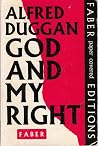
God and my right.God and my right. by Alfred Duggan
My rating: 4 of 5 stars

Church versus State conflicts seem to appear throughout the history of the Christian Church, and that between English King Henry II and Archbishop Thomas Becket in the 12th century is one of the better-known examples. It took place not long after the Norman conquest of England, and so most of the ruling class were Normans, with one foot in England, and the other on the European continent. Thomas of Cheapside, who became Archbishop of Canterbury, was the son of a London merchant of Norman descent, and was educated in monastic schools, and spent his holidays with a Norman knightly family to learn the code of chivalry.

When King Henry II was looking for a chancellor, someone recommended Thomas, and he and the king became friends. He was ordained as a deacon. His monastic schooling meant that he took his Christian duties seriously, but in his duty as chancellor he looked after the interests of his employer, the king. When the post of Archbishop of Canterbury became vacant, King Henry proposed Thomas for the job, and he was duly elected by the monks of Canterbury. King Henry expected that the post would be a sinecure, and that Thomas could go on being his chancellor, and delegate his church duties to others. Thomas, however, saw that being the most senior bishop in England required all his attention, and thought that the kings interests came second to those of God. As a result f this, their friendship cooled. Henry wanted to control the Church and its revenues, and Thomas resisted.

King Henry was given to temper tantrums when he didn’t get his way, and would roll around screaming and drumming his heels on the floor like an infant. Apparently these outbursts impressed his courtiers, and it seems not dissimilar to the temper tantrums of US President Donald Trump in our day. It was in the course of one of these rages that he complained that no one would help him to get rid of the turbulent priest. A group of his knights took him at his word, and set off for Canterbury where they murdered Thomas, and soon afterwards he was declared a saint by the Western Church. 

Alfred Duggan tells the story well, and gives an impression of what life was like in 12th-century England. As historical novels go, the story is well told.

I've been re-reading The Inklings and King Arthur: J. R. R. Tolkien, Charles Williams, C. S. Lewis, and Owen Barfield on the Matter of Britain, and since Thomas was Archbishop of Canterbury about the time that King Arthur's story was being compiled, God and my Right seemed an appropriate one to read concurrently. Of King Arthur, it says:

Bishop Gilbert had been studying the new fashionable romances about King Arthur, a frivolous diversion for a holy monk of Cluny. Geoffrey of Monmouth described a state of affairs, in the fifth century, when the Church in Britain was ruled by an Archbishop of London. At this Gilbert’s imagination took fire, and he began to claim that his See should be raised to Metropolitan status; at the same time King Henry relied on him to administer all benefices left vacant by the exile of the Archbishop’s supporters.

Geoffrey Monmouth and other contemporary compilers of Arthurian romances, like Layamon, doubtless viewed fifth-century Britain through twelfth-century spectacles. Later historians referred to the fifth century as the beginning of the “Dark Ages” because so few written sources had survived from that time. Archaeology has given later historians a better idea of the material culture of the earlier period, but Geoffrey and Layamon lacked such resources, and so Alfred Duggan in giving us a picture of life in the twelfth century, also gives a picture of the fifth-century as seen through the eyes of the authors of the Arthurian romances.

View all my reviews

03 July 2025

The Inklings and King Arthur (book review)

The Inklings and King Arthur: J. R. R. Tolkien, Charles Williams, C. S. Lewis, and Owen Barfield on the Matter of Britain

The Inklings and King Arthur: J. R. R. Tolkien, Charles Williams, C. S. Lewis, and Owen Barfield on the Matter of Britain by Sørina Higgins
My rating: 5 of 5 stars

Several of the Oxford Inklings wrote about King Arthur though for most of them Arthur was not the main focus of their work. Roger Lancelyn Green's prose retelling probably did a great deal to make the Arthurian stories accessible to 20th-century readers, and Charles Williams devoted quite a lot of poetry to Arthurian themes, but for the other Inklings, Arthur, though not central, was always present.

This book looks at the ways in which the four main Inklings -- Barfields, Lewis, Tolkien and Williams -- handled the "Matter of Britain" in their writings, and how they themselves contributed to it. In such a project, one of the first things that needs to be decided is what makes a particular text "Arthurian". In the first chapter editor Sørina Higgins deals with this question and generally adopts an inclusive approach. Any reference to the Arthurian legend, explicit or implicit, is included. So the book also includes a list of all the writings of the four main Inklings, published or unpublished, that contain such references.

This alone would make the book useful to Inklings scholars, or indeed anyone wanting to know about 20th-century Arthuriana, but the main articles deal with it comprehensively from various points of view, including a survey of the source material, the writings of the Inklings themselves analysed from various points of view, and much more.

I found it especially valuable because much of my own knowledge of "The Matter of Britain" comes from the Inklings. As a child I had read a children's edition of Stories of King Arthur by Stuart Campbell, and likewise a child's edition of Spenser's The Faerie Queen (during the reading of which I fell in love with Britomart). So when I read Arthurian bits of the Inklings, that was my reference point, and things that were not mentioned there (like the Fisher King) passed right over my head. So this book helps to anchor the Inklings' Arthurian references in a wider tradition, and helps one to make sense of them.

There is not much mention in this book of Roger Lancelyn Green, a minor Inkling, whose retelling of the stories of King Arthur helped me to put them in context. I've said more about that in South African Camelot.


View all my reviews

03 November 2021

The Crystal Cave: an autobiography of Merlin the magician

The Crystal Cave (Merlin, #1) (Arthurian Saga, #1)The Crystal Cave (Merlin, #1) by Mary Stewart
My rating: 4 of 5 stars

The first part of a biography of Merlin the prophet and magician, mentor of King Arthur, based on the work of Geoffrey of Monmouth.

It reads like a historical novel, though Merlin is not a figure of history, so it is probably most accurately described as a fantasy in the form of a historical novel. It is said that Geoffrey of Monmouth created the figure of Merlin by combining elements of the stories of two earlier prophets and adding a few bits of his own. Mary Stewart adds several details of her own to round out the figure of Merlin.

In this story he is the bastard son of a daughter of the King of South Wales, who refuses to reveal who is father was, and does not deny rumours that he was the son of the devil. In Stewart's story Merlin meets a hermit-prophet Galapas, who becomes his tutor, but runs away from home at the age of 12, fearing members of his own family.

As a fictional autobiography it makes a good story, but since it is written in the first person it gives a definite impression of the character of Merlin, which differs from that of other writers. Given the basic outline of the legend of Merlin (of which Mary Stewart gives a summary at the end, an author is given great freedom to shape that character as they wish, and in this book Merlin is shown as rather diffident and lacking in self-confidence. He has to be told by other people what he has prophesied, and even how he interpreted it.In this respect a more appropriate title for the book might have been The Reluctant Shaman.

Perhaps the weakest part of the book is the end, dealing with the conception of Arthur. I haven't read Geoffrey of Monmouth's original, so I'm not sure how much of the blame is his, and how much Mary Stewart's but it felt like an inauspicious beginning for a predicted marvellous reign. Merlin's grand scheme seems pointless, as does Uther's reaction 

Other authors, medieval and modern, have written Merlin with a very different character, and I've wound some of them more convincing than this one.  

View all my reviews

05 September 2021

King Arthur, Arthurian literature and the Holy Grail

King Arthur In Legend And History

King Arthur In Legend And History by Richard Barber
My rating: 4 of 5 stars

This is the second book on Arthurian literature I've read in the last month, and since I read them so close together, I can't help comparing them. The first one was King Arthur: the True Story, and you can see my review here.

This book is the earlier one (first published in 1961) and in my opinion the better one, though it gets a lower rating on GoodReads, perhaps because of the limitations of the 5-star rating system. In a 10-star system I would give King Arthur in Legend and History 7 stars, and King Arthur: the True Story only 6.

The books start at opposite ends of the story, and work in different directions.

King Arthur in Legend and History starts with what is known of the historical Arthur, and then follows the development of the legend in literature. King Arthur: the True Story starts with the developed legend, and works back towards the history. That is because its main purpose is to present its candidate for the true historical Arthur, and so, apart from a general survey of the literature at the beginning, its main argument is directed to that end.

Richard Barber, on the other hand, shows how scanty historical sources led to the growth of a rich literary legend. On the whole, I liked his book and his approach better. He also deals much more thoroughly with the later Arthurian literature, which is of little interest to anyone looking for clues to the historical Arthur. He also gives quite a bit of space to one of my favourite authors, Charles Williams, though he concentrates on his poetry, and not on his prose narratives.

Barber compares most of the major Arthurian writers, and compares the way in which they presented the stories and the characters, and also how people in different periods tended to present them differently.

I'm almost more interested in the history of the literary treatment of the legend than I am in the legend itself. For one thing, King Arthur himself seems to play very little part in the stories. Other than at the beginning, where he becomes king, and the end, with his rather enigmatic end, he seems to do little except announce that he will fast until one of his knights has an adventure and comes back to tell him about it. And the rest is the story of the adventure of this or that knight -- adventures that often seem to involve murder or adultery or both. 

One of the things I find most interesting, though, is the story of the Holy Grail, or Graal. This was introduced to the Arthurian story by Crétiene de Troyes about 1190, though he does not describe it in detail. Within ten to fifteen years (about 1200-1210) Robert de Boron had expanded this narrative, and the Graal had become the cup used by Christ at the last supper. brought to Britain by Joseph of Arimathea and taken to Avalon by Bron the Rich Fisher.


I don't think that it is mere coincidence that this was the very period in which the word "transubstantiation" was introduced into Western theology to explain the transformation of the Eucharistic elements of bread and wine into the body and blood of Christ. It was in 1215 that the Lateran Council declared that the doctrine of Transubstantiation was essential to the faith. For more details on this see Eucharistic theology and witchcraft.

Though Barber discusses Charles Williams's  Arthurian poetry, he does not mention his novel on the Graal, War in Heaven, which also introduces the figure of Prester John. It is a kind of 20th-century version of a Grail Quest, with the Duke of North Ridings playing the part of a questing knight, with his Roman Catholic Eucharistic theology, and the Anglican Archdeacon of Fardles having a somewhat more mystically real eucharistic theology. 

Now perhaps there is somewhere, mouldering on a forgotten shelf  in some university library, someone's doctoral thesis on the parallels between the development of Western Eucharistic Theology in the late 12th and early 13th centuries and the development in the legend of the Grail in Arthurian literature during the same period, and if so, I'd like to read it. But if there isn't one, I would love to see someone working on one, and someone suggesting that to potential students as a possible topic.


View all my reviews

LinkWithin

Related Posts with Thumbnails