Showing posts with label interfaith. Show all posts

08 January 2009

Reality isn't what it used to be

In considering the general topic of "Religion and science" the first question that occurs to me is "What religion? What science?"

Both "religion" and "science" are cultural constructs based on Western modernity. By "modernity" I mean the Western worldview (or "paradigm") shaped by the Renaissance, the Reformation and the Enlightenment.

Concerning religion, Peter Harrison says in his book "Religion" and the religions in the English enlightenment:

One of the effects of the Reformation was the exchange of an institutionally based understanding of exclusive salvation to a propositionally based understanding. Formerly it had been "no salvation outside the Church", now it had become "No salvation without profession of the 'true religion'" - but
which religion was the true religion? The proliferation of Protestant sects made the question exceedingly complex, and led to the production of innumerable abstracts, summaries and the like of the Christian religion, with confessions and statements of faith, in attempts to arrive at a solution. Thus there was a concern for 'fundamentals', which could therefore bring Christianity into a closer relation with other faiths, if the 'fundamentals' were broad enough to include them. Religions, in the new conception, were sets of beliefs rather
than integrated ways of life. The legacy of this view of "the religions" is the modern problem of conflicting truth claims (Harrison 1990:63-64).

The very term "interfaith" is thus a product of this conception, which is in turn a product of Western history -- the idea of religions as "faiths", that is sets of beliefs.

Harrison (1990:5-6) also points out that, in the West, there were three different understandings of 'nature', which led to three different understandings of 'religion' and 'the religions'.
  1. The natural order is opposed to the supernatural. 'Natural' religion is the result of human sin and stands in opposition to 'revealed' religion. This dichotomy was largely shaped by the Protestant reformers.
  2. An instinct, or the light of conscience (also Bacon, and Kant's 'practical reason'). This view is derived from Renaissance thought and ultimately from Stoic philosophy. In this view the natural is not opposed to the supernatural but complements it.
  3. The light of nature is that which springs from reason, sense, induction and argument (Bacon), which Kant later called 'pure reason'. It was this view that developed as the Enlightenment progressed, and led to 'religion' being investigated in the same way as phenomena of the physical universe.

There were such radical changes in religious orientation in post-Reformation England that there was in effect a diachronic religious pluralism, which led to secularization, and "the comparison of the various forms of Christianity with one another, and shaped to a significant extent the way in which the English were to see other 'religions'. The whole comparative approach to religion was directly related to confessional disputes within Christianity"(Harrison 1990:3).

In other words, the frame of reference for the understanding of "religion" has been shaped by the history of Christianity in Western Europe since 1500. To this extent "religion" is a modern Western social and cultural construct.

For more on the differences between premodern and modern Western Christianity, see my post on The ikon in an age of neo-tribalism.

Like religion, "science" is also a social construct.

In English, more than in other languages, "science" has come to refer primarily to the "hard sciences":, those that use empirical methods of verification, though even in English there is a wider meaning. In premodern times, for example, theology was called "the queen of the sciences". In that sense, "sciences" meant "branches of knowledge". And even today non-English speakers sometimes refer to people writing "scientific articles" and reading "scientific papers" on theology, whereas native English speakers would probably say the articles and papers were "academic" or "scholarly", and reserve "scientific" for the "hard" sciences, like physics, chemistry, botany and zoology. Even social scientists would be thought of as reading academic papers rather than scientific ones.

I am particularly conscious of the language difficulty from the time that I worked in the editorial department at the University of South Africa, which was bilingual in Afrikaans and English. It was a distance-education university, and all study material was prepared in both languages. Some subjects, however, were uniquely bound up with Afrikaans culture, and with white Afrikaner nationalism. One such was Fundamental Pedagogics, which claimed to be the science of education. It was not, its proponents claimed, a philosophy of education, because there can be many different philosophies. It was scientific, and there can only be one science, and so from its lofty scientific pedestal it could sit in judgement on all mere philosophies of education.

In the original Afrikaans the word was "wetenskap" and "wetenskaplike", which are usually translated as "science" and "scientific" respectively. It is the equivalent of the German Wissenschaft or the Russian nauka. Though "wetenskap" can also mean knowledge, Afrikaans also has another word, "kennis", which corresponds more closely to the English term "knowledge". To English-speaking people, however, or at least to English editors, Fundamental Pedagogics did not seems so much like a science as an ideology, and the fundamental pedagogicians, in their claims for their discipline, seemed to be including it among the natural sciences. One could never be sure whether this was a linguistic or cultural misunderstanding, or whether the fundamental pedagogicians were simply snake oil salesmen.

In English, more than in many other languages, "science" has come to be used primarily of the natural sciences. This in itself shows that the term "science" has a meaning that varies from culture to culture. Thomas Kuhn, with his concept of paradigm shifts, emphasised this even more.

Both "religion" and "science", therefore, are cultural constructs, and need to be seen in the context of the culture in which they originated.

Can one say more?

Can one bring religion and science together, and see how religion sees science or how science sees religion?

Harrison (1990:2) says of this

It is evident from the philosophy of science that objects of study are shaped to a large degree by the techniques which are used to investigate them. If we apply this principle to the history of 'religion', it can be said that the very methods of the embryonic science of religion determined to a large extent what 'religion' was to be. It would be expected that 'religion' and the strategies for its elucidation would
develop in tandem. For this reason 'religion' was constructed essentially along rationalist lines, for it was created in the image of the prevailing rationalist methods of investigation: 'religion' was cut to fit the new and much-vaunted scientific method. In this manner, 'religion' entered the realm of the intelligible.


That brings us back to the question I asked at the beginning. Which religion? Which science?

One way in which I saw them brought together was a science fiction story. It introduced me to the concept of scientific paradigm shifts some years before Thomas Kuhn's book on the subject was published. I've sometimes wondered if Kuhn read the story, and whether it perhaps gave him the germ of an idea. Or perhaps both his thesis and the story grew out of the same Zeitgeist.

The story was The new reality by Charles L. Harness, first published in 1950 (ie 12 years before Kuhn's The structure of scientific revolutions).

The story concerns a group of scientist who are investigating a theory that paradigm shifts were not just changes in human consciousness, but that the world itself actually changed each time there was a paradigm shift. When the paradigm was that the sun revolved around the earth, the sun really had revolved around the earth, and when the paradigm changed, the earth began to orbit the sun.

To test this thesis, they want to break down the current paradigm, the Einsteinian one, which is based on the speed of light. They construct an apparatus (remember the Large Hadron Collider?) that will let through exactly one photon of light and direct it at a prism set at exactly 45 degrees. When a rat in a laboratory maze is faced with a fork in the path, so that it doesn't know whether to go left or right, it hesitates. So the photon, on encountering the prism, would hesitate for a split second before deciding whether to reflect or refract. That would slow down the speed of light on which the Einsteinian paradigm is based.

The apparatus was constructed, and the machine was switched on. One of the male laboratory staff suddenly found himself naked in a garden. The laboratory and everything in it had vanished. A female colleague, likewise naked, approached him through the trees, offering him an apple.

______

Bibliography


Anderson, Walter Truett. 1990. Reality isn't what it used to be. San Francisco: Harper.
Harness, Charles L. 1998. An ornament to his profession. NESFA Press.
Harrison, Peter. 1990. "Religion" and the religions in the English Enlightenment. (Cambridge: Cambridge University Press).
Kuhn, Thomas. 1962. The structure of scientific revolutions.
_____

This post is part of an interfaith synchroblog on "Religion and science".

Here are links to other synchronised blog posts on this general topic:

27 September 2008

Interfaith synchroblog and forum

A group of us are planning to have a synchroblog on 8 October on the general topic "Interreligious dialogue".

If you would like to take part, just write a blog post on that day with your thoughts on interreligious dialogue, and, as soon as you have posted it, send me information about your post (see below) and add the list of other participants in the synchroblog to your post when the list is available. You should also tag your post with "metareligionrap" and a tag for your own religious (or irreligious) background, and post it to del.icio.us with those tags too. They will then appear on the Metareligion blog aggregator at http://religionrap.blogspot.com

I suggest that we post as follows:

People in North and South America post in the early morning
People in Europe and Africa post about noon
People in the Middle East, India etc post midafternoon
People in eastern Asia, Australia, New Zealand etc post in the evening

As soon as you have posted your contribution, copy the URL for your post from your browser and send it to me in an e-mail message in the following format

NA Poster's name
BL Poster's blog name
TI Title of your post
URL Url of your post
REL Your religious background
EM Your e-mail address

If you use that format -- with the preceding tags in capital letters followed by a single space, and each piece of information on a separate line (it can word-wrap), I will be able to import it straight into a database without re-typing, and produce a report with the HTML code for the links which can then be appended to your post. I will post them on my contribution, and the easiest thing will be to copy and paste them from there. But I will also send it by e-mail to all the registered contributors (to the e-mail address you provide, so don't munge it).

If you send it to me by e-mail at

shayes (at) dunelm.org.uk


it will avoid cluttering up the mailing lists with lots of messages about addresses and titles of blog posts.

We will discuss the Synchroblog post on the interfaith forum Religionrap

For what it's worth the membership of the interfaith list (Religionrap) is as follows (so far):

Pagan 53%
Christian 23%
Jewish 7%
Buddhist 7%
Other 7%

No Muslims or Hindus yet, it seems.

If you want to know more about the Religionrap discussion forum see Notes from underground: Interfaith dialogue and Religionrap.

19 September 2008

Interfaith dialogue and Religionrap

About 10-15 years ago I belonged to the RELIGION conference on the RIME BBS network. It was an interesting forum where people of different religious backgrounds and traditions discussed various topics and learnt about each other's beliefs and practices.

BBS networks and forums began to die after 2000, partly because much of the software that made them so useful was not Y2K compatible, and there were bugs in the date format, and partly because Windows 95 and later versions hid the software one needed to access BBS networks.

But I still miss that forum.

There were interesting people there, like Deke Barker, Soonand Myosurus, John Eveland and many more.

Recently there has been a proposal for an interfaith synchroblog. That is OK, but it is not really the best medium for interfaith dialogue. In a blog individuals express their views, and people can respond to each individual by way of comments. But there is no real back-and-forth discussion.

A couple of us have therefore started an interfaith discussion forum, called Religionrap. I hope that if any of the people from the old RIME religion conference are around and see this, they may join in. I hope that the people who want an interfaith synchroblog will also join in -- after all, there has to be somewhere where one can discuss the topic for the next synchroblog, and some of the points raised in the synchroblog.

For anyone interested, the people who started it are me, Steve Hayes, an Orthodox Christian from South Africa, and Yvonne Aburrow, a Wiccan Unitarian from England. For the time being we are the moderators, to try to keep discussion civil.

Group Email Addresses


Or got to the web site at:

http://groups.yahoo.com/group/religionrap/

30 January 2008

Neopagan discussions of Christianity

A few months ago a group of Christian bloggers had a synchroblog on Christian-Neopagan relations, and now a similar thing seems to be happening spontaneously among Neopagans. MetaPagan:
It must be something in the aether...Discussions of Christianity are breaking out on Pagan blogs everywhere.

It's odd, but whenever I post anything related to the subject of Christianity at my own blog, the number of hits and comments--from Pagans--goes way up. Maybe I'm not the only person to have noticed this, because over the last few days, numerous members of the Pagan/Heathen blogosphere have posted entries on the topic of Christo-Paganism and related topics. Some bloggers are concerned, some are puzzled, and some are embracing at least some Christian concepts, if not Christianity, per se.

Generally speaking, a Blog Carnival or a Synchro-blog event, like the Brighid in Cyberspace Poetry Reading described below, is planned in advance. This one, however, seems to be just happening.


Visit Metapagan to see the links to some of the posts.

26 October 2007

Pagan comments on the Halloween synchroblog

The Halloween sychroblog has got some interesting interfaith dialogue going between Christians and Neopagans, which Yvonne has blogged about on Metapagan.

14 October 2007

Muslims call for peace with Christians

In my previous post I reported some confusion about a letter to Roman Pope Benedict XVI signed by 38 Muslim scholars, and another addressed to a wider audience by 138 Muslim scholars.

The confusion has now been resolved, with the latter being issued on the anniversary of the former. The second and more recent letter is addressed to a number of different Christian leaders and is a call for Muslims and Christians to work together for peace. It is addressed to all Chtristian leaders everywhere, and is addressed to two African church leaders by name: His Beatitude Theodoros II, Pope and Patriarch of Alexandria and All Africa and His Holiness Pope Shenouda III, Pope of Alexandria and Patriarch of All Africa on the Apostolic Throne of St. Mark.
Muslims and Christians together make up well over half of the world’s population. Without peace and justice between these two religious communities, there can be no meaningful peace in the world. The future of the world depends on peace between Muslims and Christians.

Ruth Gledhill, the religion correspondent of The Times, blogs about it here, and reports that Irene Lancaster thinks the letter is "threatening". Part of the confusion about the two letters was caused by Ruth Gledhill linking to the wrong one on her blog, which one hopes may be corrected.

There seems to have been a mixed reaction among Christians, but I think that any call for peace is a hopeful sign, if it can be followed up. Religious leaders might not be able to deter political leaders who are bent on war. Many of the Christian leaders to whom the letter was addressed urged the USA and Britain not to invade Iraq in 2003, and the call was ignored. But quite a number of ordinary Christians went to Iraq to face the bombs.

Imagine what might have happened if Christian and Muslim leaders had been united, and the Roman Pope, Orthodox Patriarchs and the other leaders to whom the letter was addressed had gone to Baghdad in March 2003 and refused to move until George Bush withdrew his threat?

The world might have been a much less dangerous place today.

So if the letter leads to united action for peace by Muslim and Christian leaders, it is to be welcomed.

13 October 2007

Muslim initiative in interfaith dialogue

Islamica Magazine reports
In an unprecedented move, an open letter signed by 38 leading Muslim religious scholars and leaders around the world was sent to Pope Benedict XVI on Oct. 12, 2006. The letter, which is the outcome of a joint effort, was signed by top religious authorities such as Shaykh Ali Jumu‘ah (the Grand Mufti of Egypt), Shakyh Abdullah bin Bayyah (former Vice President of Mauritania, and leading religious scholar), and Shaykh Sa‘id Ramadan Al-Buti (from Syria), in addition to the Grand Muftis of Russia, Bosnia, Croatia, Kosovo, Slovenia, Istanbul, Uzbekistan, and Oman, as well as leading figures from the Shi‘a community such as Ayatollah Muhammad Ali Taskhiri of Iran. The letter was also signed by HRH Prince Ghazi bin Muhammad bin Talal of Jordan and by Muslim scholars in the West such as Shaykh Hamza Yusuf from California, Professor Seyyed Hossein Nasr of George Washington University in Washington, D.C., and Professor Tim Winter of the University of Cambridge.

All the eight schools of thought and jurisprudence in Islam are represented by the signatories, including a woman scholar. In this respect the letter is unique in the history of interfaith relations.

The letter was sent, in a spirit of goodwill, to respond to some of the remarks made by the Pope during his lecture at the University of Regensburg on Sept. 12, 2006. The letter tackles the main substantive issues raised in his treatment of a debate between the medieval Emperor Manuel II Paleologus and an “educated Persian”, including reason and faith; forced conversion; “jihad” vs. “holy war”; and the relationship between Christianity and Islam. They engage the Pope on an intellectual level concerning these crucial topics—which go well beyond the controversial quotation of the emperor—pointing out what they see as mistakes and oversimplifications in the Pope’s own remarks about Islamic belief and practice.

But like the Patriarch of Moscow's address to the Council of Europe, the Western press seems to be reporting an entirely different letter, unless there are two different letters, and the reporting has got mixed up.

Can anyone clarify this?

16 August 2007

Theology of religion and interreligious dialogue

This is a continuation of a synchroblog article Christianity: inclusive or exclusive?

In the first two parts of this article I noted that writers on "theology of religion" tended to concentrate on the question whether "salvation" was to be found in non-Christian religions, and to divide views on this into "inclusive", "exclusive" and "pluralist". I have tried to show why I believe that this is the wrong question to ask, because no matter what the answer, it does not lead to a "theology of religion".

Some years ago I attended a course on evangelism at the Haggai Institute in Singapore. At that time I was Anglican, and one Sunday I went with a fellow South African Anglican on the course to a service at the Anglican cathedral in Singapore. After the service we went to have coffee at Raffles Hotel, one of the most famous hotels in the city, just to be able to say say we had done so. Then we walked up the road from the hotel to look at the Sultan Mosque, another of the famous sights of the city.

On the way our attention was attracted by a lot of noise from a building on the other side of the road -- a sound like banging frying pans and blowing hooters. It was a Chinese temple, and we crossed the road to have a look. We asked someone what was happening, and were told that it was the goddess's birthday. We wandered inside to have a look, in some trepidation, not sure if we were intruding. Two ministers, dressed in orange robes, were chanting something at a table full of fruit, and would occasionally turn round to two women kneeling behind them and wave incense over them. Every now and then a bloke sitting on one side would bang gongs and another would tootle a sort of oboe affair that made a noise like a bicycle hooter.

Further in was another room with two benches, on one of which was a pig with an orange in its mouth, and on the other a shaved goat. Some people were standing around, others walking about with joss sticks, kneeling down at various places, or bowing and prostrating themselves. On the right was a rack of tablets, -- I wondered if they were ancestor tablets -- and further to the right a kind of altar with a fire. Geoff remarked that the goddess seemed to be doing rather well for her birthday: apart from the pig and the goat there were plucked ducks (with their heads over their backs), fruit, vegetables and more. As we went out again past the chanting ministers a little girl of about nine was coming in, right past the tooter, following her parents, with her hands over her ears and her face all screwed up. I wish I could have taken a photo of her. The place had an oppressive atmosphere of idolatry, and was very ritualistic.

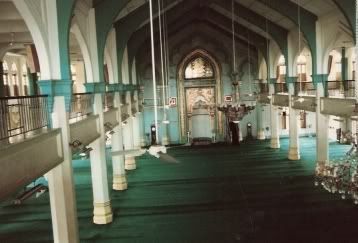
We went on to the Sultan Mosque, a little further up the road. Since it was a Sunday, it was empty, and very quiet, a kind of oasis of peace, with its blue-green carpets, and the noise of the streets seemed far away. We stayed there for a while, enjoying the contrast -- the raucous idolatry of the temple, contrasted with the cool iconoclasm of the mosque.

Singapore is a very pluralistic place, where several religions can be found coexisting. A week later at an Anglican service we met a man who had been a spirit medium and fortune teller. He had become a Christian, but said he had been plagued by demons. This had persisted until he had had a tattoo of a goddess surgically removed from his back, and he showed us the dressings on his back where the tattoo had been removed.

In none of these things did the inclusive-exclusive-pluralist model make much sense. Now I am an Orthodox Christian, and I find that the extremes of the raucous idolatry of the Chinese temple and the cool iconoclasm of the mosque are not for me. Orthodoxy is somewhere in the middle between those two extremes. But that may just be a cultural preference.

The man who had switched from being a devotee of the goddess to Christ did, however, have a theology of religion. He believed that having a tattoo of the goddess on his back laid him open to demonic attack (I do not know if his was the same goddess as the one who had had her birthday the previous week). This was not something that Western missionaries had told him to do, in the course of a general attack on Chinese culture. The church be belonged to, an Anglican parish, consisted mainly of people who were the only Christians in their family. The parish priest had been brought up as a Buddhist, but he did not preach against Chinese religion. He simply told people about Jesus Christ. Most members of the congregation had formerly practised Chinese religions, and most of their relations still did. But when they became Christians they developed a theology of religion that interpreted their former beliefs and practices in a new way, from the point of view of their Christian faith. And this theology or religion doesn't fit very easily into the "inclusive-exclusive-pluralist" model.

As a South African, I tended to look at it differently, as an outsider. I had not encountered Chinese religion before, and there are very few books about it in English, so one can't even read about it. It's not taught in most religious studies courses in non-Chinese universities (I don't know about Chinese ones). Most Religious Studies courses seem to teach that the Chinese religions are Taoism, Confucianism and Buddhism, but in fact those are schools of philosophy rather than religion, and to them one could add a fourth, the Thought of Chairman Mao.

Among other things, as I noted in part II of this series, a Christian theology of religion should explain why the Bhagavad Gita is there. And these things will all look different when seen from different perspectives. The Christians in Singapore have just come from Chinese religion, and in their perspective it looms very large, because they are still close to it, not just geographically but existentially. A Christian theologian in Chicago, brought up in a Christian environment, will have a different and more distant perspective on it. So in any Christian theology of religion there will be different perspectives, depending on how close one stands to the religion concerned, personally, historically and geographically.

There would also be at least as many theologies of religion as there are religions. There might be a Christian theology of Islam, for example. In fact there might be several. I've heard some English-speaking Christians, for example, saying "Allah is not God". I'm still not sure whether that is actually a theology of religion, or simply English-speaking chauvinism, because what it primarily asserts is that those who say it believe that God speaks English and not Arabic, and listens to prayers in English but does not listen to prayers in Arabic. It is but a small step from that to saying that Bog is not God, o Theos is not God, Dieu is not God, uNkulunkulu is not God, Gott is not God, and no doubt God is not God, if God is pronounced with a guttural G, as in Afrikaans and Dutch, instead of the approved English pronunciation, with a hard G. But then what about all those Americans in the soaps who are always saying "Oh my Guard!"? Guard is not God? Or should that be God is not Guard? But if Allah is not God, who do Arabic-speaking Christians worship?

As I also noted in Part 2, C.S. Lewis interpreted the Roman Mars and the Greek Ares as Malacandra. That, in a way is a theology of religion, even though Lewis used it in works of fiction. But the very identification of Ares with Mars is a theology of religions, interpreting the ancient Greek and Roman pantheons in terms of each other. And C.S. Lewis was by no means the first to do this, even from a Christian point of view. A Christian work that was very popular in the Middle Ages, the story of Barlaam and Ioasaph, is a Christianized version of a very ancient "spiritual romance" that was composed in India and first written down in an Indian language by Buddhists.

So, as I see it, a true Christian "theology of religions" would deal with questions such as "Why does the Bhagavad Gita exist? It would seek to explain other religions in Christians terms But in order to do that, we need first of all to understand them in their own terms. So I think "theologians of religion" like Paul Knitter have got it exactly the wrong way round. We don't need a theology of religions in order to have authentic dialogue. We need authentic dialogue in order to have a theology of religions. Without such authentic dialogue, we will not have a theology of religion, but a theology of a caricature of religions. Those, like the Chinese Christians in Singapore I referred to, had a dialogue of sorts with Chinese religion, in the sense that they knew it from within before they became Christians. The rest of us are not really qualified, until we have made at least some attempt to understand Chinese religion (see book suggestion below).

And just as there might be a Christian theology of Hinduism, the dialogue would enable Hindus to develop a Hindu theology of Christianity, as indeed some have already done.

[ continued in the September synchroblog on Christianity, paganism and literature ]

Bibliography


  • Budge, E.A. Wallis, (ed) 1923. Barlaam and Yewasef: being the Ethiopic version of a Christianized rescension of the Buddhist legend of the Buddha and the
    Bodhisattva
    . Cambridge: Cambridge University
    Press.
  • Chamberlain, Jonathan. 1987. Chinese gods. Selangor, Malaysia:
    Pelanduk. ISBN: 967-978-105-4

14 August 2007

Christianity: inclusive or exclusive? (Synchroblog)

The theme for this month's Synchroblog, Christianity -- inclusive or exclusive? is rather vague, perhaps deliberately so. It allows people to blog about different things depending on how they understand those epithets.

But when I go back about 20 years, I encountered the terms mainly in the academic discipline known as Theology of Religion. The terms "inclusive" and "exclusive" were there applied to the views that different groups of Christians were alleged to hold on whether salvation was to be found in other religions or not. The inclusivists believed that salvation was to be found in other religions, and the exclusivists believed that it wasn't. There was a third group, called "pluralists". There is a pretty good summary of that debate and its various views here.

In 1990 I was asked to help with the teaching of the third-year course in Missiology at the University of South Africa (Unisa) which included a half-course in "Theology of Religions" (Course MSA301-B). I was asked to mark one of the assignments for the course, and in order to prepare myself for doing this, I read through the prescribed book (No other name? by Paul E. Knitter, SCM, London 1985) and the study guide issued to students (Kritzinger 1985). This raised a number of questions in my own mind, which I wrote down at the time in order to discuss them with others - especially those who were marking other assignments in the course. I found Knitter's book frustrating, because it seemed to ask the wrong questions, and it seemed to beg too many questions. Other literature on the same topic seemed to have the same shortcomings.

Even though I was called upon to teach the course, I found the whole debate quite meaningless. Whatever it was, it was not a study of theology of religions, but rather a study of different Christian factions. It never got to grips with the content of other religions at all. There was much talk of interreligious dialogue but the dialogue never took place. It was all metatalk, talk about talk, talk about Christian attitudes to talking, and the talking never happened.

The main difficulty I had with Knitter may have sprung from my own failure to understand what "theology of religions" means. I had assumed that, in a Christian context, it meant the Christian understanding of other religions in the widest sense. I have always understood that it was to be distinguished from "Science of Religion"in that theology of religion was concerned with the Christian understanding of, and approach to, other religions, while science of religion was concerned with a phenomenon called "religion" (however defined) and took a more comparative approach. In other words, I understood science of religion to be concerned with questions like "How does a Buddhist regard the Buddha?" or "How does a Christian regard Christ?" and possibly a comparison between them, and I thought that a Christian theology of religions was concerned with questions like "How does a Christian interpret the Buddha and
Buddhist teaching?"

Knitter did not seem to me to deal with theology of religions at all. Throughout his book, the non-Christian religions are somewhere "out there". Knitter seems not to be concerned with a theology of religions, but with reshaping Christian theology to conform to the values he regards as most important, one of which is a "more authentic dialogue". Except that the dialogue does not actually take place. It's all about how to get to the bus stop, but it never gets on the bus, it never goes anywhere.

And I believe it never goes anywhere because it starts from the wrong place, by asking the wrong questions.

"Is there salvation in other religions?" is the wrong question.

First of all, it is the wrong question because Christians believe that there is no salvation in any religion, including Christianity. Salvation is in Christ, not in religion.

Secondly, if Christians can't agree among themselves on what salvation is (see, for example, here, here and here), how can they expect to find it in other religions, especially if, like Knitter, they don't even examine or discuss those religions?

Thirdly, do the "other" religions think salvation (in the Christian sense) is at all important? Should we not rather ask how those religions pereive their own goals, and only then consider whether and how they relate to Christian ideas of "salvation"?

To use a consumerist metaphor, it is like describing the different views of the customers and staff of a bakery about the quality of bread to be obtained from the builder's merchant, selling cement, bricks and window frames. The inclusivists would say yes, the bread you get from the builder's merchant is just as good as the bread you get from the bakery, as they spread jam on a slice of cement loaf, while the exclusivists would say it isn't as good. What neither group appears to consider is that it isn't bread at all.

[continued in next post]

Other synchrobloggers this month


15 June 2007

Untouchables - Dalits and Hindutva - Synchroblog

Over the last few years I have edited a number of abstracts of articles in missiological journals and a surprisingly high proportion of them deal with Dalits and Hindutva.

Consider the following extracts from a missiological article "Post Modern Challenges to Christian Mission in India" by V. Devasahayam (Bishop in Madras, CSI)
Though there has been a variety of approaches among missionaries, this wholly negative picturisation of mission history is neither factual or true to the experience of people in India, particularly the oppressed. JW Pickett says that Christianity has contributed to the economic development of converts, through education, health services, housing, personality reconstruction, reduction of wasteful expenditure etc. Missionaries protected the untouchable converts from violence and harassment, pleaded with government for their rights and represented them in public forums and courts. Their efforts to draw public attention the untouchables question stimulated Indian efforts on their behalf. “The fear of the Christian missionary is the beginning of social wisdom in India” remarked K. Natarajan

Mrs. Mohini Das attests to this fact:

“Stop for a moment and see what is happening. In both mission schools and government schools and hospitals the daughters of so called ‘Depressed classes’ now Christians, are teaching and tending the children of ‘Brahmins’. Untouchables? What has happened? They are untouchables no longer, for Jesus has touched them”.

To say that, however, affirms only the positive side, but there was a negative side as well, because a bit further on in the same article the author writes:

The caste Christians have not recognised Christian Dalits as equals and Dalits’ claim to equality is resented. Syrian Christians protested when all students were seated together in the CMS Teacher Training Institute in 1905. They complained to the Bishop: “We shall be glad to be informed why you have made this innovation in the seating arrangements without paying due attention to our feelings and opinions”. Fortunately the petition was dismissed both on theological ground and on the principle of equality. When Dalits demanded admission in school for their children, it was resisted by caste people including caste Christians. A prominent journalist wrote: To admit together the caste that had been cultivating intelligence for generations and those castes who had been cultivating land tannamount to tying a horse and a buffalo to plough under the same yoke. There are stories of caste Christians jumping out of the church through the windows when some Dalits were taken into the church for baptism. Christian Dalits are discriminated against by caste Christians both in the religious and secular spheres.

I have quoted just one article but one can read much the same in many articles in many different journals. One can summarise it by saying that Christian mission helped to improve the social position of the Dalits in India, but that many caste Christians were scandalised by this. And in recent years there has been growing resistance among Brahmins, leading to a growth in Hindutva -- Hindu nationalism.

Again, in the same article the author describes Hindutva without "Hindu tolerance": From the time of Gandhi, Hinduism was known for its tolerance of other religions, but that time is rapidly passing, and Hindutva seems to be gearing up for the Clash of Civilizations.
The controversial supreme court Judgement on Dec.11, 1995 has given Hindutva a legal approval: “ordinarily, Hindutva is understood as a way of life or a state of mind, and it is not to be equated with or understood as, religious Hindu fundamentalism”. The Hindu nationalist parties fought the elections in the name of Hindutva with the legal sanction for the first time. The architect of Hindutva ideology Savarkar’s said, “the crying need of our times is not men of letters but soldiers. …. you should abandon your pens in favour of guns.” The major items of Hidutva agenda are the consolidation of the Hindu community, the defence of its religion, the Hinduisation of politics, the militarisation of Hindudom, the establishment of Hindu rashtra and the reconversion of former Hindus.

Read the full article here:

For other synchrbogs on the theme of "untouchables", see:

25 February 2007

Christian responses to witchcraft and Wicca

About 10 years ago I wrote an article on Christian responses to witchcraft and sorcery, prompted mainly be the prevalence and frequency of witchhunts in what is now the Limpopo province of South Africa.

I recently found an article on Wikipedia, Christian views on witchcraft, which quoted my article at one point, and was rather confused and patchy, and would probably be confusing to most readers. One reader complained that, since many students used Wikipedia as a tertiary source, the article was frustrating, as it did not really give any references to secondary sources, and so was practically useless.

I tried to do a quick patch -- wrote a historical introduction, and tossed in a couple of bibliographical references, but such a thing really needs to be a collaborative effort, and so this is a call for discussion and help in trying to improve the article.

I'm not sure how much of the rest of the article is usable, though, and it may need to be completely rewritten.

One problem, which I touched on only briefly in my original article, is the confusion between witchcraft and Wicca. Russell (1980:12). defines "witch" as follows:
What really is a witch? One answer lies in the roots and development of words. 'Witch' derives from the Old English wicca (pronounced 'witcha' and meaning male witch) and wicce ('female witch', pronounced 'witcheh') and from the word wiccian, meaning 'to cast a spell'. Contrary to common belief among modern witches, it is not Celtic in derivation, and it has nothing to do with the Old English witan, 'to know', or any other word relating to wisdom. The explanation that witchcraft means 'craft of the wise' is false...

'Wizard', unlike 'witch', really does derive from Middle English wis, 'wise'. The word first appears about 1440, meaning a 'wise man or woman'; in the sixteenth and seventeenth centuries it designated a high magician, and only after 1825 was it used as the equivalent of 'witch'.

Anthropologists like Evans-Pritchard have made a distinction between witchcraft and sorcery, regarding the former as an innate capacity to cause harm, sometimes even unintentionally (as in the evil eye), while sorcery is the conscious and intentional use of spells or substances. I doubt that the distinction holds good in all societies, and some use the same word for both, In Zulu a witch is umthakathi and witchcraft ubuthakathi, and the same word applies to both witchcraft and sorcery in Evans-Pritchard's sense.

As I note in my article, however, there is a modern religion called Wicca, which, though its name is derived from the old English word for "witch", is really something different. Though Wicca is a religion, witchcraft is no more a religion than carpentry is. In Africa there are religious specialists who are concerned with witchcraft, but their concern is mainly with countering its harmful effects. Early English-speaking visitors to Africa who encountered these specialists in African society described them, quite accurately, as "witchdoctors" -- that is, doctors whose job it was to heal those who had been harmed by witchcraft, and to counter the spells of witches.

"Witchdoctor" is a fairly broad term, and because of this anthropologists have tended not to like it. It is too imprecise, and fails to take into account differences in societies and cultures. Some detect witches, some detect and remove harmful substances, some provide protective medicine to counter harmful substances, and so it goes. Sometimes the job of witchdoctor is combined with that of a diviner (smelling out witches is, after all, a form of divining) but a diviner often has a much wider task. Not every misfortune or sickness is caused by witchcraft. It could be caused by an annoyed ancestor, for example. The diviner's job is to determine the cause (which may be witchcraft or something else) and recommend appropriate countermeasures.

One problem that arises, therefore, is that Christians also confuse witchcraft and Wicca, and treat them as interchangeable things. One web site where this can be seen is A Christian response to Wicca. where Wicca is identified with witrchcraft without even an attempt at definition, and both together are subsumed under "the occult" which in turn is lumped together with "humanist" and "new age" beliefs, which include just about anything, so vague is the generalising.

The primary Christian response to witchcraft is that Christians don't do such things. Killimg people is wrong, in the Christian understanding, whether you do it with knives, guns, napalm or spells. It is the intention, rather than the effectiveness of the weapon, that is the criterion.

Christian responses to Wicca are different. Wicca is a religion, and many Wiccans are ex-Christians. Where that is the case, they are apostates from Christianity, and therefore to be treated as heathens and publicans. But if we recognise this, we should study the gospels to see how Jesus treated heathens and publicans, and take note of his implicit and explicit criticism of those who treated them harshly.

These are some of the problems I see with trying to revise the Wikipedia article. Any comments or suggestions?

29 November 2006

Interfaith environmental conference

Photobucket - Video and Image Hosting
I've spent the last couple of days at a meeting of the management board of SAFCEI -- the South African Faith Communities Environmental Institute. Our Archbishop Seraphim (seen here with Anglican Bishop Geoff Davies, the Executive Director of the Institute) has been a member of the SAFCEI board since its inception, and invited the board to meet at St Cosmas and St Damian Orthodox Church in Sophiatown, Johannesburg.

You can read more about what happened at the conference itself in my LiveJournal.

But one of the things that became clear at the conference was the eagerness with which Canadians were destroying the environment. There are plenty of countries that have been pointed out as villains in the world, but Canada has not usually been among them. But the evidence has started piling up.

I had known for some time that Canadians seemed to have some strange ideas. They have had trolley buses in western towns like Vancouver, and that seems to be a good environment-friendly means of public transport, running it on locally-generated renewable hydro-electric power. But now they seem to want to run their buses on diesel fuel -- a non-renewable fossil fuel, most likely imported from the Middle East.

That's just odd, and anyway I'm prejudiced in favour of trolley buses.

But now, it appears, the Canadians are intending to bring aluminium ore here to South Africa, and refine it here using heavily-subsidised electricity generated in coal-fired plants, and export the ingots. So our electricity bills are inflated to make Canadian companies rich, our cities have to endure acid rain to make Canadian companies rich, and our non-renewable fossil fuels are being depleted to make Canadian companies rich.

And Canada is, apparently, one of the biggest pushers of genetically-modified foods.

That makes Canada a bigger threat to our life-support system than Al-Quaeda. Bush and Blair, move aside. Your villany has been superseded.

Now I'll have to Google to find out who the Prime Minister of Canada is.

19 November 2006

Saints Barlaam and Joasaph

Today is the day of Saints Barlaam and Joasaph (in the Gregorian calendar).

As with many Christian saints, stories and legends about other people got attached to them, so that it is sometimes difficult to see what is historical in their lives, and what are transferred legends.

Saints Barlaam and Joasaph are interesting in this regard because their story has many features of the life of the Buddha, so that some have said that this is simply a Christianised version of the story of Siddartha Gautama -- the prince who left a life of luxury to seek enlightenment.

Comments, anyone?

21 June 2006

Beats, Inklings, Christian literature and paganism

When I first started making my own web pages ten years ago, these were some of the themes that interested me, and that I hoped I'd be able to discuss with other people. Now, for the first time, it really does seem to be happening.

For the last few days I've been having a very interesting discussion with Luthienofold on LiveJournal, which echoes some of the thoughts I wrote in an unfinished article on Christianity, paganism and literature.

We were discussing what it was that made good fantasy literature, and what was so attractive about Beat generation authors, and I think we agreed that it was that the heroes were on a human scale. I had a vague recollection of Chesterton having said that fairy tales were appealing not because they were about extraordinary people, but because they were about ordinary people having extraordinary adventures. I have since looked it up, and here it is:
... oddities only strike ordinary people. Oddities do not strike odd people. This is why ordinary people have a much more exciting time; while odd people are always complaining of the dulness of life. This is also why the new novels die so quickly, and why the old fairy tales endure for ever. The old fairy tale makes the hero a normal human boy; it is his adventures that are startling; they startle him because he is normal. But in the modern psychological novel the hero is abnormal; the centre is not central. Hence the fiercest adventures fail to affect him adequately, and the book is monotonous. You can make a story out of a hero among dragons; but not out of a dragon among dragons. The fairy tale discusses what a sane man will do in a mad world. The sober realistic novel of to-day discusses what an essential lunatic will do in a dull world.

And in another post in this blog, Notes from underground: Jack Kerouac I noted that the Beats usually write not only about ordinary people, but even their adventures are quite ordinary -- a mountain-climbing expedition where they fail to reach the top of the mountain, boozy parties, a hiking expedition -- but they manage to see them as imbued with extraordinary significance. They help use to see the ordinary things with new eyes.

So I'm posting this mainly to try to draw some of the threads together, and to invite people to perhaps continue the discussion (if you want to) in my Bravenet Forum, which you will find on most of my Christianity and literature pages, where comments are less ephemeral and easily lost than on blog pages.

See also: Christianity, paganism and literature.


Technorati tags: , , , , , ,

LinkWithin

Related Posts with Thumbnails