Showing posts with label saints. Show all posts

29 July 2026

Church-State conflict in 12th-century England

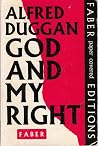
God and my right.God and my right. by Alfred Duggan
My rating: 4 of 5 stars

Church versus State conflicts seem to appear throughout the history of the Christian Church, and that between English King Henry II and Archbishop Thomas Becket in the 12th century is one of the better-known examples. It took place not long after the Norman conquest of England, and so most of the ruling class were Normans, with one foot in England, and the other on the European continent. Thomas of Cheapside, who became Archbishop of Canterbury, was the son of a London merchant of Norman descent, and was educated in monastic schools, and spent his holidays with a Norman knightly family to learn the code of chivalry.

When King Henry II was looking for a chancellor, someone recommended Thomas, and he and the king became friends. He was ordained as a deacon. His monastic schooling meant that he took his Christian duties seriously, but in his duty as chancellor he looked after the interests of his employer, the king. When the post of Archbishop of Canterbury became vacant, King Henry proposed Thomas for the job, and he was duly elected by the monks of Canterbury. King Henry expected that the post would be a sinecure, and that Thomas could go on being his chancellor, and delegate his church duties to others. Thomas, however, saw that being the most senior bishop in England required all his attention, and thought that the kings interests came second to those of God. As a result f this, their friendship cooled. Henry wanted to control the Church and its revenues, and Thomas resisted.

King Henry was given to temper tantrums when he didn’t get his way, and would roll around screaming and drumming his heels on the floor like an infant. Apparently these outbursts impressed his courtiers, and it seems not dissimilar to the temper tantrums of US President Donald Trump in our day. It was in the course of one of these rages that he complained that no one would help him to get rid of the turbulent priest. A group of his knights took him at his word, and set off for Canterbury where they murdered Thomas, and soon afterwards he was declared a saint by the Western Church. 

Alfred Duggan tells the story well, and gives an impression of what life was like in 12th-century England. As historical novels go, the story is well told.

I've been re-reading The Inklings and King Arthur: J. R. R. Tolkien, Charles Williams, C. S. Lewis, and Owen Barfield on the Matter of Britain, and since Thomas was Archbishop of Canterbury about the time that King Arthur's story was being compiled, God and my Right seemed an appropriate one to read concurrently. Of King Arthur, it says:

Bishop Gilbert had been studying the new fashionable romances about King Arthur, a frivolous diversion for a holy monk of Cluny. Geoffrey of Monmouth described a state of affairs, in the fifth century, when the Church in Britain was ruled by an Archbishop of London. At this Gilbert’s imagination took fire, and he began to claim that his See should be raised to Metropolitan status; at the same time King Henry relied on him to administer all benefices left vacant by the exile of the Archbishop’s supporters.

Geoffrey Monmouth and other contemporary compilers of Arthurian romances, like Layamon, doubtless viewed fifth-century Britain through twelfth-century spectacles. Later historians referred to the fifth century as the beginning of the “Dark Ages” because so few written sources had survived from that time. Archaeology has given later historians a better idea of the material culture of the earlier period, but Geoffrey and Layamon lacked such resources, and so Alfred Duggan in giving us a picture of life in the twelfth century, also gives a picture of the fifth-century as seen through the eyes of the authors of the Arthurian romances.

View all my reviews

05 June 2023

St Boniface of Crediton, church history, and missiology

Today (June 5) is the feast of St Boniface of Crediton, Apostle of Germany. 

As a missiologist, I've always found him interesting, and one of the most interesting missiologial things about him is that most missiologists pay little attention to him, and quite a lot of them are perhaps not even aware that he existed. 

He was born in Crediton in Devon in England about AD 680, and died a martyr's death in Frisia about 754. His original name was Wynfrith and he became a Benedictine monk. He went on a missionary journey to Frisia but found that no one was interested in his message there and the King opposed the Christian message.

He then travelled to Rome, and got the support  of the Roman Pope to reorganise and beef up the infant German church (which had been established by earlier rather haphazard Irish missionaries) and get it more active in mission. He did this with considerable success in Thuringia, Bavaria and Hesse. The Roman Pope Gregory II, on getting news of this summoned him to Rome and gave him more enthusiastic support. 

Boniface then returned to Germany, and the Hessian Christians, we are told, approached him with a problem. Some were pure in their faith, but others still retained practices that the purer ones thought were not compatible with the Christian faith, such as divination using the entrails of sacrificed animals, or from the flight of birds, and engaging in incantations and sacrifices. They urged Boniface to cut down a large oak tree that was much revered by pagans, and as he began to do so, amid the angry mutterings of the pagan spectators, a "blast from above" felled the tree without any human help, and we are told that most of the pagan spectators were so impressed that they converted on the spot. Boniface himself, however, in a report to Pope Gregory II, said that this account was exaggerated.

Boniface went on to reform the Frankish Church, and later became Archbishop of Mainz. Perhaps he found that too dull, and felt that he wasn't cut out to be an administrator, so he resigned and went back to being an active missionary again, on the scene of his earlier unsuccessful mission to the Frisians. He was reading the scriptures to a group of new Christians when a group of pagans attacked and killed him.

The treatment of Boniface by church historians and missiologists

My daughter, Julia Bridget Hayes, has painted an ikon of St Boniface, and he is remembered in the Orthodox Church as well as in the Western Church, though not perhaps as well as he might be, but the different treatment by church historians and missiologists is something else. 

I had done a BA degree at the University of Natal, majoring in Biblical Studies and Theology, with a couple of years of secular history as well. Later I did a BTh degree at Unisa, majoring in Church History and Missiology, which I found more interesting. The church historians made quite a big thing of Boniface, and went into some detail, and I wrote an assignment on him. 

Some time later I mentioned him in a missiology assignment. I thought it was perhaps significant that Boniface was English, and that the English had migrated to Britain from Germany over the preceding 200 years, and their kingdoms in southern Britain eventually amalgamated to form England. 

Boniface therefore went to the land that the English had originally come from, and so the language and culture of the people would not be entirely alien to him. We can still read and understand the English of the 1820s now, and so Boniface would hot have had any more difficulty in making himself understood than a US evangelist in the UK would today. He might annoy people with his message and some of his new-fangled cultural ideas, but he would be understood. 

I mentioned this in a missiology essay on cross cultural mission, and my professor, David Bosch, was quite astounded. It was clear that such a thing had never occurred to him before. He had no doubt heard of St Boniface, but obviously had never thought of him as missiologically significant. 

I began wondering about church historians and missiologists living in separate silos, each being unaware of the others were doing. The church historians found Boniface tremendously important, but not for his missionary work or his missionary methods. No, what they found important was not what he did in Germany, but the fact that he went to Rome. The significant thing about this for church history was that it marked a stage in the growing influence and power of the Pope of Rome, and it was therefore a stage in the development of the papacy.

But as a missiologist I thought there were other things worth noticing. The wandering Irish missionaries who had preceded Boniface were travelling evangelists, perhaps like the tent evangelists of the 20th century; they may have made converts, but they did not plant functioning churches. Boniface was a church-planting missionary, and one of his priorities was to establish Benedictine monasteries ans centres of Christian life and growth. He was so good at this that the Roman Pope asked him to reorganise the whole Frankish Church.

And one more thing worth remembering is that it was monastic missionaries who took the Christian message throughout Europe, and the tool for the evangelisation of Europe was forged in Africa, where Christian monasticism first developed. Long before Europeans evangelised Africa, African Christians created the tools that evangelised Europe.

17 March 2012

St Patrick's Day

It is said that St Patrick drove the snakes out of Ireland, which is why there are now no native snakes there.

There have been various explanations of this, and of how it was done. I rather like this one, hat-tip to Casher O'Neill.

Here's another one, with a more scientific explanation: nourishing obscurity | St Patrick’s Day mood setter.

On a more serious note, there's this:

Saturday 17th March 2012
* Tone 6 - Third Saturday of Great Lent
* Memorial Saturday
St Alexius the Man of God, in Rome (411)
St Patrick, Bishop of Armagh, Apostle to the Irish (?461)
St Withburga, Solitary at Holkham and East Dereham (c 743)
Martyr Marinus, Soldier, at Caesarea in Palestine (260)
St Ambrose, Deacon, and disciple of St Didymus (400)
Monk-Martyr Paul of Cyprus (767)
St Macarius, Abbot, Wonderworker of Kalyazin (1483)
Hieromartyr Gabriel of Mtsyr (Georgia) (1802)
Revised Julian (New Style) Calendar

And, from Orthodox Church in America: lives of the saints:

Commemorated on March 17

Saint Patrick, the Enlightener of Ireland was born around 385, the son of Calpurnius, a Roman decurion (an official responsible for collecting taxes). He lived in the village of Bannavem Taberniae, which may have been located at the mouth of the Severn River in Wales. The district was raided by pirates when Patrick was sixteen, and he was one of those taken captive. He was brought to Ireland and sold as a slave, and was put to work as a herder of swine on a mountain identified with Slemish in Co. Antrim. During his period of slavery, Patrick acquired a proficiency in the Irish language which was very useful to him in his later mission.

He prayed during his solitude on the mountain, and lived this way for six years. He had two visions. The first told him he would return to his home. The second told him his ship was ready. Setting off on foot, Patrick walked two hundred miles to the coast. There he succeeded in boarding a ship, and returned to his parents in Britain.

Some time later, he went to Gaul and studied for the priesthood at Auxerre under St Germanus (July 31). Eventually, he was consecrated as a bishop, and was entrusted with the mission to Ireland, succeeding St Palladius (July 7). St Palladius did not achieve much success in Ireland. After about a year he went to Scotland, where he died in 432.

Patrick had a dream in which an angel came to him bearing many letters. Selecting one inscribed "The Voice of the Irish," he heard the Irish entreating him to come back to them.

Although St Patrick achieved remarkable results in spreading the Gospel, he was not the first or only missionary in Ireland. He arrived around 432 (though this date is disputed), about a year after St Palladius began his mission to Ireland. There were also other missionaries who were active on the southeast coast, but it was St Patrick who had the greatest influence and success in preaching the Gospel of Christ. Therefore, he is known as "The Enlightener of Ireland."

His autobiographical Confession tells of the many trials and disappointments he endured. Patrick had once confided to a friend that he was troubled by a certain sin he had committed before he was fifteen years old. The friend assured him of God's mercy, and even supported Patrick's nomination as bishop. Later, he turned against him and revealed what Patrick had told him in an attempt to prevent his consecration. Many years later, Patrick still grieved for his dear friend who had publicly shamed him.

St Patrick founded many churches and monasteries across Ireland, but the conversion of the Irish people was no easy task. There was much hostility, and he was assaulted several times. He faced danger, and insults, and he was reproached for being a foreigner and a former slave. There was also a very real possibility that the pagans would try to kill him. Despite many obstacles, he remained faithful to his calling, and he baptized many people into Christ.

The saint's Epistle to Coroticus is also an authentic work. In it he denounces the attack of Coroticus' men on one of his congregations. The Breastplate (Lorica) is also attributed to St Patrick. In his writings, we can see St Patrick's awareness that he had been called by God, as well as his determination and modesty in undertaking his missionary work. He refers to himself as "a sinner," "the most ignorant and of least account," and as someone who was "despised by many." He ascribes his success to God, rather than to his own talents: "I owe it to God's grace that through me so many people should be born again to Him."

By the time he established his episcopal See in Armargh in 444, St Patrick had other bishops to assist him, many native priests and deacons, and he encouraged the growth of monasticism.

St Patrick is often depicted holding a shamrock, or with snakes fleeing from him. He used the shamrock to illustrate the doctrine of the Holy Trinity. Its three leaves growing out of a single stem helped him to explain the concept of one God in three Persons. Many people now regard the story of St Patrick driving all the snakes out of Ireland as having no historical basis.

St Patrick died on March 17, 461 (some say 492). There are various accounts of his last days, but they are mostly legendary. Muirchu says that no one knows the place where St Patrick is buried. St Columba of Iona (June 9) says that the Holy Spirit revealed to him that Patrick was buried at Saul, the site of his first church. A granite slab was placed at his traditional grave site in Downpatrick in 1899.

14 June 2009

All Saints: making it personal

The Sunday after Pentecost is All Saints Sunday in the Orthodox Church (which means that yesterday was Halloween)

Antioch Abouna: For All the Saints ...:
The saints personalise Christianity. There are versions of Christianity around which reduce Church life to a set of doctrines, good in themselves, but because they are not enfleshed in the lives of real people, such Christianity remains, abstract, dry, formal, conceptual. Think back to your time at school. I guess it's not the lessons you remember directly, rather the teachers who, for you, embodied and made accessible what they taught. So it is with saints. If you want to know who the Holy Spirit is, read the account of Motovilov's conversation with Fr. Seraphim. If you want to understand the place of monasticism in the life of the Church, read St. Athanasios' Life of St. Antony the Great. If you value the healing work of God, don't even read about it, just invoke the prayers of St. Panteleimon, St. Swithun or some other unmercenary healer. The saints make real, vivid and personal what we believe and how we live by those beliefs.

Last week at the Amahoro Conference I met Adriaan Vlok, who had been Minister of Law and Order in the apartheid regime. Truth, reconciliation and smelly feet: Khanya:
When he was Minister, Mr Vlok’s underlings had attempted to poison Frank Chikane, the General Secretary of the South African Council of Churches, and Adriaan Vlok had appeared before the Truth and Reconciliatian Commission and later the Amnesty Committee and had apologised for that and other things. But he said that no one seemed to hear him, and in 2006 several things he read or heard convinced him that he needed to go beyond making a general apology, and apologise to a person, and Frank Chikane seemed to be one of those people. So he had gone to his office and washed his feet.

Adriaan Vlok told this story at the Amahoro Gathering and there was a sequel Truth, reconciliation and smelly feet: Khanya:
the person sitting next to him on the podium, Sean Callaghan, said he had been a member of Koevoet, one of the most vicious units of the apartheid security forces, who were, in effect, hired killers. He and others had had to have psychotherapy for post-traumatic stress, and his counsellor had told him he should not just curse the system, but a person to focus his anger on, thd the person he had chosen to do that was Adriaan Vlok. So he wanted to wask Vlok’s feet, and in the end the both washed each other’s feet, right there on the podium.

I found that quite scary. It was one thing to make repentance personal, as Vlok had done with Frank Chikane. It was quite another, in my mind, to make hatred personal. Sometimes we say "Love the sinner, hate the sin", but here was a psychotherapist urging someone to hate the sinner, namely Adriaan Vlok.

So I've been wondering at my own reaction. Why do I think that it's OK to personify virtues in the cult of the saints, but that it is not OK to personify vices in the execration of sinners?

My mind also goes back to the apartheid time, long before Adriaan Vlok was minister, under one of his predecessors, B.J. Vorster. Vorster passed a lot of repressive legislation to crush opposition to apartheid. He introduced detention without trial for 90 days (which Tony Blair wanted introduce in Britain, and Gordon Brown still wants to). It became personal when a friend of mine, Stephen Gawe, was detained. A few years later I was banned by another of Vlok's predecessors, as were several of my friends and acquaintances. I was then an Anglican, and the Anglican Church celebrated St Peter's Chains on 1 August, also called Lammas (in the Orthodox Church it is celebrated on 16 January). This celebrates the incident in Acts 12:1-11 in which St Peter was arrested, and the church prayed, and he was miraculously freed from prison. I regarded this as the patronal festival of all people who were banned or detained without trial, and was quite shocked when the Anglican Church's Liturgical Committee announced that they planned to abolish its observance. I regarded this as a slap in the face for all Anglicans who were banned or detained, and wrote to the chairman of the liturgical committee, Bishop Philip Russell, pleading with them to change their minds.

This led to quite a protracted correspondence. In those days, among Western Christians at least, "relevance" was regarded as one of the greatest virtues, and "irrelevance" one the greatest vices.[1] Bishop Russell was one of those who regarded "relevance" as very important and said that the Liturgical Committee regarded the feast of St Peter's Chains as irrelevant in our modern age. I was astounded that they could not see its relevance to South Africa, where people were being detained without trial regularly and every year more and more repressive legislation was being passed to enable them to be detained for longer periods and with fewer legal safeguards. I prayed that God would preserve the church from relevant priests.

Eventually Bishop Russell offered, as a consolation prize, a commemoration of Martyrs and Confessors of the Twentieth Century, which was introduced in 1975, commemorated on 8 November. The equivalent of the Synaxarion for the day explicitly mentioned Dietrich Bonhoeffer and Martin Luther King (neither of whom were Anglicans, though of course, neither was St Peter).

The implication was that I could consider myself among the "countless men and women of our time" who faced "misunderstanding, social ostracism, imprisonment and even death" for the sake of "the changeless truths of God". And it seemed to miss the point altogether. The commemoration of St Peter's Chain's was important to me because it was a concrete example of how the Lord "executes justice for the oppressed, who gives food to the hungry. The Lord sets the prisoners free, the Lord opens the eyes of the blind" as the Psalmist says. The point about St Peter's Chains is not so much that men imprisoned him as that God set him free, and that it was therefore an image of hope to those in prison. But that was not "relevant" enough for the twentieth century theologians of relevance.

No, it is better to personify good, and to depersonify evil, or to personify it only in the person of the devil. Apartheid made prisoners of us all, even Adriaan Vlok, and it is better to curse the system than to demonify a person, because that makes demons of us all.

And I wonder what the world would have been like today if George Bush and Saddam Hussein had washed one another's feet, and if Robert Mugabe washed the feet of the Zimbabwean refugees who sleep in doorways in Johannesburg.

But there were saints who did such things and more. They were irrelevant in the eyes of the world, and even in the eyes of some theologians, but not in the eyes of God.

Notes

[1] Colin Morris, a Methodist minister who worked in Zambia, wrote in his book Include me out: confessions of an ecclesiastical coward

(Karl Barth writes 'Jesus is immanent in the Church only because He transcends it'. In everyday speech this is like saying that something is wet only because it is dry, near only because it is far away, and relevant only because it is irrelevant...

... Ah, breathes the theologian. That is paradox and, therefore, profound.

... Ah, says the man in the pew, it's beyond me but I'll take the parson's word that it means something.

... So what? says the man in the street, it has nothing to do with the price of fish! -- a remark calculated to touch a theologian on the raw; say that he's unintelligible and he will take it as a compliment, but suggest that he is also irrelevant and he will sue you!

30 December 2008

Did I meet a saint?

Some forty years ago now, I think I met a saint.

He was Peter Bridges, a first-year student at the University of Natal in Pietermaritzburg in 1964, from Rhodesia, where his parents apparently owned a huge ranch. He was a member of the university Anglican Society, but I did not get to know him well until he, Ken Lemmon-Warde, Bridget Bailey and I went on a weekend work camp at Springvale Mission near Ixopo where Ken Hallowes was the priest.

Peter and I worked together on stringing a fence around a vegetable garden, and that was when I got to know him as a person, and concluded that he was a saint. He seemed totally innocent, totally loving, a perfect example of genuine humility, with never a bad word to say about anything or anyone.

Soon afterwards the July vac came, and when we returned to university after the vac Peter did not. Mrs Anger, the housekeeper at the William O'Brien Hall Men's Residence, asked me about him. She said she had had a letter from his parents asking what had happened to him at university, and why he had become a religious maniac. It sounded as though they thought he was mad.

I was troubled by this, and went to ask the local parish priest and university chaplain, Fr Mervyn Sweet, about it. He said Peter had spoken to him quite a lot, and had lots of questions, and eventually made his confession. But he showed no sign of being mad.

There was no further word from him or his parents and I never discovered what subsequently happened to him, though he would now be in his 60s. But I still think that for a brief period I was privileged to be in the presence of a genuine saint.

13 November 2008

Book review: The Enemy Within: 2,000 Years of Witch-Hunting in the Western World - Scotsman.com

With such a broad subject as witch-hunting in the Western world, it is a pity that this book was not broadened still further to include the whole world.

Book review: The Enemy Within: 2,000 Years of Witch-Hunting in the Western World - Scotsman.com:
Book review: The Enemy Within: 2,000 Years of Witch-Hunting in the Western World

Published Date: 08 November 2008
By Germaine Greer
THE ENEMY WITHIN: 2,000 Years of Witch-Hunting in the Western World

By John Demos

Viking, 336pp, �17.99
JOHN DEMOS HAS BUILT A formidable reputation with his five scholarly books on early American history. His new book, The Enemy Within, is very different. Not only is it intended for a broad readership, but its putative subject, as indicated by the sub title, is no less than '2,000 years of witch-hunting in the western world.' Demos tells us in his introduction that the plan for the book came from his publisher, but he does not really explain why he accepted the challenge. To paint so vast a picture requires a broader brush and rather more intellectual arrogance than Demos has at his disposal.

The review itself has come in for criticism. Letters - Witch Hunts - NYTimes.com:
I have not yet read John Demos’s new book on witch hunting (“The Enemy Within,” Oct. 12), but your reviewer, Germaine Greer, reveals an astonishing lack of up-to-date knowledge concerning a topic that has undergone a revolution among historical researchers over the last 40 years.

And I have a minor quibble of my own, when later in the review Greer says: Book review: The Enemy Within: 2,000 Years of Witch-Hunting in the Western World - Scotsman.com:
This reader would have been intrigued to find out what Demos, with his in-depth understanding of the events in Salem, would have made of the judicial murder of Joan of Arc, whom the British would have tried as a witch if only Anne of Burgundy, Duchess of Bedford, deputed to examine her, had not testified that she was a virgin. Joan was tried as a heretic instead, found guilty and burnt alive at the age of 19. Like the teenagers in Salem, Joan could cite spectral evidence. Whether her voices would be classed as saints from heaven or goblins damned depended on her judges. The British burned her; 25 years later the French retried her and declared her saint and martyr.

Many of the female saints of the early church behaved in ways that in a different setting would have brought an accusation of witchcraft. Many had relationships with birds and beasts identical to those that witches were thought to have. The seventh-century saint Melangell, for example, sheltered a hare beneath her skirts as she knelt praying in a wood and when the following hounds caught up they fell back whining; later, witches would be thought to inhabit the bodies of hares.

Interesting stories, but rather spoilt by the anachronistic references to "the British" -- it was the English, surely? The story of St Melangell is interesting, though rather tangential to the main topic. I've blogged about that elsewhere at SAFCEI: Saints and animals.

But to return to witch-hunting, I'd like to see more comparative studies between the Western world and elsewhere. Perhaps they will prove or disprove my hypothesis that witch-hunting seems to increase in societies where premodernity meets modernity, as in early modern Europe, and much of Africa at the present day. Maybe it's just that I've been over influenced by the title of the collection of essays by Comaroff & Comaroff: Modernity and its malcontents: ritual and power in post-colonial Africa (Chicago: University of Chicago Press, 1993), ISBN: 0-226-11440-6, Dewey: 303.4, but the comparison is long overdue.

23 July 2008

Saint Stalin?

Could Josef Stalin be made a saint? - Telegraph:
The Communist party in St Petersburg has petitioned the Orthodox Church to canonise Josef Stalin if he wins a television poll to nominate the greatest Russian in history...

The Soviet dictator, who was responsible for the deaths of around 15 million people during his 31-year reign of terror, is in second place in online voting for the Name of Russia competition.

Stalin last week surrendered a narrow lead to Nicholas II in the contest, which is based on the BBC's Great Britons series.

Is that chutzpah, or what?

Who's next? Decius? Diocletian?

12 July 2008

What's in a name?

Holy Whapping gives some snippets from the "Random Things the Orthodox Do So Much Better Than Us" File


Shrine of the Holy Whapping: June 2008:
They have a real knack for naming holy stuff. Witness St. John of Shanghai and San Francisco (known in life with the plain old name of John Maximovitch), John of Moscow the Fool-For-Christ, the Holy and Bodiless Powers (so much nicer than the plain-vanilla 'angels'), the Astoria, Queens institution called the Sacred Patriarchal and Stavropegial Monastery of St. Irene Chrysovalantou, and my new favorite miracle of all time, the Miracle of the Moose, ascribed to the equally baroquely-named Venerable Macarius of the Yellow Water Lake and the Unzha*, the Miracle Worker. The long and short of it is apparently it is possible to catch a moose by prayer, and then enjoy a nice venison dinner afterwards. This is my kind of miracle. Practical and yummy.

The only thing we really have to do now is having all those marvellous names, get signwriters to be able to spell them correctly. One of our institutions is described as "The Alexandrian Catechitical School of South Africa 'Petros VII'"

09 January 2007

St Constantine, Scapegoat of the West

For the last 30 years or so I have read that the greatest villain, the one responsible for most of the ills of Christianity, was the Roman Emperor Constantine the Great. I've read it in academic texts, in undergraduate essays I've marked, in journal articles. I've read it in postings in electronic forums like BBS echoes, mailing lists and newsgroups. I've read it in numerous blogs and online journals, and in works of popular fiction like The da Vinci code.

This notion has become a myth, a legend, an unexamined assumption of stupendous proportions. People see no need to to substantiate the assertion, because "everyone knows" that it is true. And the number of things attributed to Constantine grows and grows. We are told that he censored the Bible, reducing the number of books in the New Testament to a mere 27, and that he ensured the dominance of Christianity in the world for the next 1500 years.

There are at least two historical phenomena that need to be examined. One is the question of St Constantine himself, and his alleged legacy, in the 4th-7th centuries. The other is the scapegoating of Constantine in Western culture in the 19th, 20th and 21st centuries.

There isn't space in a blog post to deal adequately with either. It would take several books to refute all the assertions that have been made. My aim in this essay is more modest -- to question some of the unquestioned assumptions, to point out some of the contradictions, in the hope that some church historians will take up the task. Actually it's more than just church history. The assumptions are widespread, not just among Western Christians and Western theologians, but among neopagans and in secular circles as well.

I first really began paying attention to this when I was marking undergraduate assignments in Missiology at the University of South Africa. If there was one fact that almost all of them mentioned, and remembered, it was the Battle of the Milvian Bridge in AD 312. Whether it was relevant or not, it was a Fact, and therefore to be mentioned. None of them, however, knew anything about Christian mission between that date and Roman Pope Alexander VI who divided most of the world into Spanish and Portuguese spheres of influence in the 15th century.

The general Western belief seems to be that Constantine imposed an official belief on the Christian Church at the Council of Nicaea, which made the Christian Church dominant in Society for the next 15 centuries or more. This is repeated again and again, as if it were a simple, unquestionable and authoritative fact. Christians lived in a society in which they were the top dogs, and, for the most part, the only dogs.

But this view is rooted in Western chauvinism, ethnocentrism, and assumptions of cultural superiority. Western missiologists have tried to get away from the ideas of Western imperialism. They have recognised that there was something wrong with the association of mission and Western colonialism, mission and Western imperialism, mission and Western capitalism in the 19th century. And one way they have tried to do this is by making Constantine the scapegoat for all these things.

Unfortunately in doing this they have tended to ignore or downplay some of the historical facts about Constantine and his legacy. It is commonly asserted in Western culture that Constantine imposed his version of doctrinal orthodoxy on the Church at the First Council of Nicaea in 325, and that thereafter the Church was obedient and subservient to the Roman state, a condition which, according to the common Western view, is adequately summarised by the adjective "Constantinian".

What this ignores, however, is the fact that, far from imposing Nicene orthodoxy on the Church, Constantine and his immediate successors supported the anti-Nicene faction, and opposed the views of the Church expressed at the Council of Nicaea. St Athanasius, the Pope and Patriarch of Alexandria, was sent into exile five times during this period for his defence of Nicene orthodoxy which he, far more than Constantine, had helped to shape.

Constantine's sin (in the eyes of the West) was that he proclaimed religious toleration in the Roman Empire in the Edict of Milan in AD 313. It is strange, in the light of this, that one of the things the West thinks important in constitutions of states is a guarantee of religious freedom. For Christians in Constantine's time, he was the Liberator. He was like Simon Bolivar in South America in the 19th century, like Nelson Mandela in South Africa in the 20th century. When Mandela became President of South Africa in 1994, an era of constitutional freedom of religion began. All Christians were now free to preach the gospel, and not just the government-approved varieties, the Dutch Reformed Churches and (later) the Apostolic Faith Mission. I wonder whether, 15 centuries from now, missiologists will be telling their students about the evils of the Mandelan era.

Perhaps the most revealing assumption of all is the one that the "Constantinian era" lasted for 15 centuries. For the majority of Christians in the Roman Empire it lasted a little more than three centuries. In the seventh century most Christians became a minority group, and were treated as second-class citizens from then until now. But it appears that to Western scholars they do not count at all, and are not worth mentioning, because they are "non-Europeans". Thus in speaking of "the Constantinian era" Western scholars display the very ethnocentrism, chauvinism and racism they are trying to distance themselves from by blaming it on Constantine.

For a good corrective to this, I recommend the book From the Holy Mountain by William Dalrymple. It is not a heavy treatise on church history, but more of a travel book, where the author retraces the travels of two monks in the twilight of the "Constantinian era", just before it ended for the Christians in the lands where they travelled. Dalrymple is also not a propagandist or apologist for Orthodox Christianity. He writes from a Western secular/Protestant point of view.

If one wishes to talk about links between Church and State, it would be more accurate to speak of the Theodosian era, for it was the Emperor Theodosius who, 60 years after Constantine, made Christianity the official religion of the empire. But right up to the last ecumenical council the interests of Church and State did not always coincide, and often clashed. As Fr Michael Oleksa points out:
The iconoclastic controversy was the last, and ultimately unsuccessful, attempt by the Byzantine empire to influence church doctrine as it had often influenced church administration throughout the post-Constantinian period. Their opponents were mostly monastic theologians living beyond the boundaries of the empire where they could preach and write in relative security and peace. They pointed out that whereas in the Old Testament God never assumed visible form and could not be depicted, he had now become flesh, and to forbid ikons of the Saviour was tantamount to denying his humanity. They insisted that Christ not only assumed flesh temporarily, but also ascended in glory as transfigured man, having fully retained his human nature (Oleksa 1992:62).
So one of the divisions between Eastern and Western Christians is the attitude to St Constantine. St Constantine was, and remains, a hero and favourite saint among Orthodox Christians, as can be seen by the number of people bearing the name Costa. St Constantine and his mother St Helen are joint patrons of numerous Orthodox Churches. St Constantine is honoured as the one who ended the persecution of Christians, St Helen as the one who promoted the Christian faith, and paved the way for Christians to return to the Holy Land, from which they had fled at the time of the destruction of Jerusalem in AD 70, and she is therefore known as Equal-to-the-Apostles.

At times, indeed, the devotion to St Constantine takes on extreme forms, which do not always meet with the approval of the bishops, such as the Anastenaria or Firewalkers of northern Greece, who walk through fire on St Constantine's day (May 21), carrying ikons of the saint.

And the contradiction continues. The Western Christians (and non-Christians) who denigrate St Constantine, and seek to blame him for the faults of their own history, actually demonstrate those same faults in their treatment of Eastern Christians. The crusaders of the 11th century and later paid no regard to the local Christians in the lands they "liberated". They had not liberated them but conquered them. And this can be seen in the neo-Crusaders of the 21st century, whose actions seem calculated to eradicate Christianty from the lands of its birth and early spread.

So my appeal to Western Christians is this: next time you want to attribute something to Constantine, or to use the adjective "Constantinian" to describe something, stop and think what you are doing. Examine your assumptions, and only use the term if you are sure that is historically appropriate. And when you see the term in the writings of others, do not simply accept it uncritically, but question it.
19 November 2006

Saints Barlaam and Joasaph

Today is the day of Saints Barlaam and Joasaph (in the Gregorian calendar).

As with many Christian saints, stories and legends about other people got attached to them, so that it is sometimes difficult to see what is historical in their lives, and what are transferred legends.

Saints Barlaam and Joasaph are interesting in this regard because their story has many features of the life of the Buddha, so that some have said that this is simply a Christianised version of the story of Siddartha Gautama -- the prince who left a life of luxury to seek enlightenment.

Comments, anyone?

LinkWithin

Related Posts with Thumbnails