Showing posts with label Namibia. Show all posts

19 April 2026

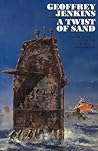
A Twist of Sand: a novel set in Namibia 65 years ago

A Twist of Sand

A Twist of Sand by Geoffrey Jenkins
My rating: 4 of 5 stars

I first read A twist of Sand about 60 years ago, before I ever went to Namibia, so because that is the setting, it played a big part in my preconceptions. It is set in the Skeleton Coast, the dry north-western part of Namibia, then known as South West Africa, and ruled by South Africa. The only other thing I had read about it was set in the same area, it was a piece in a children's encyclopedia about the wreck of the Dunedin Star on the same coast. When I saw a copy of the book in a second-hand bookshop, I thought it would be interesting to read it again, after having been in Namibia.

It is the story of the captain of a trawler operating out of Walvis Bay, Geoffrey Macdonald, who is asked by a man he takes an immediate dislike to, Dr Albert Stein, if he can charter his boat to take him up to the Skeleton Coast, an the vague pretext that he is searching for an unusual beetle.Because of his past criminal activity, we discover that Geoffrey Macdonald isn't even his real name.

A Twist of Sand was the first novel by Geoffrey Jenkins to be published, and when I read first read it, soon after publication, I enjoyed it, and thought it was quite good. I read a few of his later novels, and thought they were rather flat by comparison. On rereading it, I still enjoyed it, but became aware of things about it that I missed on the first reading. For one thing, the plot is as full of holes as a Swiss cheese. The protagonist is just as much an immoral criminal as the villain. That might not be a bad thing, in some ways, it makes the book perhaps more believable than those in which the good guys are too good and the bad guys too bad.

I first went to Namibia in 1969, just 10 years after the book was published, so the country would not have changed a great deal in that time. I got a job with the Department of Water Affairs, which took me to to most parts of the country within my first three months there. and I am pretty sure that in those three months I saw more of Namibia than most people who were born there saw in their life time. In the month I spent with Water Affairs (before being fired for suspect associations with the Anglican Church and the Christian Institute) I had been to Lüderitz in the south-west (including the Koichab Pan in the prohibited diamond area that Jenkins writes about); to Kamanjab in the northwest, and had driven down the dry beds of the Hoanib and Hoarusib Rivers, experienced a break-down in a Jeep in the Kaokoveld (the dreaded Skeleton Coast that Jenkins writes about); and gone to Rundu and Mukwe and camped on the banks for the Okavango River. On these journeys, which lasted for a week to 10 days, we camped out every night, and took a trunk of tinned food to eat on the way. Any tins left over at the end of the trip looked like rugby balls and had their labels rubbed off from bouncing over rough roads and tracks.  So I know that quite a lot of what Geoffrey Jenkins said about the country was inaccurate. 

At one point in the story he has his characters going up the dry bed of the Cunene River, but it is, in fact, one of the few perennial rivers in Namibia. All the perennial rivers in Namibia are on its borders -- the Kunene (Cunene if you're in Angola), the Okavango and the Orange. All the rivers wholly within the country are seasonal (my job at Water Affairs involved servicing instruments to measure the depth of the water in the rivers when they did flow). For any one interested, you can find more descriptions of journeys in some of the remoter areas of Namibia here.

I read some of the other reviews on GoodReads, and noted that some of the reviewers said that the book was "dated" because of the racism and sexism displayed by the characters. But at that time quite a lot of the white people in Namibia were racist or sexist or both, and that was perhaps one of the more accurate portrayals in the book. he, like The violence and criminality of the main characters in the story are perhaps exaggerated; if there were characters like that back then I didn't meet them, but the racism and sexism were not exaggerated. After I was sackedand she transformed the  from Water Affairs I worked for the time on the Windhoek Advertiser, and a South African journalist, Willie Lamprecht, came to work as the assistant editor. His wife Madeleine took over the women's page, and she was a feminist, though not one spoke of feminism back then, we said rather that she was into women's liberation, and she transformed the women's page from being full of cosy housekeeping tips into pointing out how women, including black women, were overworked and underpaid. This did not go down well with the establishment at the time, and Willie and Madeleine Lamprecht were sacked after a few months.

Jenkins contrives to give the impression that the Kaokoveld was virtually uninhabited, yet if anyone entered it without a permit the police would be on to them within 24 hours. In the desert areas along the coast it was largely uninhabited, but there were people living in most places though the population was sparse. And though the police were not quite as efficient as Jenkins suggests, they did nevertheless arrest people for being there without permits -- my wife's great-uncle, Frederick Alwyn Greene, served time in prison for being in that part of the world without a permit, and he, like the characters in the story, seems to have lived on the wrong side of the law for most of his life. 

In spite of its shortcomings, however, I still enjoyed the book on a second reading. It was a toss-up whether to give it 3 stars or 4, and in the end I thought it deserved 4.


View all my reviews

26 May 2021

The Quiet American

The Quiet American

The Quiet American by Graham Greene
My rating: 5 of 5 stars

I think this is one of Graham Greene's best books. I find Graham Greene a bit like Stephen Kind -- I like some of his books a lot, and others I don't like much at all. This is definitely one that I liked.

Thomas Fowler is a reporter for a British newspaper, reporting on the French colonial war in Vietnam when the Americans are just beginning to get involved. One of the new people at the American embassy, Pyle, tries to befriend Fowler, and falls in love with his girlfriend, Phuong, whom he steals, ever so politely. 

Fowler tries to be neutral in his reporting, and to remain uninvolved, but Pyle's role causes him to reexamine his approach, and but he is never sure whether his actions are due to Pyle's political role or his own jealousy. 

Perhaps one reason that the book appealed to me so much is that it reminded me of my time in Namibia in the early 1970s. Namibia was then in a colonial situation, under South African rule, as Vietnam had been under France 15 years earlier, and I was, like the protagonist in The Quiet American, a journalist. And something Greene wrote illuminated a difference that I was aware of, but fund difficult to describe.

In December 1971 there was a big strike of Ovambo contract workers in what was then known as South West Africa. One of the interesting differences in the approach to journalism came on the second day of the strike, Tuesday 14th December 1971. My friend David de Beer and I worked for the local Anglican Church, and I also worked on the local paper, and we were also stringers ("correspondents") for the Argus Africa News service, which supplied most of the South African evening newspapers. But the strike was big news, so some of the newspapers sent their own in-house reporters to cover it, and one of them was Alan Hardy of The Star of Johannesburg.

Pastor Maasdorp of the Lutheran Church had said that one of their evangelists had been arrested in the Ovambo compound, and that Pastor Haufiku was busy trying to bail him out. Alan Hardy immediately phoned Brigadier Brandt, the local police chief, who denied that there had been any arrests. Dave and I went out to see Pastor Haufiku to check up, and he confirmed it, and said he would take us to see the evangelist, Thomas Nalupi. And Thomas Nalupi showed us his admission of guilt receipt.

This ties up with an interesting passage in The Quiet American, where the protagonist, the journalist Thomas Fowler says:

It had been an article of my creed. The human condition being what it was, let them fight, let them love, let them murder, I would not be involved. My fellow journalists called themselves correspondents; I preferred the title of reporter. I wrote what I saw. I took no action—even an opinion is a kind of action.

Alan Hardy was a reporter, Dave de Beer and I were correspondents. And that describes the difference between us. To confirm a report that there had been arrests, the reporter asked the chief of police. That would never have occurred to us correspondents. For us the convincing evidence was the admission of guilt receipt.

There was more, perhaps. Alan Hardy was a bit older than us, but not by much. But he belonged to a different generation. We belonged to the 1968 generation. It had been, for both Dave and me, our last year as full-time students, and that was the year of student power, which had been immediately preceded by the year of flower power. But both hippie flower power and student power shared a distrust of authority. I had even developed a theological rationale for it. One of the slogans was "Don't trust anyone over 30," and I had just passed my 30th birthday, though I thought the least trustworthy age was between 40 and 60, when people were at the most powerful stages of their careers and were most likely to be embedded in and thus wedded to the System.

Of course the trouble with us was that we seldom adhered to the "audi alteram partem" rule, but then neither did the establishment reporters. They put the point of view of the establishment, businessmen, employers, government officials, whereas we reported what we heard from the underside -- the strikers and ordinary workers and those who ministered to them. And Graham Greene in this book illustrated the difference very clearly. 

And perhaps even more clearly he showed the shallowness and folly of much American foreign policy. Pyle, the eponymous "quiet American", was a fan or a particular (fictional) foreign policy wonk called York Harding. And at one point Dave de Beer met just such an American foreign policy wonk by the name of George Kennan, who struck Dave as incredibly naive. Kennan talked as though all he had to do was press some magic button in the depths of the Pentagon and all Namibia's problems would be instantly solved. 

I have sometimes wondered since then whether George Kennan was playing some devious game, and trying to appear more naive than he actually was, but since reading Graham Greene's book I wonder if he wasn't the model for York Harding.

View all my reviews

18 January 2021

Travelling in Tibet in the 1990s: colonialism and neocolonialism

Naked Spirits: A Journey Into Occupied Tibet

Naked Spirits: A Journey Into Occupied Tibet by Adrian Abbotts
My rating: 4 of 5 stars

I recently read Magic and Mystery in Tibet, written by a western visitor who illegally entered Tibet in the early 20th century. This book is about a couple of western visitors to Tibet 75 years later, when it was under Chinese occupation. And at the same time I was reading Orientalism, on how to deconstruct western views of "the Orient".

The earlier visitor, [author Alexandra David-Neel], had a couple of advantages. She could speak Tibetan, and she had also spent several years in Tibetan monasteries. And though she was an illegal immigrant, she was seeing a relatively independent Tibet, where Tibetans were free to be themselves. She was, nevertheless, also seeing Tibet through western eyes, and even, at one point, described herself as an Orientalist.

But the authors of Naked Spirits were tourists in the 1990s, when Tibet had been under Chinese rule for 40 years, and while foreign tourists could roam relatively freely in China proper, the Tibet Autonomous Region (TAR) was closed to all but expensive organised tour groups, who were kept isolated from the Tibetan people, and only allowed to see what their tour guides would allow them to see. Adrian Abbotts and his wife Maria therefore spent a great deal of time applying for permits to go to this or that place, and describe their dealings with Chinese officialdom and bureaucracy, and at that point it all seemed very familiar indeed. Tibet under Chinese rule reminded me of nothing so much as Namibia under South African rule, which I experienced from I went to Namibia in 1969 until I was deported from there in 1972.

The parallels between Chinese rule in Tibet and South African rule in Namibia were amazing, especially the attitudes and reactions of government officials to whom one applied for various permits and permissions to visit or travel through places. There were many parts of the book where I thought "Been there, done that." And Adrian Abbots and his wife evidently learned the lesson that we learned in Namibia: it is easier to ask for forgiveness than to ask for permission.

Also similar was the naked racism. The white South African rulers thought themselves superior to the native Namibians just as the Han Chinese rulers saw themselves as superior to the native Tibetans, and tried to make their language dominant.

There are differences too. In Namibia the South African rulers at least pretended to a kind of respect for local cultures, and encouraged them to "develop on their own lines" (the lines, of course, being lad down by the South African government). In Tibet there was no such pretence. Within Tibet all higher education was in Chinese and for Chinese. Tibetans who wanted higher education had to travel to China proper, and be immersed for several years in Han culture before they could return home, a policy that seemed more akin to that of Sheldon Jackson in Alaska than to the South African Department of Bantu Education.

So the book was particularly interesting to read in the light of the recent growth of Chinese economic activity in Africa, which looks suspiciously like neocolonialism. This includes the destruction of Namibian forest by Chinese logging, and, just over the border in Botswana, the threat of fracking in the Okavango Delta by a Canadian mining firm. It doesn't matter if the neocolonialism is Western or Eastern, there is little difference.


View all my reviews

01 January 2021

The Last Warrior: book & film review

The Last Warrior

The Last Warrior by Clair Huffaker
My rating: 4 of 5 stars

Fifty years ago I saw a film called The Last Warrior, which I now discover has been renamed to Flap. I enjoyed the film very much, so when I saw the book in a second-hand bookshop last month I had no hesitation in buying it.

In the film a hard-drinking, reckless-living Indian named Flapping Eagle decides that his people have been pushed around by the white man long enough. Mounting his horse H-Bomb, Flap proceeds to hijack a railroad, lasso a helicopter, and begin the Last Great Indian Uprising. His assaults on the Establishment provide an earnest indictment of Indian neglect by the U.S. government. And that pretty much summarises the plot of the book as well. If my memory has not faded too much over the last fifty years, the film stuck pretty closely to the book

The story is both funny and sad, and well worth reading.

So much for the book review, but there is a deeper story behind why I had no hesitation in buying the book when I saw it. 

When I saw the film I was living in Windhoek, Namibia, and working at a local newspaper, the Windhoek Advertiser for money, and otherwise for the local Anglican Church whose bishop, Colin Winter had an American secretary named Marge Schmidt. Marge had seen the film in the USA, and insisted that I must see it, so we went together to see it.

And I could see why she insisted I must see it. The film is mainly set in an Indian Reservation near Phoenix, Arizona (where Marge Schmidt now lives) And almost every weekend I visited poor rural communities like those shown in the film -- the Ovitoto Reserve for Hereros to the north, Rehoboth for Basters in the south, and in between there were small camps for road and railway workers, which closely resembled the places in the film.

Ovitoto Reserve, north of Windhoek, 1971

 The time, 1971, was also a turning point for Namibia. The World Court had just declared South Africa's rule over Namibia illegitimate. The Lutheran Churches, who scarcely ever criticised the government, circulated an open letter declaring, in effect that South African rule of Namibia was misrule. And The Last Warrior was showing at a local cinema, which showed an analogous situation in the USA.

The effect on the cinema audience was profound. 

In those days cinema audiences in central Windhoek were all white. And at the end of this film there was dead silence. People left in hushed silence. Usially people chatted with each other when leaving, about the film they had just seen or something else. They would greet people they knew. Some would laugh, some would call to others. But this time there was none of that. It seemed that no one missed the message of the film. It was not far away in the USA. It was here, and now. 

I have never seen a cinema audience behave like that before or since. And that is why I think the film was worth seeing, and the book worth reading.

View all my reviews

21 June 2011

Namibian turning point - forty years ago today

Forty years ago today the World Court announced its judgement that South Africa's rule of Namibia was illegal. It happened, most appropriately, on the Winter Solstice. Until then the nights had been longer than the days and getting longer. But thereafter, though the nights were still longer than the days, they were getting shorter.

It was to be another nineteen long years before the last South African troops crossed the southern border, and Namibia heaved a collective sigh of relief.

The longest night was still the longest night, but for the first time it gave real hope, hope that the dawn was getting ever closer. Nothing changed, yet everything had changed.

Here's what I wrote in my diary at the time, for what it's worth. Perhaps I should explain, by way of background, that I was at the time a self-supporting priest in the Anglican Church in Windhoek and worked at the Windhoek Advertiser as a proof reader, and that Deve de Beer (who also worked for the Anglican Church) and I were stringers for the Argus Africa News Service, which fed most of the evening newspapers in South Africa.

Monday 21 June 1971

I took Musrum up to Woodway to have its silencer fixed, and then Dave took me to work. I sent off stories to the Argus Africa News Service about the World Court verdict due to be given today. There was a surface calm, and apparent indifference, but people in high places appear to be worried. Die Suidwester had an editorial asking people to keep calm, and not to take hasty decisions, and Dirk
Mudge, the acting administrator, also made a plea for calm.

At lunch time I went to the court, and saw Chris Nicholson there. He said he had heard on the radio that the World Court had decided by 13 votes to 2 that South Africa had no right to be in South West, and thought it would be interesting to see who the 2 were. It would be a guide to the impartiality of the court. If they were British and French, it would show that national self-interest dominated the proceedings, rather than a real concern for justice.

We carried the story on the front page of the Advertiser, and Cowley wrote an editorial about Bantustan presidents or leaders going overseas to do a power of good to the homelands policy. Jimmy [Jimmy Simpson, the subesitor]was bitter about the World Court, and said it looked like his fishing would be over. When I asked him why, he said, "Well, with the United Nations taking over". I don't see why the United Nations will prohibit Jimmy from fishing, but he seemed convinced they will.

After work I went to the diocesan office and Dave was there; I went out to see Clemens Kapuuo, but was told he had gone to town, and on the way saw Johan Penderis walking back from rugby practice, and gave him a lift. I went out again later to try to find Clemens Kapuuo, calling at the diocesan office again. Abraham Hangula was there, and he asked what the verdict was and when I told him he beamed and shouted "Alleluia!" and then said "If the South African government leaves, then we can really preach the gospel."

I gave Dina a lift to Katutura, and ran out of petrol. I asked her what she thought about the World Court decision, and she said she didn't think. But she asked all sorts of questions, like what would South Africa do, what would happen if they pulled out, and would they really pull out. When I got to Clemens Kapuuo's shop there was a group of men standing outside, Mbuende among them. Mbuende introduced me to the others, who were Herero councillors from Aminuis. One of them burst out "We are so glad about the World Court decision that our country is ours", and there were great smiles all round. Mbuende said that Kapuuo was not at home, but had gone to Omaruru. I asked if any of the councillors was prepared to make a statement, but they all wanted to wait until Clemens came back.

I then asked him about a Mr Meroro, the chairman of Swapo, who had recently issued a press statement denying that he had said what the SABC had said he had said. Mbuende took me to see him - his shop was nearby - and he said he would not like to make any comment until he had spoken to his vice president in Walvis Bay. But he would say that he was very pleased with the decision. He seems quite a pleasant bloke - though
not a leader like Clemens Kapuuo. I took Mbuende back to the diocesan office to see the bishop, and arranged what was to happen about the Herero church conference, but the bishop and Dave had gone to see pastor Reeh. We spoke to Clive Whitford who said we could quote him as saying he was "overjoyed" by the World Court decision. He said I should attribute it to "a white professional man" and not to a "teacher", since he and Chris Roering were the only teachers (white) in town who could possibly make such a remark.

I took Mbuende back to Katutura, and started writing stories for the Argus Africa News Service, which we went to put in the telegram box at the post office, and returned to listen to Vorster's speech on the radio at 8:00, which was predictable enough. It was funny to hear a man who bends the law to suit his own purposes complaining that others were doing this. The fact that it was the British and French judges who dissented might lend credence to this, because it was their national self-interest that was at stake.

After the speech Meroro phoned, and said I should ring the acting president of Swapo at Walvis Bay, Nathaniel Mahuiriri, and he would give me a statement, and how he did. They seemed to be having a party at his house to celebrate the decision, and he asked loudly in Herero what they all thought of the judgement, and everyone clapped. He said he regarded the judgement of the World Court as the judgement of God, and that they did not hate whites, the whites must stay, but there must be no more
apartheid, no more homelands, only one homeland for all, one nation, one Namibia. He went on for half an hour, cataloguing his objections to the contract labour system, saying Vorster's speech on the radio was hypocritical, and when I asked him what he thought of Clemens Kapuuo, he said Swapo respected him as an honest man who spoke for his people; unlike Ushona Shiimi who was a stooge, a puppet, a tape recorder, who repeated what he was told to say.

That, I thought, was true, but nobody in their right mind could take Ushona Shiimi seriously, or think he spoke on behalf of anyone but the South African government. I have not met a single Ambo who does not think Ushona Shiimi is a big joke. After the call ended, I wrote out his statement, or the relevant bits of it, and Dave wrote a description of Windhoek at lunch time, and then we dumped those in the telegram box too, and then went off to have a drink at the Berg Hotel to celebrate, and went home to bed.

21 March 2010

Sharpeville and Namibia

Today is the 50th anniversary of the Sharpeville Massacre, and the 20th anniversary of Namibian independence.

Someone sent me a newsletter from the Anglican Diocese of Namibia, and here are some excerpts from it

Theological Education

To address the chronic shortage of clergy in the diocese, the diocese has put together a group of 53 candidates to prepare them for ordained ministry. All are registered with Theological Education by Extension College of Southern Africa (TEEC). 6 are registered for Diploma in Theology and Ministry, 6 of them are registered for junior certificate in Theology (called AWARD) and 41 are registered for Certificate of Competency in Theology. This group is under tutorship of The Rt Rev Petrus Hilukiluah, our retired Suffragan bishop, The Very Rev Jeremy Lucas, our Associate Dean and Rector of the Cathedral, and The Ven Lukas K. Katenda, Diocesan Secretary & Treasurer. Progress on this program is recorded for last year with many passed their exams and assignments above average. The assignments and exams are marked in South Africa. This year they are doing their second year and have been dispatched to various parishes for their practical lessons.

Because of the shortage of clergy in the Diocese, we now rely heavily on our retired clergy to run parishes. But age is age. We must make sure that we are not abusing our retired clergy who deserved a restful retirement after decades of service to the church and the community. We owe a big thank you to our retired bishops, The Rt. Rev Shihala Hamupembe who serves as the Director of St Mary's Center replacing Mrs. Canner Kalimba who retired. He first served as Chaplain to the High school during the first two years of his retirement. He is now looking up to the diocese to find a suitable replacement for him. The Rt. Rev Petrus Hilukiluah served as Diocesan Coordinator for HIV and AIDS and later Director of Theological Education Training Program for the Diocese.

Bishop Shihala has indicated that he would like only to act as Mission Director for St Mary's Mission Center. He is looking forward to his replacement, during this year. The Cathedral Chapter and the Diocesan Standing Committee appointed Mr. Josef Hanghome to become the new Director of St Mary's Mission. Doing his Certificate in Theology, he has been registered with University of Management doing Certificate in Administration and Secretarial course, as a preparation the daunting task of managing St Mary's Mission.

Please pray for this young man to be equipped with commitment, dedication and enthusiasm as well as the divine power to dwell on him. Another landmark appointment is that of Mr Lineekela Daniel, who also is doing his Certificate in Theology. Mr Daniel was appointed to become the Manager of Christ the King Conference and Training Center. The Center is in the dilapidating condition and Mr Daniel will make sure the renovations have taken place and maintenance is carried out on a regular basis. He will be supported by a staff of one clear and temporary cooks.

The report is compiled by the Ven Kaluwapa Lukas Katenda
Diocesan Secretary & Treasurer, 24 Februiary 2010
lkatenda@gmail.com

There was much more, and lots of pictures. One thing that shocked me about it was that the only names of people I recognised were those who are retired. Shihala Hamupembe, the retired bishop, I first met when he stayed overnight with us in Windhoek on the way to a youth leadership course in Mindolo, Zambia, and we had to keep his presence secret because the Security Police were looking for him and trying to prevent him from leaving the country -- something we knew from the chance overhearing of a conversation on a police radio in a police station. Later, after I had been deported from Namibia, he stayed with us in Durban while on vacation from the seminary he was attending, and we got him to put his youth leadership training to good use by taking our parish youth group on a camp in Zululand.

Another seminary student, Eradius Mwaetako, stayed with us in one of his vacations, and the report said that he too was retired.

It was also interesting to read that 53 Namibian students were enrolled with the TEE College. When I was in Namibia 40 years ago, I was trying to get Namibian students enrolled in Theological Education by Extension courses, but the only project for such a programme, started by the Christian Institute, went through about four directors in as many months, and seemed in imminent danger iof collapse. I talked to some friends, Rich Kraft in Zululand and John Aitchison in Pietermaritzburg, and we decided that if the Christian Institute could spend half a million Rand and not produce a theological course, we could produce a theological course and not spend half a million Rand. So we started on a shoe string, writing course material that was highly illegal, because John Aitchison was banned and later I was too. We called it the Khanya Theological Correspondence Course, and it later combined with two other schemes to form the Theological Education by Extension College (TEEC), and is it was good to see that 53 Namibian students have enrolled in it. I've told more of the story of theological education here: Tales from Dystopia III: Theological education in a totalitarian state: Khanya

One thing that struck me as curious about the report, though, is that Bishop Petrus Hilukiluah, whom I also met as a seminary student, seems to have added an h to his name, as has the diocesan bishop. I knew him as Petrus Hilukilua. Is the extra h a special honorific for Namibian bishops? In which case, why doesn't Shihala Hamupembe spell his name Hamupembeh? Just wondering.

15 December 2009

Death of an old friend

This morning, in an amazing coincidence, I mentioned an old friend in a blog post on another topic, on my other blog, and as I was writing the sentence that mentioned him my cell phone beeped with a message from him, letting me know that his wife had died. He was Hiskia Uanivi, whom I had known as a student at the Paulinum, the Lutheran theological seminary in Namibia, and this is what I had written Tales from Dystopia III: Theological education in a totalitarian state: Khanya:
Two of the students, in particular, became friends of ours. One was Zephania Kameeta, who later become bishop of the Lutheran Church, and a cabinet minister after Namibia became independent; the other was Hiskia Uanivi, who later fell out with Swapo and lived in Angola under the protection of the Angolan government, returning after independence.

Hiskia came with me and another friend on a tour of South Africa at the beginning of 1971, and was amazed to see that in South Africa the grass was so green yet the cattle were so thin. Hiskia was engaged to another student, Albertina Eises, and they were married on 30 October 1971.

I was deported from Namibia three months later, and so did not see them much in their married life. Hiskia completed his studies and became a pastor in the Lutheran Church, and later left Namibia, and worked for Swapo in exile. He fell out with the Swapo leadership, however, believing that they were collaborating with the South African government. He lived in Angola under the protection of the Angolan government, and returned just before Namibia became independent, as leader of a workers revolutionary party.

A couple of years ago Hiskia and his family were in Pretoria, and came to visit us. and we saw each other for the first time in more than 30 years. Their children and ours had grown up. It was good to see them again, and I was sorry our meeting could not have been longer. I'm sure Hiskia must have fascinating stories to tell about his adventures. And it would be interesting to to have heard what Albertina did in this time, but now I'll never hear it from her.

The picture shows Albertina, Dangi, Uetu and Hiskia Uanivi, when they visited us on 4 March 2007.

And today came the news that his beloved Albertina had died. May her memory be eternal!

06 August 2007

New SAMS Web page

Since August 2007 the Southern African Missiological Society has had a new web site at
http://missiological.org.za/

Please go there to see the latest news and information about SAMS. The material on the old site at http://www.geocities.com/missionalia/ will be retained to preserve links and search engine listings, but, with the exception of the AIC pages and material, it will no longer be updated.

In future I may use the old site to post more material specifically on African Independent Churches (AICs).

the next SAMS congress will be held on the campus of the North West University in Potchefstroom/Tlokwe from 23-25 January 2008. Since the Edinburgh 2010 organising committee has asked SAMS to take responsibility for the commission called "The development of Christian communities in contemporary contexts", the SAMS business meeting agreed to focus in the following two congresses on gathering and analysing stories of vibrant and sustainable Christian communities in Southern Africa. The theme for the 2008 SAMS was fixed as "Mission in humilty and hope: Stories of hope-giving Christian communites in Southern Africa." It was also agreed that hope-giving has alot to do with healing and reconciliation, so that a concerted effort will be made to gather stories of healing and reconciling communities.

07 October 2006

Truth, reconciliation and healing

I finally got the book, Namibia by Bishop Colin Winter, via Amazon. It seemed new, seemed new though I had paid $1.14 for it (postage and packing was about 10 times that).

I had not really known that the book existed at all until I saw it mentioned in the bibliography of Buys and Kritzinger's book on the history of the church in South West Africa - the Kritzinger in question being Dons. But the fact that they knew of Winter's book and cited it makes their playing down of the persecution of the church by the South African government between 1960 and 1990 inexcusable. Colin Winter did not mince words, he told exactly what went on, and Buys and Kritzinger diluted it and covered up the persecution.

The book is not in the Unisa library, perhaps because it was banned at the time it was published, but it is one that should be there now. Maybe someone had told me about the book, but it had not registered with me, perhaps because it was banned, and so I am reading it as something new and fresh 29 years after it was published -- and when I went to Namibia and met Bishop Colin Winter for the first time I was 28 years old, so that makes it feel rather strange to read it.

Of course Colin Winter's style makes it a frustrating book to use as a historical source. He is great at conveying atmosphere, and has many vivid descriptions, but the chronology is all over the place, and some incidents are conflated. It's written more like a gospel than anything else, with pericopes where you have to try and work out the sitz im leben.

That's one of the things that make it interesting.

I'm reading it a bit like the people who read the first written gospels, 30 years after the fact. I read about events that I witnessed at first hand, while Colin Winter writes about them by hearsay, what he heard from others. Many, of course, are things that he witnessed at first hand, and I heard about from him or others. And if I write my Namibian memoirs, perhaps they will differ from his book as much as, or more than, the gospels differ from each other.

The vivid descriptions, of course, are part of the fund-raising style. The Anglican Diocese of Namibia was always poor, always asking for help from overseas donors, and so much of the description is aimed at getting people in other places praying and paying. But it's not just that. Colin Winter had a genuine love of people, and that comes across in the book. He has harsh criticism for the political system of apartheid and its cruelty, but when it comes to individuals, one can see the Christian love of enemies. He rarely has anything bad to say about anyone.

Yesterday I went to a symposium at the University of South Africa on religion and reconciliation, to celebrate the 75th birthday of retired Anglican bishop Desmond Tutu. Much of it dealt with the Truth and Reconciliation Commission, which Bishop Tutu chaired.

Piet Meiring and Tinyiko Maluleke spoke about the role of faith communities in the Truth and Reconciliation Commission. The idea to have groups in the TRC hearings was a late innovation. It was originally intended only for individual perpetrators and victims. But it was the faityh communities that acknowledged their failures to oppose the partheid system. Other groups of civil society, such as business and the media, were only concerned to exonerate themselves.

The TRC did not really concern itself much with human rights abuses in Namibia. But given South Africa's involvement in Namibia up to 1990, they are closely linked.

And eventually, perhaps, the cover-ups and papering over the cracks in these two books will need to be confessed. Buys and Kritzinger play down the persecution, and try to pretend that it did not happen, and so events are disjointed and inexplicable. Winter makes no secret of the persecution, but fails to set it in its context, and at times it seems that it just happened, and no one was responsible.

Many people mentioned that the youth of today are not interested in that sort of thing. That is for the old people to sort out. But Bishop Desmond Tutu, addressed some of his remarks to the students watching from the galleries, and said we need to know where we have come from when we try to see where we should be going.

And having seen Namibia, I think the full story has yet to be told.

LinkWithin

Related Posts with Thumbnails