01 April 2026

The Day we met a Saint

Thirty years ago today we met a man I believe should be numbered among the Saints. 

On Monday 1 April 1996 I spent most of the day working at my job as an editor at the University of South Africa, editing a Science of Religion study guide. When I got home, Fr Nektarios Kellis phoned. 

He was a missionary priest in Madagascar, and said he was on his way back to Madagascar from
Zimbabwe, and was staying in a hotel near the airport waiting for his connecting flight which only left the next morning. The hotel he was staying in was in an industrial area, so there was nothing to do there. Going for a walk among dark empty factories closed for the night was not an appealing prospect, so he tried to phone someone just to talk to. He had my phone number as a contact, and so he phoned me.

I had never met Fr Nektarios, but I knew of him from a student of his whom I had met in Nairobi the previous year when I was doing research for my doctoral thesis on Orthodox mission methods. As part of my research I had interviewed Jean Christos Tsakanias, who came from Madagascar. 

He told me that the Orthodox Church there had been started by Greeks in 1953, and had been purely Greek. It had closed in 1972, when foreigners, including the priest, had been expelled after political disturbances on the island. It had remained closed until last year, when the Greek community made announcements in various periodicals, and an Australian priest, Archimandrite Kellis, had come to the
island, and began active mission right away. They were then under Bishop Chrysostomos of Zimbabwe, who had already ordained several local priests, and the Divine Liturgy was celebrated in the Malagasy
language. 

It sounded as though Father Nektarios had achieved an amazing amount in the 18 months he had been there. Jean Christos told me he would travel with Fr Nektarios down the east coast of Madagascar, and when he saw a village without a church he would stop, and ask the chief of that place if he could meet any people who might be interested in Orthodox Christianity. If the chief agreed, he would make a date to return and speak to the people, and if any were interested, would start a new parish there. In this way he started about 12 parishes within 18 months.

So when Fr Nektarios phoned on that Monday afternoon I didn't just want to alleviate his boredom by chatting on the phone, I wanted to meet him. My wife Val then worked in Klipfontein, which was halfway to Kempton Park, where the airport was, so she went to fetch Fr Nektarios from the hotel after work and brought him to our house in Kilner Park, Pretoria. I thought we could take him out to supper, so he could be with people instead of just sitting in a hotel room. 

We took him down to Johannesburg to show him the parish we then belonged to, the Church of St Nicholas of Japan in Brixton. Then we looked for a place to eat, but being Monday, all the restaurants were closed. 

We took him to see Fr Chrysostom, then our parish priest, and then took him back to his hotel at 11 pm. 

In the course of all this driving around Father Nektarios told us a bit of how he had got to Madagascar. He had been in Adelaide, South Australia, as chaplain to an old age home, and read an article in a publication from Greece about Madagascar, appealing for a priest there. It turned out later that the article was phony -- no one in Madagascar was appealing for a priest, just someone in the magazine office thought it would be a good idea.  But he thought God was calling him to Madagascar anyway, though he had a difficult job persuading his bishop, who was reluctant to lose a priest from his diocese. Eventually the bishop allowed him to go only because he saw that he would be resentful if forced to stay. 

Father Nektarios had been visiting Zimbabwe, where the Patriarch of Alexandria was blessing a monument to the first bishop, who had died in Bulawayo. While they were there the Metropolitan of
Zimbabwe, Archbishop Chrysostomos, had had a heart attack, and had only just come out of hospital, so Fr Nektarios had stayed until he was well enough to go home, and so only now was he returning to Madagascar. There were no direct flights from Harare to Madagascar, which was why he had had to come to Johannesburg and stay overnight. 

Fr Nektarios was very interested in mission and was keen to see mission happening in Mocambique and other places in the diocese. He thought we should go to Zambia, where there were several people who wanted to become Orthodox.

Well, that was thirty years ago, and a lot has happened since then. Madagascar was later made a diocese in its own right, and Fr Nektarios was elected as its first bishop. Sad to say, he was killed in a helicopter crash along with several other clergy, including the Pope and Patriarch of Alexandria, Petros VII, on 11 September 2004.

May their memory be eternal!


29 January 2026

Mistborn: The Final Empire -- book review

Mistborn: The Final Empire (Mistborn, #1)

Mistborn: The Final Empire by Brandon Sanderson
My rating: 3 of 5 stars

I think a couple of people recommended this book, probably at one of the literary coffee klatsches were had before Covid put an end to them. it is somewhat reminiscent of A Game of Thrones in that it deals with political rivalries and conspiracies, But whereas A Game of Thrones deals with rivalries between different kingdoms, in this one the rivalry is between aristocratic families in the same empire.

In The Final Empire there is also a clear class division between the privileged nobles and the oppressed underclass. In that respect it seemed to be a kind of parable of the old Rhodesia, with a great contrast between the privileged nobles and the oppressed underclass, the skaa.

I didn't like it as much as A Game of Thrones, and it was only after about 500 pages (of 643) that I began to feel sympathy for any of the characters. Perhaps it was partly because I don't like the genre much -- books where the heroes have superpowers of some sort, which sets them apart from other people. In this case it it due to the ability of some people to consume and "burn" metal, with different kinds of metal enhancing different abilities. Those who could do this were called "Mistborn", and there are some whose abilities are limited to one metal only, who are called Mistings. In addition there are Obligators, who form a kind of bureaucratic class, and a group of enforcers, called Inquisitors, who also have special superpowers.

Those who like superheroes with superpowers will probably enjoy it more than I did. 

Oh, and, for what it's worth, you can click here to read my review of A Game of Thrones. And (spoiler alert) I gave up halfway through the second book. It was just too much. 

View all my reviews

10 January 2026

Abandoned books

There are many reasons one might abandon a book before finishing it. When I do, it is usually because I find it boring, or because I have a lot to do and after a few busy days or weeks have lost the urge to read it. But here is a book that put me off before I reached the end of the first page.

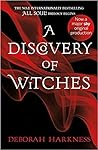
A Discovery of Witches (All Souls Trilogy, #1)A Discovery of Witches by Deborah Harkness


I'm not going to rate it, because I haven't read it.

I don't usually write reviews for books I haven't read, but I thought I would say why I don't think I'll finish this one, and in fact I didn't get further than the first page. There were two things on the first page that put me off.

"...the summer crush of visiting scholars was over and the madness of fall term had not yet begun."

The speaker, the first person protagonist, is apparently something like a visiting scholar, and is in the Bodleian Library at Oxford University in England. Oxford University does not have a "fall term"; it has a Michaelmas Term. Calling it a "fall term" tells me either that the supposed scholarship of the protagonist is phony, or the author has done a poor job of research for the book.

I suppose one could argue that the author is American, the character is American, and the envisaged (or should that be envisioned?) readers are American, so "fall term" would be understood by them all, whereas "Michaelmas term" might not be. But what would be wrong with "...the summer crush of visiting scholars was over and the madness of Michaelmas term (as the fall term is called at Oxford) had not yet begun." It makes the characters and the setting more authentic, and the readers learn something about the setting. 

And then the visiting scholar or whatever she is thanks the librarian for getting the books she had ordered, "flashing him a grateful smile". I'm not quite sure why, but that phrase put me off completely. It's the kind of language I associate with badly-written and poorly-edited self-published Y/A fantasy novels (for an example, see my review of The Enchanted Crossroads).

I found more examples of such usage in another such book I read recently, The Raven Moonstone, which had phrases like I tossed Jesse a questioning look and Jesse shot me a dopey grin

The thought of another nearly 700 pages of the same put me off. If it were 200 or even 250 pages I might persevere in the hope that it would improve, but this fat book is just too long. I read one Twilight book, and that was enough.

But perhaps if I post this here someone who has read it might tell me that my judgement is too hasty, and if I read on it might improve, and I might even enjoy it.

I read somewhere that Stephen King said that Fritz Leiber had written some good books, so when I found Ill Met in Lankhmar in the library I took it out and began to read it, but didn't finish it. Leiber may have written a good book, but this wasn't it.

But there are some bad books (or at least books that I have thought bad) that I've not only finished, but have actually read twice, mainly because I couldn't believe they were as bad as I thought them after the first reading. More on that here: On Reading Unbelievably Bad Books

LinkWithin

Related Posts with Thumbnails