Showing posts with label love. Show all posts

18 July 2020

Lockdown reading: The Brothers Karamazov

The Brothers KaramazovThe Brothers Karamazov by Fyodor Dostoyevsky

My rating: 5 of 5 stars


Having just finished reading it for the third time, I up my rating from four to five stars. It took me three readings to really appreciate this book. Perhaps in part that is because it is a long and complex book with many characters and incidents, and it took me three readings before I could hold them together enough to follow the thread of the story properly.

I began re-reading The Brothers Karamazov this time partly because I had recently finished Resurrection by Leo Tolstoy, and wanted to compare them, and partly because I wanted to check on Dostoevsky's alleged views on Christian socialists (which turned out to be very different from what was alleged). I have dealt with those points in a blog post here Notes from underground: Dostoevsky and Tolstoy on Orthodox Christian worship.

And now, having reached the end of The Brothers Karamazov. I can perhaps take the comparison further, because it now seems clear to me that Tolstoy probably wrote User:Denghu, CC BY 3.0, Link title="Resurrection by Leo Tolstoy">Resurrection as a reply to, and perhaps as an intended refutation of The Brothers Karamazov.

Tolstoy was clearly the "woke" Russian author of his time, with a passion for justice. So he embarks on a crusade against against the injustice of the Russian criminal justice system, probing its weaknesses -- the fallibili8ty of its judges and judgements, the cruelty of its prisons, and so on.

Dostoevsky does not do this. He just describes, and lets the reader decide.

Tolstoy writes about injustice, with a passion for justice. But Dostoevsky writes about love, and justice is congealed love.

The Brothers Karamazov is, on one level, a crime novel, a whodunit. It is also a courtroom drama. It is also a love story, where the eternal triangle becomes the infernal pentagon. But it is also a story of resurrection and love and and reconciliation. And this is what shines through the character of the youngest Karamazov brother, Alyosha, whose love and goodness leads others to love, who leads schoolchildren and members of his own family to the beginnings of forgiveness and reconciliation where there had previously been hatred and enmity.

Tolstoy gave his book the title Resurrection, but the story of the resurrection of a dog in Dostoevsky is far more impressive that the story of the "resurrection" of the protagonist in Tolstoy's story.I get the impression that Tolstoy would give his body to be burned, but had not love (I Cor 13:3)

I am grateful to all the Orthodox priests of my acquaintance who, ignoring the rubric that says some prayers should be said by the priest sotto voce, have said aloud the prayer from the Liturgy of St Basil that contains the phrase "Preserve the good in goodness and make the evil be good by Thy goodness", for that is the main message of The Brothers Karamazov.


View all my reviews

24 April 2010

Christian witness: God is love, and He hates you


What do you when street preachers appear proclaiming a message of hate?

Jackrabbit's response was to distribute "Love" signs among the audience.

Jackrabbit Goes Down the Rabbit Hole: Fear, Loathing, and "The Laramie Project": Jackrabbit vs. the Street Preacher:
By the time I got back, the hate preachers were in full force, and I suddenly went from wet-my-pants terrified to extremely determined, which was totally a God thing. I started by working the crowd with my big yellow signs, handing them out to anybody who wanted one, and then stood on the top of the amphitheater in the middle of the quad with a huge LOVE poster.


Isn't repentance important? Indeed it is, but I'm not sure that this is the best witness to the need for repentance:

... when a girl in a very short plaid skirt bent over to talk to her friends, he pulled out a camera and basically up-skirted her. He did all this while wearing a "no porn" button on his shirt. I found this very interesting for a man who claimed that he had stopped sinning the moment he accepted Jesus.

I think I prefer the examples of repentance of wicked politicians like John Profumo and Adriaan Vlok.

01 February 2009

St. Maximus Confessor and Christian Hospitality at The Land of Unlikeness

St. Maximus Confessor and Christian Hospitality at The Land of Unlikeness:
St. Maximus the Confessor (580-662 A.D.) understands the cosmos through a theological ontology of Love. All creatures in creation are unified through participation in the ecstatic Love that is the life of the Trinity. Participation in this Love unifies the difference of creatures into a harmony. As such this love is the “reason” or “logos” of creatures. With the fall of humanity this love is disrupted cosmically. The fall of humanity is key in this “cosmic tragedy” for humanity is the microcosm (micros-kosmos or “little cosmos”), which participates in the sensuous creaturely dimension of being and the rational-spiritual dimension of the hierarchy of being. Humanity, the microcosm, is the center or crux of the hierarchy of being as it co-inheres in the second person of the Trinity, the Logos. It is the crossing of the divine and the sensuous dimensions of the hierarchy of being. Consequently, when humanity falls the harmony of creation is disrupted.

This interesting article not only illuminates the practice of Christian hospitality, but also the Orthodox understanding of original sin, and how it differs from that of the West.

12 February 2007

What is this thing called Love?

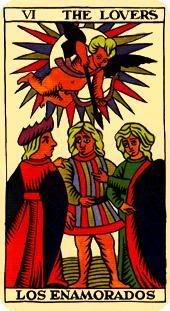
Photobucket - Video and Image HostingThe Tarot card originally called "Love", later "The Lovers" originally showed a man and a woman with Cupid aiming an arrow at them. Later a third figure was added, so that there were two women, one beautiful, the other ugly. Some saw them as allegorised into vice and virtue.

In a recent post on this blog (Fr Alexander Schmemann in Russia), I mentioned Father Alexander Schmemann's theological writings. One of the things he wrote about was marriage as the sacrament of love. Human love is the reflection of God's love, and it is through the experience of human love that we can relate to God's love. Schemann notes that many people sentimentalise marriage, and make the mistake of thinking that the "content" of the sacrament is "family", and so miss the main point; that it is love. One of the problems in the world today is that some people have idolised the family.

Nevertheless, family is important. A book that illustrates this is John Bowlby's Child care and the growth of love, which demonstrates that children who do not experience loving relationships with parents, especially their mothers, in the first six months of life, find it far more difficult to form loving relations with other people in later life.

By our own behaviour, we often create this problem. Though wars, we make children orphans. Through systems like migrant labour coupled with influx control, which prevailed in South Africa for many years, children are effrectively deprived of parental love. They are more likely to become juvenile delinquents, child soldiers, adult criminals and abusive spouses and parents. In such a way the sins of the fathers are visited on the children, even to the third and fourth generation.

Schmemann points out that in Christian marriage, husband and wife become king and queen to each other. There is a small kingdom, a reflection of the heavenly kingdom. The possibility may be lost, perhaps in a single night, but it is nevertheless there. And he gives a moving description of a couple of old people sitting holding hands on a park bench, all battles past, all passion spent, but still an image of love.

St John summed this up when he said, "herein is love, not that we loved God, but that he first loved us." In order to be able to give love, we first have to receive it, and even if we have received no human love, we can still receive the love of God, though of course it is much more difficult. But having received the love of God, we need to give love, in order to enable others to love. "Freely ye have received, freely give." Too often human love dies when people say that they no longer "feel" anything for each other. But love is more than an emotion or a feeling. We do not show love or give love by having loving "feelings" about other people. We show love and give love by loving actions, even contrary to our feelings.

To return to the Tarot card: Cupid's arrow may strike, and we may have overpowering feelings of love towards another person. If we are lucky, they will be reciprocated. But that is not enough to lead to the couple Father Alexander Schemann saw sitting on the park bench in the evening of the day, in the evening of their lives. That takes more than just those first feelings.

In a beat generation novel by John Clellon Holmes, Go one of the characters, Stofsky, has a dream of meeting God, and God tells him "Go, and love without the help of anything on earth". And that is surely the only thing that can turn back the tide of hatred that threatens to engulf the world.

List of synchronised blogs on the topic of Love -- visit them!

LinkWithin

Related Posts with Thumbnails