17 July 2026

Amis and Son -- a literary biography

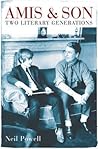
Amis And Son: Two Literary Generations

Amis And Son: Two Literary Generations by Neil Powell
My rating: 4 of 5 stars

I have known the names Kingsley and Martin Amis for years, decades even, but have never read any of their books. I have a science fiction anthology edited by Kingsley Amis, and started to read, but did not finish, The Information by Martin Amis, so why would I want to read a literary biography of both of them?

One reason is that I have often enjoyed literary biographies more than I've enjoyed the works of the authors themselves, and because I have heard so much about them over the years I thought I might learn something about how they fitted in to the 20th-century literary scene. I thought if I read more about their books and how they came to write them, I might find one or two that I might enjoy reading.

I found the biography interesting, but rather confusing in parts. Neil Powell deals with Kingsley Amis, but then when he starts telling the story of his son Martin he goes back to earlier periods of Kingsley's life, so the story is rather fragmented. He also looks for autobiographical hints in the characters in the books of both of them, and so sometimes it is difficult to keep track -- is this person mentioned someone they had met, or was it merely a character in one of their books?

Neither father nor son seem to be particularly attractive characters, or the kind of people I would like to hang out with, though I did feel that at times Powell's criticism of Martin Amis and his works was rather harsh.

At certain points, however, I did find the book very interesting, but this is more because of a particular interest of mine, and so might not be of the same interest to other readers. For a long time I have been interested in the Beat Generation, and I have a book, Protest: The Beat Generation and the Angry Young Men, which has an excerpt from Kingsley Amis, and is probably where I first heard his name. Powell gives the background to that book, and Kingsley Amis's contribution to it.

Powell's biography throws more light on this. It seems that in the US the British authors referred to as the "Angry Young Men" were regarded as similar to the Beat Generation authors in the US, hence their inclusion in the anthology.  That puzzled me back in the 1960s and it appears to have puzzled Kingsley Amis too. I recalled a a small informal gathering in Pietermaritzburg in 1965, of members of the small and persecuted Liberal Party. Some of us (then) younger members of the party were invited to meet Margaret Ballinger, the grand dame of the Liberal Party, and the only one ever to have been elected to parliament (by black voters). She asked me about the difference between beatniks and ducktails, which I tried to explain to her: that the ducktails' outlook was "we want it all, and we want it now". They shared the values of straight society, but didn't have the possessions and prestige that were valued. The Beats, on the other hand questioned the values of mainstream society.

Mods in the 1960s
The UK equivalent of Ducktails were the group of youth known as Rockers, who rode big powerful motorbikes and wore leather biker gear. There were reports in newspapers of pitched battles at British seaside resorts between Rockers and Mods. The Mods rode small underpowered motor scooters decorated with bling, numerous rearview mirrors and the like. Kingley Amis was a Mod. He was neither a Rocker nor a Beat. I didn't try to explain to Margaret Ballinger the difference between Beats and beatniks -- that the Beats were the genuine article, while the beatniks were the groupies and hangers on, in orbit around the Beats as sputnik was in orbit around the earth. 

The Angry Young Men were more akin to the Mods, Kingsley Amis certainly was. But Jack Kerouac, one of the better-known Beat Generation authors, was born in 1922, as was Kingsley Amis, though their literary schools were not the same. 

Another literary link that interested me was to an earlier generation -- the Oxford Inklings, who interest me even more than the Beat Generation.   Among Kingsley Amis's lecturers at Oxford were two of the Inklings, C.S. Lewis and J.R.R. Tolkien. Powell notes that:

When Kingsley Amis went to teach in the English department at Swansea University College, "Because he had experienced, or endured such widely varying standards of lecturing at Oxford, he was determined to emulate the best rather than the worst of them: his own style owed much to that of C.S. Lewis, from whom he had borrowed the useful trick of reading out important but hard-to-find quotations at dictation speed."
Lecturers, Kingsley later suggested,
could be divided into the hard and the soft, like policemen. The former imparted the necessary, if barely intelligible information which was likely "to appear in the relevant parts of the final examination"; the latter, more enjoyably but less usefully, offered "civilised discourse with perhaps some critical interpretation and ideas about the past"... Tolkien was, clearly, granite-hard; while the best of the soft -- indeed, "the best lecturer, in more than one sense, that I have ever heard" -- was C.S. Lewis.
View all my reviews

06 July 2026

God, the gods, and Nephilim

Reading Canto XXXI of Dante's Inferno I was struck by Dorothy Sayers's note on the Giants:

But allegorically, what do they signify? In one sense they are images of Pride; the Giants who rebelled against Jove typify the pride of Satan who rebelled against God. But they may also, I think, be taken as the images of the blind forces which remain in the soul, and in society, when 'the general bond of love' is dissolved and 'the good of the intellect' wholly withdrawn. and when nothing remains but blocks of primitive mass-emotion fit to be the 'executives of Mars' and the tools of treachery. Nimrod is a braggart stupidity; Ephthialtes, a senseless rage; Antaeus, a brainless vanity: one may call them the doom of nonsense, violence and triviality, overtaking a civilization in which the whole natural order is abrogated.

Nimrod is a braggart stupidity; Ephthialtes, a senseless rage; Antaeus, a brainless vanity: and Donald Trump is all three.

Nimrod, a mighty hunter
And perhaps that is why, in reading social media, I get a sense of an upsurge of interest in the Nephilim. There seem to be numerous podcasts about them. Podcasts are not my favourite medium, so I've only listened to one or two, but I've noticed the theme in many more. And, since Dorothy Sayers's translation of Dante was first published in 1949, a word has appeared to typify "the blind forces which remain in the soul, and in society" -- egregores. C.S. Lewis, in his book That Hideous Strength calls them macrobes.

And indeed it seems that "nothing remains but blocks of primitive mass-emotion fit to be the 'executives of Mars'" -- genocide in Gaza, war between Russia and Ukraine, US attacks on Venezuela and Iran, Israeli attacks on Lebanon and Iran, the governments of Germany, France and the UK increasing their military spending, and saying there is no money for health care. There is always enough money when they want to kill people and break things, never enough when you want to heal people and build things. The executives of Mars seem to be more powerful and influential than ever. 


LinkWithin

Related Posts with Thumbnails