21 April 2010

Who is Glenn Beck?


I'd never heard of Glenn Beck until I began reading about him in blog posts by other people who had never heard of him until they read about him in e-mails or blog posts from other people who may have heard of him. But from what I've heard, he had been preaching a new gospel about some kind of false Christ.

Jim Forest, in the Netherlands, writes On Pilgrimage: Thank you, Glenn Beck:
I live a sheltered life, that is to say I watch very little TV. Until yesterday I had never heard of Glenn Beck. But when a friend in Kentucky sent me an e-mail asking if I was aware that Dorothy Day had been mentioned on Glenn Beck’s weekly TV show, I got curious. Via YouTube, I quickly discovered that Glenn Beck is more than willing to accuse anyone he doesn’t agree with of being a socialist, a communist, a marxist or a nazi, or even all four.


And Matt Stone, from Australia, writes Glenn Beck and Social Justice - Glocal Christianity:
Glenn Beck, an American radio and television host that I'd never heard of till this week, has set off a firestorm of web commentary after denouncing social justice as a 'perversion of the gospel'. Well, what do I say to that? I'm lost for words.


It seems that Glenn Beck has mentioned Dorothy Day as a Marxist and someone Marxists knew, but whom he had never heard of. I suspect, however, that more Christians have heard of Dorothy Day than have ever heard of Glenn Beck. Glenn Beck also mentioned a book about Dorothy Day, which happens to have been written by Jim Forest, and that was why someone tipped Jim Forest off about the existence of Glenn Beck, hence his blog post. So it seems a suitable opportunity to mention the book and put it on my "to read" list: Love Is the Measure: A Biography of Dorothy Day Love Is the Measure: A Biography of Dorothy Day by Jim Forest

Jim Forest is an Orthodox Christian, and bosser-up of the Orthodox Peace Fellowship. Dorothy Day was an American Roman Catholic who cared for the poor and homeless, and along with Peter Maurin and Amon Hennessy founded the Catholic Worker movement and developed the philosophy of Communitarianism, which is similar to that expounded in the UK by G.K. Chesterton and Hillaire Belloc. So I'm sure Jim Forest's biography of her is well worth reading.

19 April 2010

Surveillance society

Big Brother's tentacles are stretching deeper into people's homes as webcams in school pupils' laptop computers send bedroom pictures back to the school authorities.

Lawyer: Laptops took thousands of images | Philadelphia Inquirer | 04/15/2010:
The system that Lower Merion school officials used to track lost and stolen laptops wound up secretly capturing thousands of images, including photographs of students in their homes, Web sites they visited, and excerpts of their online chats, says a new motion filed in a suit against the district.


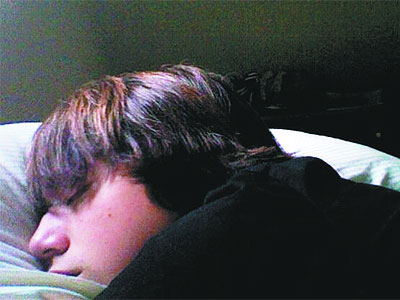
The complaint is about a picture of a pupil sleeping, but what else might they be watching? Voyeurs could watch pupils dressing and undressing, and more.


This photo, allegedly taken surreptitiously by the Lower Merion School District through a laptop web camera, shows Blake Robbins sleeping at home at 5 p.m. on Oct 26. (Photo provided by the Robbins family)
More than once, the motion asserts, the camera on Robbins' school-issued laptop took photos of Robbins as he slept in his bed. Each time, it fired the images off to network servers at the school district.

Back at district offices, the Robbins motion says, employees with access to the images marveled at the tracking software. It was like a window into "a little LMSD soap opera," a staffer is quoted as saying in an e-mail to Carol Cafiero, the administrator running the program.

"I know, I love it," she is quoted as having replied.

16 April 2010

Volcano eruption likely to disrupt 2012 Olympic Games

If you think the disruption to transport caused by Icelandic volcanic ash in the northern British Isles this week was bad, that is nothing compared to the volcanic eruptions that are predicted to disrupt the 2012 Olympic Games in London.

A likely scenario?

About as likely is this:

Daily Star: Simply The Best 7 Days A Week :: News :: World Cup South Africa 2010: Quake Fears:
WAYNE Rooney could be shaking in his boots at the World Cup – because of fears of an earthquake.

An expert has predicted the country is almost certain to be hit by a major natural disaster.


And it could strike during this summer’s footie tournament.


Dr Chris Hartnady has singled out Durban and Cape Town as the areas most likely to be hit by a quake.


As one commentator put it, the Brit media just jumped the shark.

13 April 2010

Two gardens

We're interested in family history and last week we went to the Mormon Family History Centre in Johannesburg to do some research in their library (details of what we found are on our family history blog).

One of the things I always enjoy when visiting there is the walk from the car park to the reading room, through a garden filled with ponts and shady trees. The ponds have goldfish in them, and it is a pleasant peaceful place, and it's cool shade is especially good in summer.

And then on alternate Sundays we go to church in Mamelodi, where we have services in a classroom at the Zakhele Primary Schooll. Outside is a vegetable garden, where the kids learn about botany and agriculture, and last Sunday it seemed in particularly good condition. It seemed to say something about the quality of the teachers and the diligence of the learners, and gives one hope for the future of education. This picture was taken from the window of the classroom where we had just held our service.


So there are two gardens, one ornamental, and the other practical and educational.

Fascist digital technology in "The Priest" movie

It seems there has been quite a spectacular anachronism in the film The Priest

Interfax-Religion:
Fascist digital technologies in The Priest movie


Scene from The Priest film about the WWII.
Look at German soldier's camera.
In the evening, he will go to his barrack with an Internet access terminal, post it on his page in the German Classmates and write to Fuhrer in Twitter…

11 April 2010

Politics is getting interesting again, thanks to two fascist clowns

Easter week of 2010 will be remembered as the week when politics in South Africa became interesting again, thanks to two political clowns and the media.

On the left, Eugene Terre'blanche (known as ET), former leader of the AWB (Afrikanner Resistance Movement), and on the right, Julius Malema, leader of the ANC Youth League.

ET made headlines by the manner of his death, and the rumours that circulated around it, and his political buffoonery lay in the past, though his funeral was a circus, if media accounts are to be believed, and some of his supporters appear to believe that Julius Malema's racist rhetoric at least contributed to his death, if it was not directly responsible for it.

But, as the front page of City Press shows, they were actually birds of a feather, both dedicated to overblown fascist and racist rhetoric. But a nation divided? I doubt it. Both these demagogues appealed to small but vocal minorities, and they have been boosted by much media attention.

For ten years or more, politics has been excessively boring. Endless stories of graft and corruption, and fat cats jockeying for position. In the apartheid days we were largely protected from such stories because the press was kept on a tight leash by the National Party regime. The best one could say about the corruption stories was that they showed we now have a free press.

But the antics of ET and Malema and their supporters provide entertainment, and the media are determined to give it to us. Not all of the jounalism is responsible, though. One can expect sensationalism from tabloids like The Sun, but even "responsible" papers like the Sunday Independent could not resist a sensation-mongerring headline like

Was ET gay and bonking darkies?


based on the rumour that a used condom had been found in the room where ET was murdered. The police had categorically denied that a condom had been found, but the Sunday Independent was not about to let the facts get in the way of a good story. They did include the police denial -- in small print, right at the bottom. So the antics of the media are almost as entertaining as those of the protagonists.

But it also reaches the point where it goes beyond a joke.

The last straw was when Julius Malema kicked a BBC journalist, Jason Fisher, out of a press conference, claiming he had been insulted.

Malema apparently castigated the Movement for Democratic Change, the Zimbabwean opposition group, for speaking from their air-conditioned offices in Sandton. And Fisher pointed out that Malema himself lived in Sandton, and Malema blew his top.

Any politician in a democratic society with a sense of proportion would probably have grinned, said "Touché!" or something similar, and moved on.

The fact that Malema perceived that as an insult and lost his cool over it and kicked the journalist out speaks volumes. It doesn't matter what Malema said. The words he used are not important. It his actions that show that he is a fascist, with no sense of democracy, and no sense of proportion.

As another journalist in City Press, Xolela Mangcu, put it, "Il Duce step aside: a fascist fire rages in Malema."

If Malema had any political nous at all he would see that as an insult, and an insult far worse than saying that he lived in Sandton.

As Mangcu says of this incident

Perhaps a little world history could be helpful in opening our eyes to what Malema's reaction could mean for our young democracy and people.

The historical figure I have in mind is Italy's fascist leader, Benito Mussolini. On the eve of Mussolini's reign as prime minister a critic asked him about his party's political programme. Mussolini mocked the critic thus: "The democrats of Il Mondo want to know our programme? It is to break the bones of the democrats of Il Mondo, and the sooner the better."

Mussolini concluded his tirade thus: "The fist is the synthesis of our theory."

And that statement is a pretty good summary of the political programme and philosophy of ZANU-PF in Zimbabwe, which Malema has just visited, and spoken admiringly of ZANU-PF.

This, is of course, an embarrassment to the leadership of the ANC, which is trying to portray itself as a neutral honest broker between ZANU-PF and the MDC, an image which Malema's blatant partisanship has shattered. His outburst to the BBC journalist has shown his true colours. It bodes ill for our democracy if his political career goes any further. Xolela Mangcu is hopeful that it won't

Could Malema be the face of the replacement of politics with violence? I doubt it. Malema will ultimately trip on his own words. Besides, South Africa is too complex and differentiated to fall under the rule of one Il Duce.

I hope he's right.

But if anyone is getting cold feet about coming to South Africa for the World Cup for fear of a bloodbath, don't worry about it. Julius Malema is unlikely to become president this year, or next year, or any time for the next nine years. And a lot can happen in nine years. South Africa has plenty of precedents of politicians who appeared to have a meteoric rise, and had a sputtering fall. Tielman Roos, for example. Anyone remember him? With any luck, Julius Malema will go the same way.

10 April 2010

Zimbabwe's Bishop Abel Muzorewa dies

BBC News - Zimbabwe's Bishop Abel Muzorewa dies:
One of the most prominent political figures in the turbulent years before the independence of Zimbabwe, Bishop Abel Muzorewa, has died, aged 85.

He was seen by many as a moderate black leader at a time of extreme political change. But black militants saw him as a puppet of white politicians.

Bishop Muzorewa entered politics in the 1970s when nationalist politicians were either imprisoned or in exile.

After Zimbabwe's independence, Bishop Abel Muzorewa was virtually forgotten by the outside world, yet in the 1970s he played a similar role in Ian Smith's Rhodesia to that of Anglican Archbishop Desmond Tutu and Allan Boesak in South Africa in the 1980s.

In the 1970s most opposition leaders in Rhodesia were in jail or in exile, and Muzorewa's African National Council revived the internal opposition to the Smith regime in much the same way as the United Democratic Front (UDF) did in South Africa.

The difference was that towards the end of the 1970s Muzorewa allowed himself to be co-opted by the Smith regime, entering a coalition government. But today history is repeating itself as opposition leader Morgan Tsvangirai, of the Movement for Democratic Change, has similarly allowed himself to be coopted by the Mugabe regime.

07 April 2010

Mugabe, Malema and the future of South Africa

The death of Eugene Terre'blanche stole the news over the weekend and drew public attention away from something far more ominous for the future of South Africa -- Julius Malema's visit to Zimbabwe.


Mugabe, Malema on Terreblanche:
PRESIDENT Robert Mugabe and ANC Youth League president Julius Malema have discussed the murder of South African white supremacist leader Eugene Terreblanche during talks in Harare.

Mugabe met Malema -- who was concluding a four-day visit to the country as a guest of Zanu PF -- at State House for over two hours on Monday.

With reporters present, Mugabe spoke to Malema at length about Zimbabwe’s land reform programme and what he said was Britain’s failure to honour its obligations to white farmers whose properties were seized for resettlement.

Mugabe also praised South Africa as an unstinting ally against what he said was a global crusade by “imperialists” to remove his government through economic sabotage and propaganda.

Former President Thabo Mbeki was frequently criticised for taking a low profile on Zimbabwe, and refraining from public criticism of the fascist Mugabe regime.

Julius Malema has shown no such restraint, and has shown his true colours by praising the Mugabe regime. And this is a clear indication of one scenario for South Africa's future: Julius Malema becomes president (possibly succeeding Jacob Zuma), and then it's goodbye to our hard-won democracy. Perhaps in another 15 years time there will be South African refugees sleeping in the Methodist Church in Harare.

Look at what has happened.

Malema is welcomed in Zimbabwe, and praises the leadership of the Zanu-PF and Robert Mugabe. In South Africa he has attacked the trade unions and Cosatu, and just a few years ago, far from meeting Mugabe, a Cosatu delegation was turned away at the Zimbabwe border.

The white, Western and capitalist press has concentrated its criticism of the Mugabe regime on its "land reform" policies, which has entailed the seizure of land from white farmers, and its redistribution among relatives and supporters of high-ups in Zanu-PF.

But long before that, Mugabe attacked the trade unions, which was of less interest to the white, Western and capitalist press.

To understand this one must go back to the 1990s, when Mugabe sent Zimbabwean troops to intervene in civil wars in the Congo. In these foreign military adventures he resembles Tony Blair and George Bush, whom he professes to dislike. In reality, they are birds of a feather.

Foreign military adventures are expensive, and depleted Zimbabwe's foreign currency reserves. This in turn led to fuel shortages, which in turn led to an economic recession, particularly in the towns. Businesses were closed, workers were laid off, and the Zimbabwean trade unions were up in arms. Opposition to Mugabe's policies grew, and in a referendum some constitutional amendments that would, among other things, have made Mugabe president for life, were rejected by the electorate.

This was a wake-up call for Mugabe. If he could lose a referendum, he could also lose an election.

But instead of reversing the unpopular economic policies that had caused the problem, he exacerbated it by instituting his land redistribution scheme as an electoral ploy to buy the rural vote. If Mugabe were sincere about land reform, he had had 20 years to do something about it, and had done nothing. It was only the threat of losing an election that made him bring it in hastily, for the purpose of buying votes. And in the way it was implemented exacerbated the economic problems as Zimbabwe's agricultural productivity plummeted. The foreign exchange problems worsened as tobacco, the main export crop, virtually disappeared. In a couple of years Zimbabwe went from being the bread basket of central Africa to basket case, as hyperinflation took hold.

The opposition grew stronger and reorganised, and coalesced around the trade unions, to form the Movement for Democratic Change (MDC). And they have a natural affinity for Cosatu in South Africa, which is why the Cosatu delegation was turned away at the Zimbabwe border.

But who is Malema talking to?

News - Politics: Malema upsets MDC:
ANC Youth League president Julius Malema has upset the Zimbabwean political party, the Movement for Democratic Change, by meeting only Robert Mugabe's Zanu-PF on a visit to Harare.

'Is Mr Malema saying that the ANC does not respect democracy and is willing to ignore the millions of Zimbabweans who sent Zanu-PF packing in the corridors of power?' asked Austin Moyo, chairman of the MDC in South Africa, at a media briefing in Johannesburg on Thursday.

'Does Malema understand that there are millions of liberation heroes in the MDC?'

Moyo said Malema made it clear that he would be visiting the Zanu-PF because it was 'a revolutionary party'.

At the moment Cosatu is still allied to the ANC in the tripartite alliance, but if Malema should ever become president Cosatu will have the choice -- become a lapdog, or follow the Zimbabwe trade unions into the political wilderness, and form an equivalent of the MDC.

allAfrica.com: South Africa: Vavi to Tackle ANC Over Malema's 'Disdain':
CONGRESS of South African Trade Unions (Cosatu) general secretary Zwelinzima Vavi yesterday said the bilateral meeting with the African National Congress (ANC) next week would be an opportunity to deal with how the ANC's actions had threatened Cosatu's functionality within the tripartite alliance.

ANC Youth League (ANCYL) president Julius Malema's public mudslinging against Cosatu, the ANC's unilateral decision banning municipal workers from taking up leadership positions in political parties, and a 'general lack of commitment by the ANC to make the federation one of its political centres', had left the alliance in a crisis, Vavi said at the National Union of Metalworkers' National Bargaining Conference yesterday.

'The oppression and super- exploitation of workers remains widespread - despite government and union efforts.


What South Africa lacks, and probably needs, is a strong and coherent left opposition, preferably before a fascist takeover. Is Zwelinzima Vavi up to it? The tragedy of the assassination of Chris Hani continues to haunt us.

And perhaps Thabo Mbeki kept quiet because he saw how easily what was happening in Zimbabwe could happen in South Africa, and lead to the break-up of the tripartite alliance. He preferred the Ronald Reagan approach of "constructive engagement".

05 April 2010

Flowers in church

One of the problems of Western Easter and Orthodox Pascha coinciding, as they do this year and next year (it's quite rare for them to coincide two years running) is that flowers are virtually unobtainable.

It's also interesting how Western customs differ from Orthodox ones. Western Christians give up flowers for Lent, and go mad with them for Easter, as Cherie shows on her blog Cherie's Place: The Easter Cross:
As part of the Easter celebrations the local parish church always erects a wooden cross and adorns it with flowers. This is done by the congregation just before the Easter morning service. I think it is a lovely idea and the little children get involved with it too.


The Human Flower Project notes, however, that:
In contrast with Roman Catholic and most Protestant churches, the Eastern Orthodox sects do not shun flowers on Good Friday: lemon flowers in Crete, floral biers in New Jersey, daffodils in Bulgaria, and more.


And they even nicked a picture from my other blog, Khanya, showing the Epitaphios decorated with flowers.

The Epitaphios is the burial shroud of Christ, which is placed on a table in the middle of the church, decorated with flowers. St Nicholas parish in Johannesburg is perhaps somewhat unusual, in that we combine both Greek and Russian customs, so that there is more action in the services. On Holy Thursday morning the Last Supper is commemorated, and after the service members of the congregation decorate the Epitaphios table with flowers. Usually we use chrysanthemums, white and purple, which are cheap and plentiful, but this year, because of Western Easter, there were none to be had.

At the Thursday service there is Matins of Good Friday, sung the evening before by anticipation, interspersed with 12 gospel readings of the Passion. It is the longest of the Holy Week services, lasting nearly 4 hours. After the fifth gospel reading the cross is brought out from the altar. Then on Good Friday morning, we have Vespers, which is the taking down from the cross. The body is taken off the cross, and the Epitaphios is brought out and placed on the table. And at the evening service it is carried in procession around the church, and young girls act the part of the myrrh-bearing women and scatter flowers petals on it.

So for the Orthodox Good Friday is the most flowery day of the year.

04 April 2010

The death of ET and immaturity of our democracy

In today's Sunday Independent there is an interesting article by Mcebisi Ndletyana, which which he offers a defence of the song "Kill the Boer", which a high court judge recently declared was "hate speech".

Unfortunately I (or Google) could not find a version of Ndletyana's article on the web that I could link to, which is a pity, because it it worth reading for the historical background.

Ndletyana points out that the song is not racist in the sense of being anti-white, because the late Joe Slovo, who was white, used to sing it with great gusto. The song was not in my political repertoire, but I used to sing one that had similar references:

Mayibuye, mayibuye,
mayibuy' iAfrika
eyathathwa ngamaBhunu
sisasebumnyameni.

(Let Afrika return, which was taken by the Boers when we were still in darkness)

And, lest I be suspected of "Boerehaat", there was another verse that referred to "amaNgisi" (the English), in the same context.

But I nevertheless agree with the judge, and disagree with Mcebisi Ndletyana, in that I think that singing such songs now is an anachronism, and a sign of political immaturity. But maturity never was the strong point of the likes of Julius Malema.

Back in the bad old days of apartheid "amaBhunu" referred, pretty clearly, to the National Party government, alias the Apartheid Regime. And such songs were directed at encouraging people in the struggle against a hated and oppressive regime.

There are some paranoid people who believe that there is a deliberate campaign of genocide against white farmers in South Africa. Singing such songs at political rallies now tends to fuel such paranoia, and some appear to believe that the recent murder of the notorious white supremacist Eugene Terreblance (ET) is further proof of the exiatence of such a conspiracy.

Malema's political idiocy also extends to attempting to hijack the Sharpeville massacre for the ANC, and to downplay the role of the PAC. His public utterances continually remind us that we no longer have people of the political stature of Robert Sobukwe with us.

The fact is that after 16 years of democracy, struggle songs like "Shoot the Boer" no longer mean what they once did.

But there are other, more serious indications of political immaturity.

That can be seen in the tendency to destroy buildings and damage property in protests over lack of "service delivery". Pretoria station was burnt down by angry commuters because trains were late. In another instance, Soshanguve commuters burnt trains because the trains were late, and then complained that there was no train service, when they themselves had destroyed the trains.

Back in the 1980s the apartheid regime erected the showpiece township of Ekangala, north of Bronkhorstspruit. Half of it was run by the KwaNdebele government, and half by the East Rand Administration Board, and which half one lived in made a big difference to one's right to live and work in urban areas. Residents burnt down the administration offices, which destroyed the records of who lived where. It was a direct attack on the system, and made political sense at the time, because the people concerned had no vote.

But now people do have a vote, and so it makes no sense to burn trains and public libraries and other public or private property. Local government elections are coming up, and if people are dissatisfied with service delivery, or with the performance of their municipal councillors, they now have a democratic remedy -- to organise people to vote them out. That is the way democracy works -- not by burning down libraries and stations.

Burning buildings and singing provocative songs made sense when there was a government did not have to listen because most of those it was oppressing had no vote. In fact part of the struggle was to ensure that everyone had the vote, and the political freedom to organise to toss self-serving politicians out. We've had that freedom for 16 years now, and it's time we began to use it.

31 March 2010

PamBG's Blog: Christian Economic Life - Post 1: Foundation

Pam BC has just started an interesting series of posts on Christianity and economics. I've read the first two, and it looks very promising indeed. PamBG's Blog: Christian Economic Life - Post 1: Foundation:
I'm going to try a thought-experiment here. I want to think about what an economy run on Christian principles might look like. And this is quite literally a 'thought experiment'. At the moment, I have no idea of what I intend to write in the future, but I want simply to think out loud, building on ideas step by step.

So here are some initial thoughts for a foundation:

1) Christian thinking on economics should begin with Christian and biblical principles, not with economic principles.

2) That being said, it seems to me that a good principle for a Christian thought experiment on our economic life would be: honor God and love your neighbor. (There are actually a number of principles that the bible expresses on economic life that a lot of us might not like; forbidding the giving or receiving of debt is one of these.)

3) As I think and write, I will try to separate 'What works' from 'What should be'. I will recognize that 'What should be' doesn't always work well. In separating the two principles, I intend to avoid what seems to me to be a usual problem in Christian economic thinking: 'That operational method doesn't work, therefore it is unjust'.
That is a very good start, and I recommend that people who are interested in the topic read the whole series.

If one is really going to discuss such things properly, however, blog comments are rather inadequate. It is the kind of thing worth discussing in the Christianity and society forum.


Subscribe to chris_soc


Powered by us.groups.yahoo.com


And you can see my take on it at Notes from underground: The Invisible Hand.

29 March 2010

Stop selling military aircraft to South Africa, Anglican archbishops urge

Thabo Makgoba, the Anglican Archbishop of Cape Town, and Desmond Tutu, his Nobel Peace Prize winning predecessor, have urged that Sweden stop selling military aircraft to South Africa.

In a move reminiscent of the days when he was vilified by the government-supporting press for proposing economic sanctions and an arms embargo against the apartheid regime, former Anglican Archbishop Desmond Tutu signed a document asking that Swedish Gripen miliary aircraft not be sold to South Africa.

"Stop the sell of military aircrafs to South Africa" - Stockholm News:
KG Hammar, former Swedish archbishop, Karin Wiborn, chairman of the Swedish Christian Council, Desmond Tutu and Thabo Makgoba, South African archbishops have signed the article. They claim that the deal has released a wave of corruption that threatens the transition from Apartheid to democracy in South Africa.

The authors write that the cost for South Africa’s deal with several European countries to buy military equipment is around SEK 42 billion (about 4.2 billion euro). Half of that sum is spent on JAS 39 Gripen. They write that it is hard to gain acceptance in the South African society for the fact that resources are being allocated to military investments instead of fighting the legacy from the Apartheid era.

The four authors demand that the South African and Swedish governments investigate the accusations about corruption and put the whole deal on hold until the investigation is finished.

28 March 2010

Julius Malema -- South Africa's answer to Shane Warne?

It seems that at last South Africa has a fat buffoon to match, and even surpass Australia's Shane Warne: Julius Malema, the president of the ANC Youth League.

The media love him; he gives them soundbites galore. Every time he opens his mouth he seems to put his foot in it. He seems as arrogant as Shane Warne, and like Warne, he is revered by many.

But, as someone once said, the trouble with most political jokes is that they get elected.

Professor Tinyiko Maluleke of Unisa warns that it would be a mistake to dismiss Malema as a lightweight political clown. If there is a joke involved, the joke is on us, and on the poor.

Tinyiko Sam Maluleke's Blog: The Julius Malema Strategy of Distraction and Diversion:
What Chumani Maxwele, the jogger arrested and detained for allegedly showing the middle finger to Zuma’s blue-light brigade, is said to have done, is done daily by Malemaists. They do it to the poor. In their arrogant press conferences, in VIP events for celebrities and through the fat parties they host in their tall houses, as they drink, chatter and clutter; they stick their middle finger to the poor. As they wheel and deal in the air-conditioned corridors of public and private sector offices, it is the poor they are offending. As their luxury ministerial cars speed through the squatter camps; as their 4x4s spray the playing children with the sewage that is flowing in the streets, the Malemaists are saying voetsek! to the poor.

27 March 2010

The Pope in Gauteng

Yesterday I had to take my son Simon to work in Johannesburg, and went to St Thomas's Church in Sunninghill where the Pope and Patriarch of Alexandria and all Africa was paying a visit. After a service in the church, the Patriarch had lunch with some of the parishioners.

One of the contrasts between Orthodoxy in America and Orthodoxy in South Africa is that in South Africa there is not the same ecclesiastical apartheid that one finds in America. St Thomas's is largely a Serbian parish. The parishioners are, for the most part, Serbian immigrants and their descendants, and they use the Serbian language in their services. But the Antimension on the Altar is signed by His Beatitude Theodoros, Pope and Patriarch of Alexandria and All Africa. People of all races and ethnic groups are welcome at St Thomas's, and one of the gifts presented to the Pope by Archimandrite Pantelejon was a picture drawn by his 7-year-old niece in Serbia, showing her uncle baptising black children in Johannesburg. Some of those who regularly attend St Thomas's are black South Africans from Klipfontein View, who used to belong to Tembisa, but find it easier to get to St Thomas's.

The picture shows Pope Theodoros II with Archimandrite Pantelejmon, the Rector of St Thomas's Church.


The Archbishop of Johannesburg and Pretoria, Metropolitan Seraphim, says that we should not refer to the "Greek Orthodox Church", but rather "The Orthodox Church of South Africa", or the "African Orthodox Church" because though there are Greek, Russian and Serbian parishes in the archdiocese, which maintain ethnic traditions and have services in those languages, the Orthodox Church is one church. So while the Patriarch visited St Thomas's, he was shown a classroom attached to the church hall, which is a Serbian School, and children are taught the Serbian language and history, and he approved of it. But in spite of the variety of ethnic groups and traditions, we are still one Orthodox Church, under one bishop and one Pope and Patriarch, and nobody asks the question, so common among Americans "What juridiction are you?" In South Africa, thank God, that question is meaningless.

Every year a different bishop from Serbia visits St Thomas's for their patronal feast in October, but the visiting bishops are always given a formal reception by Metropolitan Seraphim at the Metropolis as well, and Metropolitan Seraphim makes a point of atending at least part of the celebrations of the patronal feast (panigyri).

Among the guests at lunch yesterday were Father Daniel, the new priest of the Church of St Sergius of Radonezh in Midrand, and Fr Seraphim (in the world Matthew van Niekerk), the first South African to be tonsured as a monk in South Africa, who is at the moment caring for the Greek parish in Klerksdorp.


Fimi of the Patriarch of Alexandria: Tone 4

His Beatitude Theodoros
Most Divine and Most Holy
Our Father and Shepherd, Pope and Patriarch
Of the Great City of Alexandria
Of Libya, Pentapolis and Ethiopia
Of all the land of Egypt and All Africa
Father of fathers, Shepherd of shepherds
Bishop of bishops, thirteenth in line of the Apostles
And Judge of the Universe, Many Years!

25 March 2010

Purging my blogroll

Every couple of months I go through my blogrolls and delete the links to blogs that no longer exist, or no longer interest me, or no longer allow me to read them. There have been quite a lot of those this month, either deleted by the authors, or open to invited readers only (and I wasn't invited).

My Emerging Faith, Convergence, The Lifegiver, Confessions of a seminarian and All Hallows Eve are among those that either no longer exist or are no longer accessible. Smulospace is perpetually "down for maintenance", which amounts to the same thing. Red Star Coven and Skyldings in the mead hall have announced that they will no longer be updated, but at least they are still available.

LinkWithin

Related Posts with Thumbnails