Showing posts with label economics. Show all posts

11 February 2020

Modern Paganism, Secularism and Syncretism

American Christians who support Donald Trump have warned of the danger of modern paganism, American Paganism | Commonweal Magazine:
... pro-Trump Christians have emphasized a new reason to be afraid. The United States, they say, is devolving into such wanton “paganism” that the country may not survive. The true America awaits rescue by the Christian faithful, and in such an existential struggle, nearly any means are justified—even reelecting a morally abhorrent president. Examples of this rhetoric are not in short supply, among pundits and even in more scholarly work. In an essay praising Donald Trump’s “animal instinct” for “order” and “social cohesion,” Sohrab Ahmari opposed an America of “traditional Christianity” to one of “libertine ways and paganized ideology.” These are our only choices, he insisted. Between such incompatible enemies, there can be only “war and enmity,” so true believers should be ready to sacrifice civility in the battles ahead to reconquer the public square. Rod Dreher has speculated that Trump, while unpalatable, could be a divine emissary holding back the horrors of Christian persecution, like the biblical figure of He Who Delays the Antichrist, an implicit nod to old pagan enemies. “If Christians like me vote for Trump in 2020,” Dreher warns, “it is only because of his role as katechon in restraining what is far worse.” Though in a calmer tone, Ross Douthat entertained similar ideas in his column “The Return of Paganism,” wondering if the pantheist tendencies in American civil religion could morph into a neo-paganism hostile to Christian faith.
But this article suggests that they are looking for the danger of modern paganism in all the wrong places, and seeks to show where the real danger lies. The article is written from a Roman Catholic point of view, but there is little in it that I, as an Orthodox Christian, can disagree with, and it deserves a careful reading by all Christians.

Bur before going any further, some clarification of terms may be needed, and especially the terms paganism, secularism. and syncretism. David Albertson does this to some extent in the article, but not really enough.

Paganism is Christian slang for anything not Christian. As the historian Robin Lane Fox puts it in his book Pagans and Christians,
In antiquity, pagans already owed a debt to Christians. Christians first gave them their name, pagani... In everyday use, it meant either a civilian or a rustic. Since the sixteenth century the origin of the early Christians' usage has been disputed, but of the two meanings, the former is the likelier. Pagani were civilians who had not enlisted through baptism as soldiers of Christ against the powers of Satan. By its word for non-believers, Christian slang bore witness to the heavenly battle which coloured Christians' view of life.
Since the middle of the 20th century there have been various groups who call themselves Pagans, and are sometimes called Neopagans, who have sought to revive pre-Christian religions in predominantly Christian or post-Christians societies. Albertson's article is not referring to such groups, and Eliot almost certainly wasn't.

Secularism is pagan in the sense that it is not Christian, but about 50 years ago Harvey Cox, in his book The Secular City, made an important distinction between secularism, which is an un-Christian (and sometimes anti-Christian) ideology, and secularization, which is a social process that is quite compatible with the Christian faith and indeed in many respects springs from it.

For example, in 1538 the government of England ordered every parish in the Church of England to keep registers of baptisms, marriages and burials. Thee hundred years later, in 1837, the English government introduced secular registration of births, marriages and deaths. That was secularization, which relieved the church of the burden of having to collect records on behalf of the government (though it could still do so, on its own terms, to keep track of irts own members).

In the same way there is a distinction between a secular state, which is neutral with regard to religion, and a secularist state, which is actively anti-religious.

Syncretism is the blending of two or more religions so that a new religion results which is different from either. Puritans often claimed that Christian celebrations such as Christmas and Easter were either pagan or syncretistic, and at times tried to suppress them. For more on this see Evangelicals and Hallowe’en | Khanya.

Having dealt with the definitions, let's get back to the modern paganism and syncretism, and look at some examples of the paganism and syncretism that Albertson is talking about. One example is an article that was widely circulated quite recently -- 5 Reasons Socialism Is Not Christian - The Christian Post:
To socialists, all that really exists is the material world. In fact, Karl Marx, the father of socialism/communism, invented the notion of dialectical materialism — the belief that matter contains a creative power within itself. This enabled Marx to eliminate the need for a creator, essentially erasing the existence of anything non-material.

To socialists, suffering is caused by the unequal distribution of stuff — and salvation is achieved by the re-distribution of stuff. There's no acknowledgment of spiritual issues. There's just an assumption that if everyone is given equal stuff, all the problems in society will somehow dissolve.
The article is thoroughly disingenuous, full of misleading assertions like this one, and in fact tries to fuse the pagan ideology of Neoliberalism with Christianity to form a syncretistic mixture.

I far prefer what Nicolas Berdyaev, the Christian philosopher, has said about this:
It was the industrialist capitalist period which subjected man to the power of economics and money, and it does not become its adepts to teach communists the evangelical truth that man does not live by bread alone. The question of bread for myself is a material question, but the question of bread for my neighbours, for everybody, is a spiritual and religious question. Man does not live by bread alone, but he does live by bread and there should be bread for all. Society should be so organized that there is bread for all, and then it is that the spiritual question will present itself before men in all its depth. It is not permissible to base a struggle for spiritual interests and for a spiritual renaissance on the fact that for a considerable part of humanity bread will not be guaranteed. Such cynicism as this justly evokes an atheistic reaction and the denial of spirit. Christians ought to be permeated with a sense of the religious importance of the elementary needs of men, the vast masses of men, and not to despise these needs from the point of view of an exalted spirituality.
To expand a bit on what Berdyaev said, the article displays a lack of knowledge of what socialism is.

As Berdyaev points out, it was capitalism that introduced a thoroughly materialistic world view. Socialism, in its varied forms, is a reaction to capitalism, largely with a view to remedying its defects.

Capitalism, as Berdyaev points out, subjected man to the power of economics and money.

Socialism came up with objections to this, and most of the objections are based on the principle that as the Sabbath was made for man, and not man for the Sabbath, so the economy was made for man, not man for the economy. .

The principle behind most forms of socialism is that man should control the economy rather than be controlled by it. That doesn't mean that every form of socialism is automatically good, but it does mean that it should not be simplistically dismissed as "materialistic" as this article does.It is materialistic because it is responding to a materialistic system, namely capitalism.

Capitalism arose in history out of a set of economic circumstances, generally in the 15th & 16th centuries. It wasn't really a matter of conscious human design, it just happened.

Later people tried to analyse how it worked -- Adam Smith, Karl Marx and others. Some, like Adam Smith, thought it would work OK if you left it alone. Others, like Marx, pointed out that it caused widespread misery -- and between Smith and Marx came the industrial revolution, which may have affected their analysis.

Socialism was a human reaction to the social effects of impersonal economic forces, and came up with various proposals for remedying the defects of capitalist society.

So saying that socialism is antithetical to Christianity really means that Christianity should never criticise capitalism.

Well, there are two ways of looking at it.

One is that the economic powers are among those referred to in Romans 13
as ordained by God, and to which man must therefore be subject.

Another is that they are among the weak and beggarly elemental spirits
that St Paul thinks have bewitched the Galatians (Gal 3:1-4:9).

What do you think?

Another aspect of Albertson's  article that is very interesting is that though he deals primarily with the USA, there are some notable similarities between the Cult of Trump and the Cult of Rhodes in southern Africa -- it ios the same kind of pagan impulse driving both.


27 June 2011

The Poor Mouth: Vulture Funds Act made permanent

The Poor Mouth: Vulture Funds Act made permanent: "It seems to have gathered little or no coverage at the time but it very leasing to see that The Debt Relief (Developing Countries) Act 2010 was made permanent last month.

The main effect of the act was to prevent creditors from using British courts to seek harsh payments from some of the poorest and most vulnerable countries for debts that the likes of vulture funds may have bought for a fraction of the cost."

Well, that's at least one good thing that the Tory/LibDem government in the UK have done.

25 August 2010

Mere Ideology: The politicisation of C.S. Lewis

I recently read a couple of articles that appear to me to be attempts to co-opt C.S. Lewis for the cause of American Libertarianism.

C. S. Lewis on Mere Liberty and the Evils of Statism, Part 1:
In comparison to contemporary 'progressive' Christians such as Jim Wallis, Tony Campolo, Ronald Sider, and Brian McLaren, who clamor for the foolish and disastrous notion of achieving 'social justice' through gigantic government powers, was Lewis just ignorant or naive about modern realities, or was he aiming at a deeper and more significant purpose? (See Robert Higgs's book refuting the 'progressive' myth in American history, Crisis and Leviathan, and his book on the disastrous 'progressive' state since 1930, Depression, War, and Cold War; see also Arthur A. Ekirch, Jr.'s The Decline of American Liberalism and The Civilian and the Military, and Jonathan Bean's Race and Liberty in America.) In this article, I only begin to touch on some of Lewis's many writings pertaining to the subject of liberty and Christian teachings because any truly adequate examination would warrant at least an entire book.


Hat-tip to C S Lewis on economic and social liberty - National Hobbits, Narnia & Spirituality | Examiner.com.

Though the authors of both these articles acknowledge that C.S. Lewis was decidedly non-political, he was also, and I would say even more decidedly non-ideological. Yet both authors seem to want to co-opt Lewis to support an ideology.

What gives me that impression is the use of the word "statism", which I associate with the decidely anti-Christian ideology of Ayn Rand. I know she didn't invent the term, but she used it and her followers used it to give it a particular meaning, so it has become an ideologically loaded term.

Not that I like "statism". It also speaks to me of the totalitarianism of Hitler and Stalin, which elevated the state to the highest value.

I suppose as a political (but not economic or theological) liberal I could make a case for C.S. Lewis being a liberal, and supporting a liberal view of society. When he says things like:

I am a democrat... I am a democrat because I believe that no man or group of men is good enough to be trusted with uncontrolled power over others. And the higher the pretentions of such power, the more dangerous I think it both to the rulers and to the subjects. Hence Theocracy is the worst of all governments. If we must have a tyrant a robber baron is far better than an inquisitor. The baron's cruelty may sometimes sleep, his cupidity at some point be sated; and since he dimly knows he is doing wrong he may possibly repent. But the inquisitor who mistakes his own cruelty and lust of power and fear for the voice of Heaven will torment us infinitely because he torments us with the approval of his own conscience and his better impulses appear to him as temptations. And since Theocracy is the worst, the nearer any government approaches Theocracy the worse it will be. A metaphysic, held by the rulers with the force of a religion, is a bad sign. It forbids them like the inquisitor, to admit any grain of truth or good in their opponents, it abrogates the ordinary rules of morality, and it gives a seemingly high, super-personal sanction to all the passions by which, like other men, the rulers will frequently be actuated. In a word, it forbids wholesome doubt (Lewis 1966:81).

It was sentiments like that that led me to sign up as a card-carrying member of the Liberal Party when I was a student, and to reject the ideology of the ruling party -- Christian Nationalism -- as evil and anti-Christian. When Lewis says "I am a democrat because I believe that no man or group of men is good enough to be trusted with uncontrolled power over others" that decided the case for Liberalism back then, because the Liberal Party was the only legal political party that advocated a policy of "one man, one vote". Even the Progressive Party (whose descendants, the Democratic Alliance, like to claim to be heirs of South African liberalism) believed that one group of men, the rich and the educated, were good enough make decisions on behalf of others.

And Lewis goes on to say
Being a democrat, I am opposed to all very drastic and sudden changes of society (in whatever direction) because they never in fact take place except by a particular technique. That technique involves the seizure of power by a small, highly disciplined group of people; the terror and secret police follow, it would seem, automatically. I do not think any group good enough to have such power. They are men of like passions with ourselves. The secrecy and discipline of their organisation will have already inflamed in them that passion for the inner ring which I think at least as corrupting as avarice; and their high ideological pretensions will have lent all their passions the dangerous prestige of the Cause. Hence, in whatever direction the change is made, it is for me damned by its modus operandi. The worst of all public dangers is the committee of public safety. The character in 'That hideous strength' whom the Professor never mentions is Miss Hardcastle, the chief of the secret police. She is the common factor in all revolutions; and, as she says, you won't get anyone to do her job well unless they get some kick out of it (Lewis 1966:82).

And in the fascist South Africa of the 1960s the Security Police (Veiligheidspolisie) were literally the "safety police".

Lewis may have been non-political, but it is clear from the above that he was not just non-ideological, but anti-ideological, and I'm pretty sure he would have rejected ideologies like Randism or American Libertarianism just as strongly as he rejected Hitlerism and Stalinism. Ideologies, of course, have codes of political correctness, and American Libertarians make it very clear indeed what views and attitudes they regard as politically incorrect, and we have been given a list of people whose views must be regarded as politically incorrect: Jim Wallis, Tony Campolo, Ronald Sider, and Brian McLaren.

I know nothing of Tony Campolo, but I've read some of the writings of some of the others, and I've not noticed a great love of totalitarianism or theocracy in what they write. Missing from the list, however, is Rousas John Rushdoony, who advocated something like the theocracy that Lewis thought the worst of all possible forms of government.

I agree with David Theroux and Mark Sommer to some extent, when they say that not all human problems can be solved by politics. But their silence on the ways in which they think they can be solved leaves me wondering whether they perhaps think that it is better that they not be solved at all. Christian attempts to solve all problems by politics do not work too well, as Will D. Campbell and James Y. Holloway point out in their book Up to our steeples in politics. As they say, what is wrong with us that can be solved by politics is not all that is wrong with us.

But we in the Church persist: we are still hopeful that though all these means we can build a kingdom in which all things will be set right between man and man (and occasionally between man and God), refusing to recognize that these means are an attempt to build a kingdom by our guidelines and blueprints, by our sociology and politics, not by what God's reconciliation has already done for the world in Christ. In this book we are trying to confess that the goals of the contemporary Church - that is to say, the Church of St John's by the Gas Station, the Christian College, the denominational and interdenominational seminary - the goals of these Christian communities are blasphemous. The reconciliation the Church is seeking to accomplish today by these subterfuges has already been wrought. The brotherhood - the "one blood" of Acts 17, 26 - that the Church makes its goal today is already a fact. And because this is so, that very fact judges our goals and our efforts to achieve brotherhood by social action as blasphemous, as trying to be God. Instead of witnessing to Christ, the social action of the Church lends support to the totalitarianism of the wars and political systems of the 20th century. By its social action, the Church permits and encourages the State and culture to define all issues and rules and fields of battle. The Church then tries to do what the State, without the Church's support, has already decided to do: to "solve" all human problems by politics. And this is specifically the political messianism of contemporary totalitarianism and of Revelation 13. "Politics" by definition can only "adjust" and "rearrange." It cannot - as politics - "solve" anything. But the Church's social action encourages the very movements in the contemporary political processes which are moving us straightaway into 20th-century totalitarianism (Campbell & Holloway 1970:2).

But the way American Libertarians talk, it sounds as though while they reject the attempt to solve all problems by politiccs, the propose instead to solve them all by economics, and specifically by American big business, whose interests must take precedence over everything else.

And I doubt very much that C.S. Lewis would have supported that notion. The nearest equivalent to Ayn Rand's heroes -- Dagny Taggart, John Galt and Howard Roark -- in C.S. Lewis's novels is Dick Devine, and Lewis gives him an altogether different treatment. The Sackville-Bagginses could also be said to represent the "entrepreneurial spirit", which probably needs to be exorcised rather than encouraged.

A few weeks ago my blogging friend Matt Stone posted this ikon on his blog, asking "What is it saying theologically and politically?"

My response was that what it is saying theologically and politically is that political power and authority are to be exercised subject to Christ, and not sought for their own sake. The task of those in authority is to make the earthly kingdom an image of the heavenly one in righteousness and justice.

And I think that C.S. Lewis had somewhat similar notions, when he made Peter, Susan, Edmund and Lucy kings and queens of Narnia to promote justice and righteousness. And when their successors in Prince Caspian abused their power, they returned to Narnia to put things right. Mark Sommer in his article extols freedom and social liberty, but despises social justice. Yet in The Silver Chair Jill Pole discovers at her school (a libertarian institution, if ever there was one) that liberty without justice is a recipe for misery.

We cannot solve all problems though politics because what is wrong with us that can be solved by politics is not all that is wrong with us. It is a bit like the relation between law and grace. Law can restrain us from evil, but it cannot make us good. Justice is not love. The most that can be said is that it is a kind of congealed love. Law and politics cannot make men love one another, but they can restrain the effects of their lack of love, and that is justice.

As for trying to trying to solve problems by economics, let the Orthodox philosopher Nicolas Berdyaev have the last word:

The Origin of Russian Communism (Ann Arbor Paperbacks)The Origin of Russian Communism by Nikolai Berdyaev

My rating: 5 of 5 stars

Quote: It was the industrialist capitalist period which subjected man to the power of economics and money, and it does not become its adepts to teach communists the evangelical truth that man does not live by bread alone. The question of bread for myself is a material question, but the question of bread for my neighbours, for everybody, is a spiritual and religious question. Man does not live by bread alone, but he does live by bread and there should be bread for all. Society should be so organized that there is bread for all, and then it is that the spiritual question will present itself before men in all its depth. It is not permissible to base a struggle for spiritual interests and for a spiritual renaissance on the fact that for a considerable part of humanity bread will not be guaranteed. Such cynicism as this justly evokes an atheistic reaction and the denial of spirit. Christians ought to be permeated with a sense of the religious importance of the elementary needs of men, the vast masses of men, and not to despise these needs from the point of view of an exalted spirituality.


View all my reviews


-----
Notes and References
Campbell, Will D. Holloway, James Y. 1970. Up to our steeples in politics. New York: Paulist.
Lewis, C.S. 1966. Of other worlds: essays and stories. London:Geoffrey Bles.

03 May 2010

The end (of the recession) is not in sight

The end of the global recession is not in sight, and seems to be perpetually receding. It seems that we are still on the road to a full-scale depression, thanks to "casino capitalism".

Merkel Reaches Her Overdraft Limit: Greek Bailout Could Push German Debt Through the Roof - SPIEGEL ONLINE - News - International:
The end of the spiral of debts is nowhere in sight. It just continues to grow -- and soon it will grow further if Germany provides €8.4 billion ($11 billion) in financial aid to Greece. Initially, that assistance will only come in the form of credit guarantees from the federal budget for state development bank KfW, which will then provide the money in the form of loans to Greece. So they aren't technically debts. But what happens if cash-strapped Greece is unable to pay back its loan? Then Germany's deficit would grow in real terms by several billion.

While free-marketeers prescribe "hair of the dog that bit you", others take a different view: Pension Pulse: Beyond the Greek Crisis: Will Capitalism Survive?:
It is clear to me that pensions and the global economy have succumbed to Casino Capitalism - a form of capitalism which benefits the financial and corporate oligarchs, leaving the rest of the population behind. Greece is the birthplace of democracy, will it also be the birthplace of a new form of capitalism?

Some commentators seem to be moving into conspiracy theory territory, though some might attribute this to the law of unintended consequences: First of May 2010: Organize and Fight Against Capitalist Exploitation! | Mostly Water:
Information indicates that the US and UK finance capital are using speculation in other countries' economies as a weapon against competitors. Various Anglo-American financiers [intended] that a diversionary attack on the euro, starting with some of the weaker Mediterranean or Southern European economies, would be an ideal means of relieving pressure on the battered US greenback which was at a record low in November 2009.

At the time as the EU was launching its Lisbon Treaty in December 2009 there were speculative assaults or bear raids against Greek and Spanish government bonds as well as the euro itself, accompanied by a press campaign targeting the so called PIGS (Portugal, Ireland, Greece and Spain). Both the Greek and Spanish Prime Ministers reacted against these speculative attacks.

And an apparently capitalist-favouring source makes a perceptive comment: The Greek Tragedy Unfolds - Walter Russell Mead's Blog - The American Interest:
For many Greeks, capitalism still feels wrong. The substitution of market forces for traditional social relations undermines aspects of Greek life that are very dear to many people; the inequality that so often results from capitalism offends deeply held social ideas about fairness. More, since the rising powers whose policies and interventions have done so much to shape Greek history have been capitalist, Greeks associate institutions like the IMF and the ECB (European Central Bank) with foreign meddling and unjust usurpation. And the successful capitalist countries (and the foreign multinational corporations who come with it) have never scrupled to press their advantages in less developed or weaker countries like Greece.

I wonder if those social ideas about fairness ultimately spring from Orthodox theology, and church fathers like St John Chrysostom and St Basil the Great who suggest that goods that we own in excess of our needs are stolen from the poor.

31 March 2010

PamBG's Blog: Christian Economic Life - Post 1: Foundation

Pam BC has just started an interesting series of posts on Christianity and economics. I've read the first two, and it looks very promising indeed. PamBG's Blog: Christian Economic Life - Post 1: Foundation:
I'm going to try a thought-experiment here. I want to think about what an economy run on Christian principles might look like. And this is quite literally a 'thought experiment'. At the moment, I have no idea of what I intend to write in the future, but I want simply to think out loud, building on ideas step by step.

So here are some initial thoughts for a foundation:

1) Christian thinking on economics should begin with Christian and biblical principles, not with economic principles.

2) That being said, it seems to me that a good principle for a Christian thought experiment on our economic life would be: honor God and love your neighbor. (There are actually a number of principles that the bible expresses on economic life that a lot of us might not like; forbidding the giving or receiving of debt is one of these.)

3) As I think and write, I will try to separate 'What works' from 'What should be'. I will recognize that 'What should be' doesn't always work well. In separating the two principles, I intend to avoid what seems to me to be a usual problem in Christian economic thinking: 'That operational method doesn't work, therefore it is unjust'.
That is a very good start, and I recommend that people who are interested in the topic read the whole series.

If one is really going to discuss such things properly, however, blog comments are rather inadequate. It is the kind of thing worth discussing in the Christianity and society forum.


Subscribe to chris_soc


Powered by us.groups.yahoo.com


And you can see my take on it at Notes from underground: The Invisible Hand.

29 January 2010

Haiti: Microcosm of the crisis of development

Pambazuka - Haiti: Microcosm of the crisis of development:
Haiti is a tragedy for us all. It is a tragedy for you and me. It is a tragedy for Africa, for the poor countries of Asia, Latin America and the Caribbean. An earthquake is a global phenomenon, it can happen anywhere. It can happen in the US, in Europe and in Japan. So why then is it so destructive in its effects in the countries of the South? It is because of the failure of development. Haiti is a microcosm of the disastrous outcome of the failed so-called ‘development’ policies of the last thirty years in the South, and the destructive effects of foreign interventionist policies in the affairs of the poor countries of the South – from Somalia to Bangladesh to Haiti.

Jean-Bertrand Aristide, Haiti's first democratically elected president, in his passionate book, The Eyes of the Heart: Seeking a Path for the Poor in the Age of Globalization gives a graphic account of what happens when local economies and local initiatives of a poor country like Haiti are subordinated to the will of global finance and corporate power masked by the ideologies of ‘free trade’ and ‘development aid’. ‘In a world oriented only toward profit, it may be difficult for us to hear God's voice among the din and the racket of the moneychangers who have filled the world's temples’, he writes.

Organisations trying to bring aid to Haiti after the earthquake two weeks ago have criticised the actions of the US government, saying it looks more like a muilitary occupation than disaster relif, and some have said that priority has been given to bringing in armed sodiers, and humanitarian aid has been delayed.

Haitians Dying By The Thousands As US Escalates Military Intervention:
CNN’s Karl Penhaul reported from Port-au-Prince General Hospital, where US paratroopers have taken up positions. He said that Haitians questioned why so many US troops were pouring into the country. “They say they need more food and water and fewer guys with guns,” he reported.

He also indicated that American doctors at the hospital seemed mystified by the military presence. “They say there has never been a security problem here at the hospital, but there is a problem of getting supplies in.” He added, “They can get nine helicopters of troops in, but some of the doctors here say if they can do that, then why can’t they also bring with them IV fluids and other much needed supplies.”


There was much criticism of former US President George Bush for his tardy response to the devastation caused Hurricane Katrina a few years ago. Perhaps Presdent Barack Obama has learned from this, and was quick with the rhetoric and the photo-ops, but such action as there has been has been criticised as inappropriate.

Haiti: An Unwelcome Katrina Redux:
President Obama's response to the tragedy in Haiti has been robust in military deployment and puny in what the Haitians need most: food; first responders and their specialized equipment; doctors and medical facilities and equipment; and engineers, heavy equipment, and heavy movers. Sadly, President Obama is dispatching Presidents Bush and Clinton, and thousands of Marines and U.S. soldiers. By contrast, Cuba has over 400 doctors on the ground and is sending in more; Cubans, Argentinians, Icelanders, Nicaraguans, Venezuelans, and many others are already on the ground working--saving lives and treating the injured. Senegal has offered land to Haitians willing to relocate to Africa...

One Katrina survivor noted that the people needed food and shelter and the U.S. government sent men with guns. Much to my disquiet, it seems, here we go again. From the very beginning, U.S. assistance to Haiti has looked to me more like an invasion than a humanitarian relief operation.

04 January 2010

The Invisible Hand


One of the most persistent forms of idolatry in our time has been the worship of economic forces. There have been huge debates about the nature of these economic forces. For Marxists the name of the deity is "the dialectical forces of history" while for the Free Marketeers it has been "the free rein of the market mechanism".

But these are simply two denominations of the same religion. Both believe in subjecting man to the power of economics and money.

Hat-tip to A Pinch of Salt: Invisble hands of all kinds, who comments:
What is more rational or realistic - believing in a Father in heaven or an All Encompassing Love, or in this invisible hand? Just this one time let us ask the question.

14 August 2009

Megachurches and the recession

Bishop Alan has been attending a conference at an American megachurch on the topic of how to weather the recesssion. Bishop Alan’s Blog: Church and MegaChurch Stress Test:
There’s some comfort in knowing the seas look rough from a supertanker as well as from our little English dinghies. Of course my Anglo tendency is to be sarcastic about the differences, but it’s a fact that a place like that, as well as yea many more dollars resourced (the thing people always notice first) is also yea many more dollars committed and exposed.

08 August 2009

Real Economic Development, Not Slogans

Half an Hour: Real Economic Development, Not Slogans:
Indeed, the remark reflects the fallacious belief that all private sector economic activity is wealth producing, while all public sector activity is wealth draining. This is simply not the case. A wide variety of public sector activities can directly drive revenue into the province (for example, sales of energy by a crown corporation) while others can drive it indirectly (for example, tourism marketing and promotion). Meanwhile, private sector activity can be nothing more than an unproductive drain on society.

Hear! hear!

And we know how private sector activity and "structural adjustment programmes" have impoverished many parts of Africa, though of course asset stripping does "produce" wealth for a few.

19 May 2009

Sales of Marx soar

The recession and the collapse of many capitalist economies has resulted in a boom for booksellers -- at least in the sales of the works of Karl Marx.

Thoroughly Modern Marx : NPR:
The economic crisis has spawned a resurgence of interest in Karl Marx. Worldwide sales of Das Kapital have shot up (one lone German publisher sold thousands of copies in 2008, compared with 100 the year before), a measure of a crisis so broad in scope and devastation that it has global capitalism -— and its high priests -— in an ideological tailspin.

Yet even as faith in neoliberal orthodoxies has imploded, why resurrect Marx? To start, Marx was far ahead of his time in predicting the successful capitalist globalization of recent decades. He accurately foresaw many of the fateful factors that would give rise to today s global economic crisis what he called the 'contradictions' inherent in a world comprised of competitive markets commodity production and financial speculation.

In the 1980s neoliberalism was advocated as the panacea for the world's economic ills. The fact that the "structural adjustment programmes" imposed by the International Monetary Fund and the World Bank had a disastrous effect on health and education in much of Africa did not seem to worry the proponents of neoliberalism very much. By the 1990s many advocates of neoliberalism were saying that socialism was dead.

And in the 1990s many people could be excused for thinking that Marx's ideas had been shown to be wrong, and that there could never be a revival of interest in them. Most of the "socialist" countries had abandoned socialism, and often followed the advice of neoliberal Westerners to liberalise their economics as well as their politics. In Russia the immediate result of this was a drastic drop in life-expecatancy, as health services deteriorated. Another result was a gangsterisation of the economy.

And, as the article quoted above points out, much of this was predicted by Marx. Capitalism has changed a great deal in the 150 years since Marx wrote about it, but some of the fundamentals remain the same.

But while Marx was quite good at analysing the weaknesses of capitalism, his proposals for alternatives were not as successful. And some of his fundamentalist followers who tried to apply his solutions in a spirit of ideological correctness regardless of their practical effects produced results as disastrous of those of the neoliberals.

So we should not be surprised that the sales of Marx's works are booming. But we can hope that the buyers will pay more attention to Marx's analysis of the problems than to some of the solutions proposed by him and his followers in the past.

Perhaps the adage of G.K. Chesterton can be applied to this, mutatis mutandis: "As much as I ever did, more than I ever did, I believe in Liberalism, but there was a rosy time of innocence when I believed in Liberals."

And so I hope that people will say, "As much as I ever did, more than I ever did, I believe in socialism, but there was once a rosy time of innocence when I believed in socialists."

Trade unionists and communists in South Africa seem to have the unhappy knack of allying themselves to all the wrong people and causes, and attacking all the wrong targets. Here in South Africa we have an example of unrestrained capitalism that the government dare not control, and which is a magnificent example of the application of neoliberalism in practice -- the taxi industry. I would love to see someone do a Marxist analysis of that.

24 February 2009

Give a man a fish

"Give a man a fish and you feed him for a day; teach a man to fish, and you feed him for a lifetime."

So runs a trite cliche that is often repeated, usually by people who favour capitalism, and yet it overlooks one of the fundamental realities of the capitalist system: most of the fish ponds have signs saying "Private property: no fishing".

And that seems to be becoming true of sea fisheries as well.

ENVIRONMENT: Fighting for the Right to Fish:
Subsistence fishers were hoping that a new government policy, the Draft Policy for the Allocation and Management of Medium-Term Subsistence Fishing Rights, would address their plight.

A task team representing subsistence fishers, which was appointed by South African environmental minister Marthinus van Schalkwyk in 2007, were involved in developing the policy. But the draft policy released in December 2008 has been rejected by the task team.

The deal breaker was that the policy says allocation of fishing rights to subsistence fishers is a challenge in that marine resources have already been allocated to commercial fisheries.


In this case, government and big business have colluded once again to deprive people of a livelihood.

But perhaps the story can make us think twice about glibly trotting out the slogan about "Give a man a fish..." It's rarely that simple.

23 February 2009

Bishop Alan’s Blog: Cows Come Home Shock Horror

Bishop Alan writes of a dairy farm in his diocese where the farmers have begun doing their own marketing, selling dairy products locally rather than to the big supermarket chains.
Bishop Alan’s Blog: Cows Come Home Shock Horror:
The grim fact is that UK supermarkets and banks have beggared thousands of English dairy farms into extinction over the past ten years. Like all world food prices ours are rising now, but fuel, energy and feed costs are soaring. There may be one or two corn barons in East Anglia, but, as with other media lost causes, beware stereotypes about farmers.

And of course the same thing has been happening in South Africa as well, for many years.

The ANC government, with its Thatcherist neoliberal policies, disolved most of the the agricultural control boards and did away with that particular bureaucratisation of agriculture, but I'm not sure that things are any better.

I remember 25 years or so ago visiting a farmer in the Babanango district. The EU bureaucratic regulations required that all all cattle slaughtered for sale in the UK must be done at a few central and controlled slaughter houses, which killed off the local butchers. The farmer could not eat meat from his own beef herd. Instead of taking a beast to the local butcher for slaughter, it had to be taken to the shambles at Cato Ridge, more than 250 km away, and the farmer would then have to drive to the nearest town (30 km away) to buy the meat from the supermarket.

28 January 2009

Taking your political temperature

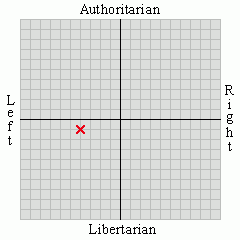
About 18 months ago I looked at the test on the Political Compass to see where the US presidential hopefuls stood. All of them, with the exception of Dennis Kucinich and Mike Gravel, were on the authoritarian right. I found I was on the libertarian left, in about much the same place as Nelson Mandela, which is no doubt why I voted for him.

Now Jams O'Donnell at The Poor Mouth: Political Spectrum has found another site, The Political Spectrum, which does much the same thing, but from an American viewpoint.

Here is my result:

My Political Views
I am a left social moderate
Left: 3.86, Libertarian: 0.9

Political Spectrum Quiz

The result was not very much different from Political Compass, but a little less libertarian so not much surprise there.

My Political Compass results were:

Economic Left/Right: -6.50
Social Libertarian/Authoritarian: -4.00


Nor is there much surprise in these results on Political Spectrum:

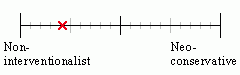
My Foreign Policy Views
Score: -5.73

Political Spectrum Quiz


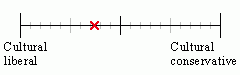
My Culture War Stance
Score: -2.57

Political Spectrum Quiz

But the tests are like chalk and cheese.

The Political Compass has carefully-worded questions, designed to be clear and unambiguous, and where the answers will actually measure something.

In the Political Spectrum test the questions are biased, tendentious, and very often beg the question, and it is difficult to see what they are trying to measure.

The Political Compass did not give the opportunity for a neutral answer, but it wasn't needed, because the questions were clear and unambiguous.

The Political Spectrum gave the opportunity for neutral answers, and also gave the opportunity of indicating the importance of the issue. In theory this should make the test more accurate, but in fact I answered most questions as neutral, and of neutral or little importance, because of the bad wording.

I can't remember the exact wording now, without going back and doing the tests again, but one example that struck me was that the Political Compass test asked something like:

Do you think that abortion should be legal for a woman when there is no danger to her life?

whereas the Political Spectrum equivalent version was something like:

Do you think that the state should deny a woman her right to an abortion?

which begs more than one question.

The difference may be because Political Compass is a serious exercise and appears to have drawn on professional expertise in designing the questionnaire and formulating the questions. The Political Spectrum one is on a public quiz site, where anyone can post a questionnaire, and there is nothing to prevent the wording of the questions reflecting the biases of the compiler.

But I can't help wondering whether it is also perhaps a reflection of the differences between British and American culture.

And now, with a general election looming, I wonder where our own political leaders stand.

I imagine Jacob Zuma would be a circle in all four quadrants, getting a different result depending on the last person he spoke to.

I also suspect that Patricia de Lille is still closest to my position (and that of Nelson Mandela).

26 November 2008

Spend! Save! Don't spend! Don't save!

As the economic recession gets closer to a full-blown depression, the conflicting messages from economic fundis and would be fundis become more and more confusing, leading to reports like this: Spend less this Christmas, says the Church of England, as retailers head for bankruptcy :: Damian Thompson:
Every year the Church of England tries to underline 'the real meaning of Christmas' with a publicity campaign and every year it makes a hash of it. Indeed the sound of a Christian PR stunt backfiring has become a much-loved feature of the festive season. This year s headline the Bishop of Reading the Rt Rev Stephen Cottrell calls on the public to spend less in the shops just as the recession is biting and shopkeepers are searching anxiously for customers. Nice one bish.
Hat-tip to A conservative blog for peace.
And then there's this.
TitusOneNine - Joe Nocera--The Worst Is Yet To Come: An Anonymous Banker Weighs In On The Credit Card Debacle:
Over my career, I have seen thousands of consumers that have credit card lines in excess of their annual salaries. Some are sinking under their burden. Some have been fiscally responsible and have minimal amounts outstanding. My 21-year-old daughter, who’s in college, gets pre-approved offers all the time. She has no ability to repay debt, yet the offers flow in just the same. We all know how these lines are accumulated. The banks, in their infinite stupidity, keep upping credit lines because the customer pays the minimum payments on time. My daughter’s credit line started at $1,000 and has been increased over the last two years to $4,400. She has no increased earnings to support this. But the banks do it without asking. And without being asked. The banks reel in the consumer, charge interest rates higher than those charged by the mob, increase lines without the consumer asking and without their consent, and lure them into overextending. And we can count on the banks to act surprised when they aren’t paid back. Shame on them.

You swipes your credit card and you takes your pick.

19 October 2008

AlterNet: How Wall Street's Scam Artists Turned Home Mortgages Into Economic WMDs

Those who caused the Wests financial crisis are now amking a fortune in consulting fees explaining how they did it.

AlterNet: How Wall Street's Scam Artists Turned Home Mortgages Into Economic WMDs:
The alphabet soup of exotic investments that represent the immediate cause of the banking mess is so complex that many of those 'innovative' financiers responsible for bringing the global economy to the brink of collapse are now making a fortune in consulting fees explaining just what the hell it is that they created. According to the Financial Times, Robert Reoch, the London banker who may be responsible for creating the first of the now-infamous debt-based securities, is now 'swamped by investors who want to extricate themselves from derivatives-linked messes, or simply to understand the products that came out of the past few years of intense financial innovation.' The Washington Post reported that Joe Cassano, the financial products manager 'whose complex investments led to (AIG's) near collapse,' is raking in $1 million per month in consulting fees from the ailing financial giant to help sort out the toxic sludge on (and off) the bank's books.

Bring back the building societies, I say.

18 October 2008

Oil prices are dropping -- the sky is falling

Anja Merret puts her finger on something that has been puzzling me recently too: why we are told that falling oil prices is a sign of depression. Six months ago we were told that rising oil prices would increase the cost of basic goods and services, and make the poor poorer. Suddenly it's become a Bad Thing, in media reporting, at least.

anja merret - chatting to my generation � Hollywood has moved to Wall Street:
During the past months the media has been reporting that the USA and UK are in a recession. However, since mid September ‘Father Christmas’ came early for the media, as the ‘Credit Quake’ took over. It was a much greater disaster to ride and make headlines with than with something as silly as a recession.

This is how it went, more or less. The financial markets took a huge tumble. Bad lending practices as well as some nasty rumours led to a few banks pleading poverty. Liquidity crunch was the reason given for this. Bad management decisions might have been a reason as well, one wonders. So the governments of the developed world pumped money into the affected banks and the financial market at an astonishing rate.

Then the oil price fell from an economy killing high of just under $150 per barrel. It’s now fluttering around the $80 mark. Suddenly this was bad news. Really? This tumbling oil price, from levels only supported by the greed of the oil traders and producers, was perceived to be a disaster. What? It’s almost unimaginable to think that anybody would consider a falling oil price to be bad news.

I think Anja Merret has put a finger on something that has puzzled a lot of people; well, it certainly puzzled me.

I'm all in favour of reducing dependence on fossil fuels, and finding alternative sources of energy. Finite resources will not last for ever, and when they're gone, they're gone. So when oil prices doubled earlier in the year, I thought that might be taken as a salutary reminder of the urgency of the need for finding alternative energy sources.

But, as Anja Merret points out, it is suddenly, in some quarters at least, being interpreted as sending a quite different message, and one wonders why.

07 July 2008

Cows Come Home Shock Horror

I'll be the first to admit that I'm not a fundi on agricultural economics and marketing, but this piece in Bishop Alan's blog makes a lot of sense to me, and I suspect that the behaviour of supermarket chains in South Africa is not all that much different.

Bishop Alan’s Blog: Cows Come Home Shock Horror:
Let’s zoom in on the dirty truth about dairy. The Blue is the farm gate price [click on the link to Bishop Alan's blog to see the graphs]. The Purple is the distributor/ processor element. The Cream, in every sense, is Lord Tesco’s Cut. In 1995, the farmer got about 24 pence a litre, the distributors got about 18, and Lord Tesco and chums got 1 and a bit. That may sound low, but of course he sold many litres compared to the farmer, so he wasn’t exactly short of a few bob. Can you believe it, but these days the farmer gets a bit less, and the distributor much the same, whilst UK supermarkets are taking a huge cut — 10 times as much as back then! The argument for going local is to try and bring some of that margin back to the people who actually do the work. Otherwise some are actually being paid less than 10 years ago. Cut out supermarket Shareholders and for roughly the same price, the farmer gets a living wage.

There's been quite a bit of talk about land reform in South Africa, but with the example of Zimbabwe's utterly botched attempt (because its concern was not with the land or the people, but with the political fortunes of ZANU-PF and its leader, Mad Bob Mugabe) many people are understandably somewhat nervous about it. But it goes beyond land and agriculture and political gain, and Bishop Alan's comments seem to be applicable, mutatis mutandis, to our situation too.

27 June 2008

Glocal Christianity: How Christian is my business?

Excellent post from Matt Stone on what makes a Christian business and what makes a business Christian. Well worth reading.

Glocal Christianity: How Christian is my business?:
For years now Hillsong have been running a Christian Business Directory for Christians in western Sydney, and apart from the missiological issues this inevitably raises, I have also long wondered, what does it mean to call a business “Christian”?

There can be many problems, which take many different forms. Some businesses use Christian symbols in their logos. That does not make them Christian, it just means they are trying to con Christians into supporting them. One church I was in asked a parishioner to design a logo that could be used on church stationery. Another parishioner, who ran a light engineering business, promptly nicked the logo to use on his business stationery -- thus implying that his business had the endorsement of the church.

A few years ago a bloke quoted for some building alterations on our house. He was full of Christian talk, but he took the money and didn't finish the job. His name was Lukas Neethling, so if you ever come across the guy, beware of any business deals you make with him!

That kind of thing gives Christians a bad name in the secular world. But the most telling exampleof the bad reputation of Christians was when I applied for a job as a bus driver with London Transport. They wanted three references. I gave them some, and they rejected them. References from anyone connected with the church were unacceptable. I'd just arrived from South Africa as a semi-refugee, having skipped the country one step ahead of the Security Police. I didn't know anyone in Britain who wasn't connected with the church. Eventually I gave them the names of some professors at the University of Natal whose courses I had taken, but hardly knew me at all, and those were acceptable.

Of course such things can take different forms, and it's not always in the form of a published directory. A few years ago there was a TV sitcom called Birds of a feather, about two sisters, Tracy and Sharon, who ran a working class cafe. One was divorced and the other's husband was in jail. A yuppie Jewish friend persuaded them to turn their cafe into an upmarket bagel bar, and their business fell off drastically. The husband in jail was Greek, so they went to see the Orthodox priest, who remarked on Sharon not being seen in church since her wedding, and when she was suitably contrite, pulled out a card index of business contacts, and at the end of the episode their business was prospering again. That kind of networking was dead true to life. I've seen it many times.

A more positive example comes from more than 30 years ago in Namibia. The Anglican bishop, Colin Winter, gave a series of Holy Week addresses in a Durban church, and urged people to come and help the church in Namibia. One guy there, Ed Morrow, said "I'm just a builder, what can I do?" And the bishop said, in effect, come anyway, God will show you. So he and his wife let their house, put their furniture into storage, bought a second-hand Volkswagen Kombi into which they loaded their stove, and set out to drive 1500 miles to Windhoek. When they arrived the church registered a building company. They wanted to call it Ikon Construction, but the Registrar of Companies said that was taken, so they called it Noki Cosntruction instead. The Diocese owned 198 shares, Ed Morrow owned one, and the diocesan secretary owned one. They asked clergy if anyone wanted to learn the building trade, and three blokes came from Ovamboland, 500 miles to the north. They went everywhere in the old Kombi, to work, to church, to social occasions. They were referred to as "the Noki outjies" (that's an in South African joke; if you're from elsewhere, skip it, it'll take too long to explain). At the end of a year, Ed reported to the diocesan synod. He said they had shown it was possible to run a business on Christian lines and still make a profit. They paid three times the going rate for workers, they quoted fair prices, and they did a good job. They had gained the respect of their customers.

But Matt goes way beyond these trivial examples in his post, so do have a read of it.

PS

I looked to see who else was talking about this stuff and this is what I saw:

Mentions by Day

Posts mentioning business ethics per day for the past 30 days.

Chart of results for business ethics

Anyone know why Technorati shows such a drastic drop off at the beginning of June?

07 April 2008

The Economist Has No Clothes: Scientific American

The Economist Has No Clothes: Scientific American
The 19th-century creators of neoclassical economics—the theory that now serves as the basis for coordinating activities in the global market system—are credited with transforming their field into a scientific discipline. But what is not widely known is that these now legendary economists—William Stanley Jevons, L�on Walras, Maria Edgeworth and Vilfredo Pareto—developed their theories by adapting equations from 19th-century physics that eventually became obsolete. Unfortunately, it is clear that neoclassical economics has also become outdated. The theory is based on unscientific assumptions that are hindering the implementation of viable economic solutions for global warming and other menacing environmental problems.

OK, I'll be the first to admit that I'm not a fundi in either economics or physics. I suspect that the physics I learnt at school 50 years ago was based on the 19th century stuff, and quantum theory was strictly recreational reading that wouldn't help you to pass matric. So is there anybody who does know about this stuff who is able to confirm or refute this?

17 November 2007

Shuck and Jive: Render to my ex-wife what is my ex-wife's...

This would be a worthy addition to the Synchroblog on The Church and money

Shuck and Jive: Render to my ex-wife what is my ex-wife's...
The estranged wife of a pastor claims her husband blended his professional and personal finances so thoroughly that his church should be counted as an asset in their divorce.

LinkWithin

Related Posts with Thumbnails