Showing posts with label history. Show all posts

29 June 2024

The Drunken Silenus

The Drunken Silenus: On Gods, Goats, and the Cracks in Reality

The Drunken Silenus: On Gods, Goats, and the Cracks in Reality by Morgan Meis
My rating: 4 of 5 stars

This book is an extended personal meditation on Peter Paul Rubens's painting of the drunken Silenus.

Silenus was the tutor of Dionysus (whom the Romans called Bacchus), the dying and rising Graeco-Roman god of wine. Silenus was also the leader of the Satyrs, the half-human, half-goat companions of Dionysus. Silenus is shown as a fat old man, and, in contrast to his companions, his drunkenness is not the drunkenness of frenzied excess; in Rubens's painting it is the semi-conscious stumbling drunkenness of one who drinks to forget.

What made me want to read this book in the first place was the appearance of Silenus, Dionysus and their retinue in C.S. Lewis's children's novel Prince Caspian. And while this book doesn't explain it, it certainly gives more of the background.

Morgan Meis takes us on a journey, starting with the life and times of Peter Paul Rubens (1577-1640), going back to ancient Greece, when the cult of Dionysus flourished, and forward to the time of Friedrich Nietzsche (1844-1900) who had his own view of Silenus, whom he regarded as the father of Greek tragedy.

Meis examines the significance of Silenus against the historical background of each of these periods with an intertwining of history, biography, art history, philosophy and religion, with a great deal of personal speculation thrown in. None of these is treated in a formal academic way; there are no footnotes or other references, though there is a short bibliography at the end. But this broad, comprehensive, interdisciplinary approach does present Silenus, and Rubens himself, in a more holistic way than, say, a purely art-historical approach would do. The only fault I could find with this approach is that at times Meis tends to become too verbose and repetitious.

I found the book stimulating. It stimulates an interest in all these topics. One does not necessarily have to accept all Meis's speculations, but one can treat them as a starting point for one's own. Rubens painted the drunken Silenus at the beginning of the Thirty Years' War, and the book would be interesting to anyone interested in that period, or art of that period.

One regret is that I could not find a decent reproduction of the painting online, and none is included in the book. The ones I could find online lacked the detail that is described in the book, and a full-colour reproduction would have been a useful additions.

In addition to being tutor to Dionysus, Silenus was a philosopher and a prophet, and when the legendary King Midas asked him what was the best thing for man, Silenus answered that the best thing for man was never to have been born, and the next best thing, having been born, was to die.

That's a pretty pessimistic outlook on life, and makes me wonder, even more, why C.S. Lewis would include him in a book written for children, even though he doesn't mention that side of Silenus. According to Meis, however, Nietzsche liked it:

The Greeks, Nietzsche thinks, the ancient Greeks— the Greeks of the satyr plays and the music in the forest, the Greeks who came before the classical period of Plato and the brilliant days of Greek rationalism, the Greeks before that, the ones who danced the Sicinnis dance and celebrated their secret rites—those Greeks were bold enough to make a health of their pessimism. They were strong, thought Nietzsche, tremendous in their ability to think that pessimism all the way through. Nay, to live that pessimism all the way through. That’s the way Nietzsche thought about it.

For Meis, the tragedy of Silenus is that he is immortal without being fully divine; he cannot die although at times he longs to do so. This is reminiscent of Tolkien's elves, for whom death is "the gift of Illuvatar", for which they envy men.

Faced with such a fate, it is perhaps unsurprising that Silenus should seek refuge in liquor. Again, as Meis puts it:

Silenus is, after all, somewhere between dying and not dying. He is not fully immortal like Dionysus, he isn’t a true god, nor is he fully mortal like King Midas, since he must always exist in order to be the attendant of Dionysus as Dionysus is perennially born and then torn apart and then reborn and then torn apart again. And Silenus is also, we should mention again, extremely drunk in the painting. And one of the key aspects of being very drunk, as everyone knows, is that you are conscious without being all the way conscious. You are there without being all the way there. You are present while at the same being absent. You are moving around without going anywhere.
For C.S. Lewis, however, even Dionysus, though a god, is not the True God. He is a creature, created, not begotten, and it is only in Christ that both Dionysus and Silenus find true fulfilment. In Prince Caspian Silenus is still tipsy, and still falls off his donkey, but it is the tipsiness of revelling rather than the drunkenness of oblivion.

View all my reviews

08 May 2024

Travelling through southern Africa in the 19th & 21st Centuries

Footing with Sir Richard's Ghost

Footing with Sir Richard's Ghost by Patricia Glyn
My rating: 5 of 5 stars

Patricia Glyn, having heard about the travels of her great grand uncle Sir Richard Glyn, decides to walk the trail of his 19th-century journey from Durban to the Victoria Falls. This is the diary of her journey, with excerpts from his diary, and notes on the places they passed through, and historical events that had taken place there.

Sir Richard Glyn and his English companion were that comparatively rare species of traveller, the British "sportsman", who came to Africa primarily to hunt animals for sport, and left with their trophies. Though comparatively rare, however, unlike most other travellers they kept comparatively good written records in the form of diaries, and so their travels are better documented than most.

The book was a toss-out from the Alkantrant Library, probably a donation from a deceased estate. I hope the reason that the library tossed it out was that they already had a copy, and not just that they didn't think they needed one because it would be a pity if this book were not available. Just as her relative's diary is a valuable account of how people travelled and lived in the 1860s, so hers is a record of how people travelled and lived in the same parts of the world in the early 21st century.

In the 1860s the travellers relied of paid local guides, accounts of other travellers, or local advice or knowledge. In the 21st century this was supplemented by cell- and satellite phones and more accurate maps.

One of the reasons I found it interesting was that in 2013 my wife Val and I went on a similar journey, following in the footsteps of her great-great-grandfather Fred Green, who travelled through much of the same region, and also that to the west, from the 1850s until his death in 1870. Unlike the Glyns, he was not a sportsman, but a professional hunter, trader and explorers, his main source of income being ivory for which he hunted and traded. Unlike Patricia Glyn, however, we did not walk, but drove by car, taking three weeks instead of five months.

The book is illustrated with photos and maps, and has side panels with historical and geographical notes drawn from a variety of sources, which are all listed in the copious bibliography.

View all my reviews

29 November 2023

Digitisation is death to data

A few weeks ago my laptop computer was stolen, and since the insurance company asked me what it would cost to replace it, I've been stuck, because it is beginning to appear that it is irreplaceable.

The computer that was stolen was about 13 years old, a Toshiba Satellite laptop running Windows 7 32-bit. It came with 64-bit Windows, but with a set of discs for a 32-bit version. Using it for a couple of hours showed me that it would not run many of my older programs, which I used to access research data I had collected over the last 25 years,  so I quickly installed the 32-bit version of Windows and all was well. 

Now, however, it seems that 32-bit versions of Windows are extremely difficult or impossible to get. I can still access my data on my desktop computer that runs 32-bit Windows XP, but what happens if that dies?

Referring to a related issue, director Guillelmo del Toro pointed out the dangers of streaming serivces when he said:

Physical media is almost a Fahrenheit 451 (where people memorized entire books and thus became the book they loved) level of responsibility. If you own a great 4K HD, Blu-ray, DVD etc etc of a film or films you love... you are the custodian of those films for generations to come

But there is another bigger problem. Even if you possess the physical media, they are quite useless if you have nothing to play them back on. And for many of these things the hardware and software to read such physical media is becoming rarer all the time. 

For a long time people have been recommending the digitisation of paper documents, with or without the destruction of the originals, as a means to better preservation, but that depends on the availability of the hardware and software to access the digitised versions. Someone wrote a book a few decades ago called CD-ROM: the New Papyrus, but how easy is it to get a computer that can read a CD-ROM? Better stick to the old papyrus!

One thing that would go a long way towards alleviating this would be for historians, librarians, archivists and others who are concerned about preservation of information from the past to push for international agreements and legislation to ensure that whenever an operating system, or version of an operating system is no longer supported by its manufacturer, it should be put into the public domain, without copy protection, and possibly also made open source, so that people can adapt it to run on new hardware.

Something similar should be done with application software (apps) such as word processors and the like -- how many people can read a Multimate document nowadays?

A personal example: 

Since the age of 11 I have kept a diary, originally written in pen and ink in a series of notebooks. In 1985 I began digitising it. I typed out the entries for 1969 in Wordstar on an Osborne Executive portable (luggable!) computer running CP/M3, stored on 185k single-sided floppy disks. I did it because I wanted to collect memories of my grandmother that I had written back then when I had seen quite a lot of her. 

Later I realised that quite a lot of what I had written might be useful to historians of Namibia, so I continued to transcribe it beyond the period relating to my grandmother. In 1987 I got a newer computer running MS-DOS, and a better word processor called XyWrite. I converted the Wordstar documents to XyWrite (I still have the conversion program on my computer today) and carried on transcribing. In about 1990 I printed out an edited version of the Namibian portion and sent a bound copy to the Windhoek archives. 

In 1992 I began making notes for the current version of my diary using a then-popular "terminate-and-stay resident" program called Sidekick, which I would then use to write up the hard copy version. In about 1995 I started using a text database program called askSam, and stopped keeping up with the hard copy version. In 2001 I started using a different text database program called Inmagic, and began converting all the remaining Wordstar, XyWrite and askSam versions to that, and since 2006 have kept it in a single file. A couple of years later I had more or less finished transcribing all the hard copy ones going back to when I had started at the age of 11, and every morning I look at it to see what I was doing in the past going back at 10-year intervals. I can do that on a computer running 32-bit Windows, but not on one running 64-bit Windows. So 64-bit Windows is quite useless to me. 

That is just one example, but there are many other things, like research notes made from books, interviews with people, with research data that I've now been collecting for 35 years (and older data that I have digitised in a similar manner to the diary). but the planned obsolescence policy of software companies like Microsoft would require that I must give up all that. Perhaps I need to do a "Go Fund Me" appeal for the funds to print out all the stuff on my computer on hard copy in order to have continued access to it.

Digitisation as a means of preservation only makes sense in an open source and public domain environment.


23 September 2023

Institutional Memory: Remembering the Good and the Bad

Yesterday morning we participated in TGIF[1] via Zoom, where Nick Koning spoke on "The good and bad of institutional memory." He said he had gone to Selborne College, a high school in East London, and would be taking that as an example, as the whole place was full of reminders of the past. 

The perimeter fence was marked with the names of old boys. There was a Jubilee Tower, a new structure, but it was meant to look old, and to be a reminder of the past. The school hall was full of sporting pictures of the past. He had walked into all this as a 14-year-old boy, and was filled with the sense of past achievements, which helped to give him the ambition to achieve similar things.

Every new pupil at the school had to pass a test on all this historical tradition before they could wear the school uniform, and that was a mild form of initiation. Among the names was one who had been awarded the Victoria Cross because he had killed a lot of Nazis. Another was Mark Boucher, a former pupil who was celebrated as the best wicket-keeper in the world, and had learned to pay cricket at Selborne College. Nick himself played hockey, and was inspired by this to be the best.

The way the past is remembered is the superpower of such institutions, inspiring people to raise their horizons.

There was the annual Founders Day ceremony, full of pomp, highly traditional and very colonial. The head boy was called the Custodian of the Keys, a practice that dated back to when the war memorial, called Bob, was erected after the First World War, and the Administrator of the Cape handed over the keys to it to the head boy. So on Founders Day two lists of names were read out -- that of past Custodians of the Keys, and that of those who had died in the First and Second World Wars. This reinforces the idea propagated by the school motto -- that reward is to the brave, who save the world from bad people.

But there were no people of colour on the lists that were read out, because back then it was an all-white school, and it was only in 2002 that there was, for the first time, a black Custodian of the Keys.  We all know the reason for this, it is a familiar thing, but still an ugly one, and we need to remember the ugly facts of our past too.

What is forgotten is as interesting as what is remembered. White exclusivity is not remembered. The horror of SA society, and the shock of it is forgotten. The glorious past is not as glorious as has been remembered. There were good things to remember, but the way we remember it is better than  it actually was.

There were also some bad things, some bad traditions. Among the lists of names were detention lists, which were mostly of black children, and so a problem. Why were black children more often in detention than white children?

In 2017 one of the pupils drew a caricature of Hector Pieterson, where the people in the famous picture of him being carried after he was shot were portrayed as dogs. There was the continuing use of racial slurs by teachers, but little is said about these things in the institutional past, though they could be used as an educational opportunity.

Though Selborne College was only one school, there are many others that preserve institutional memories and traditions in various ways, yet I thought how different it was from my own school life. 

When I went to St Stithians College in 1953 it was a brand new school. There was no past, no tradition. There were no new boys to initiate, because we were all new together. The headmaster, Wally Mears, said there were no rules, and that we, by our own behaviour would make the rules. The first founders day, on 11 August 1953, was marked by the laying of the foundation stone of the school chapel, and yes, it was an all-white affair. But the only names remembered were those of businessmen who had left money in their wills for the school to be started, or those other businessmen and lawyers who had administered the trust fund. There were no past pupils, only present ones.


In more recent years I have attended the Founders Day services, usually at five-year intervals, so this year was the 70th anniversary of the founding of the school. But it struck me that the remembered past is not much like the real past, and there is not much interest in the real past. I had suggested that they should try to arrange a reunion gathering of the foundation pupils who were there in 1953, and they suggested one for those who had been in my matric class in 1958, which was not at all the same thing.

In 2008 I had gone to a head boy's lunch, where some of the current pupils met some of the past pupils and teachers. I ppoke to Tshegofatso Rangaka, then head of Collins House, who was keen to know about traditions, but I had had to tell him that I couldn't think of any, because the school had been so new. I got the impression that there was a kind of hunt to discover traditions, and perhaps he was under some pressure to pump the past pupils for traditions. 

By that time St Stithians was 55 years old, and there were lists of names on boards up in the dining hall, and the one who had been head boy in my matric year, Bruce Young, was the first on the list, but his name was spelt wrongly, as B. Going, and no one had noticed or bothered to check. The remembered past was not the real past, and an imagined past would do just as well as the real past, as long as it was a tradition.

There are mixed memories of the past, some good, some bad. I don't recall the teachers ever being racist -- they gave us "a liberal education with a Christian teaching" in accordance with the wishes of the businessmen who had left money for the school to be established. 

We ate in the school dining room, wearing school uniforms with blazers even in midsummer. On one particularly hot evening, when the headmaster's wife, Nan Mears, was sitting alone at the high table supervising us, someone dared me to go up and ask if we could take off our blazers. 

"Certainly not!" she replied. 

We were all white, and had to learn to behave like gentlemen. There were black waiters, who brought our food and cleared the tables afterwards. One day one of the waiters appeared with his head shaved, and we all remarked on his new hair style. Only many years later did I learn, to my shame, that in his culture it was a sign of mourning, and that someone in his family must have died recently, but instead of expressing sympathy, we kids insensitively teased him about his hair style. Such things could have become educational opportunities, as Nick Koning suggests.

The best example of forgetting the bad is illustrated in the way St Stithians treated its second headmaster, Steyn Krige. He was my geography teacher from 1954 to 1958, and was only deputy headmaster when I was there, and he died in 2011 -- my memorial for him is here. The school named a hall after him, and published an obituary for him, and noted that when he left St Stithians he went on to found Woodmead School, the first fully non-racial school in South Africa. What they did not mention, and what seems to have dropped out of the institutional memory, is why he left St Stithians. He was fired in an acrimonious row that made the front pages of the Sunday newspapers back in 1969. What was never made public was the reason for his firing, and that has been conveniently swept under the carpet.

I think it is important to remember the past. Shakespeare said "The evil that men do live after them, the good is oft interred with their bones" (yes, I learned that at St Stithians). While that is often true of individuals (think of what people recalled on the recent death of Gatsha Buthelezi), in institutions the reverse tends to be true -- the good things are remembered, especially by the people who enjoyed them, the bad things tend to be forgotten. Partly for that reason I at one time wrote a series of blog posts, Tales from Dystopia, to remember some things that might otherwise be forgotten. Unfortunately I had to give it up, because the Wordpress platform became increasingly difficult, and finally impossible to use. But have a look, and maybe it will jog your memory about the past. 

______

Notes

[1] TGIF, in this context is a gathering that takes place in Johannesburg, Tshwane and Stellenbosch early on Friday mornings, so people can come and get some mental stimulation before they go to work. There are speakers on various topics.


16 February 2023

History through Fiction

I've just finished reading a children's book that has history in it. The author, Annie Barrows, recalls that as a child she didn't much like books that had a sort of hidden educational purpose, and in an author's postscript says:
... It is with some embarrassment that I find that I have written a book that has some history in it. I would be a good deal more embarrassed if it were a book about history, but it's not, I promise. It's about some kids who live in this very od house and, well... you can read it yourself. But the story also contains some hunks of history, and though I have absolutely no intention of being educational I have to confess almost all of them are true.
I found this particularly interesting because I have written some children's books of which similar things could be said. They all have hunks of history in them, and most of them are true. I can't use the disclaimer about no intention of being educational, because part of my intention was to give children a feel for an earlier time in a fictional setting. I suppose that is something that could be said of most historical novels.

Magic in the Mix

Magic in the Mix by Annie Barrows
My rating: 5 of 5 stars

A rather moving story of children who are caught up in time travel, and learn about their own family history and that of their country as a result. I class it as fantasy rather than science fiction because in the book the time travel is ascribed to magic rather than to technology.

Miri and Molly Gill are sisters (as a result of an earlier time-travelling adventure) with two older twin brothers and two younger twin sisters. The house they live in seems to be built on a thin place in time, where events of different times come close to each other, and sometimes this allows the inhabitants to cross from one time to another.

Miri and Molly are initially the only members of the family who are aware of this, and believe that they have been allowed to travel in time to put things right. Presumably they discovered this accidentally in an earlier book in the series, but in this book, while they cannot travel at will to any time they choose, they can with some thought, and some trial and error, manage to do it sometimes.

In this book they travel to the twentieth century, and learn something of Molly's family history, and travel to the nineteenth century and learn something about the American Civil War, and experience some of its dangers.

One of the reasons that I found this book particular interesting is that I finished writing one about six months ago that similarly included hunks of history that happened to be true, and instances of time travel, in a children's novel called Cross Purposes. Both stories are therefore a cross between historical novel and fantasy. The difference is that whereas in Annie Barrows's story the fantasy element is mainly confined to the time travelling itself, mine extends to folklore mythology and mythical creatures.  


View all my reviews

26 January 2023

Total Onslaught: Apartheid's Dirty Tricks Exposed

Totale Aanslag: Apartheid se Vuil Truuks Onthul

Totale Aanslag: Apartheid se Vuil Truuks Onthul by De Wet Potgieter
My rating: 3 of 5 stars

The history of the Total Onslaught and the dirty tricks of the apartheid regime, told by a journalist who doesn't bother to hide his sympathy for them.

That was all I wrote as a "review" on GoodReads, and it wasn't really a review, just a copy of a note I had made in a list of books I had read. 

I read it 14 years ago, and couldn't really write a review now unless I read it again. 

My reason for posting this now is that an online friend mentioned on Facebook that he was reading it, so I mentioned that I had read it and found a kind of dissonance between what was said in the book and the way in which it was said. 


On the surface, a catalogue of evil deeds of the apartheid security forces (Shock! Shock! Horror! Horror!), but a subtext of salaciousness (Nudge! Nudge! Wink! Wink!), like a British tabloid gleefully reporting the vicar's adultery. And  the author describes with relish how the perpetrators of some or other outrage would gather in some bar to celebrate it and congratulate each other.

It occurred to me, as I said that 14 years later, that this might, just possibly, have been very subtle satire that my mind was too coarse to grasp, but on finding the book on my shelf and opening it, I thought that unlikely. 

It also made me a bit curious about the English translation. In the Afrikaans the subtext is there, plain to see. But the nuance could be lost if it is translated into English, because the idioms do not translate well, or do not have the same force when translated.

But what confirmed my initial evaluation was a caption to a photograph. 

The photo showed a worried-looking President de Klerk, and the caption read:

F.W. de Klerk, 'n duidelik bekommerde man in die dae toe hy Suid-Afrika uit die era van Totale Aanslag gelei het na Totale Oorgawe

I don't know what the official English translation says, but my reading of that is, F.W. de Klerk, a clearly worried man in the days when he led South Africa from the era of Total Onslaught to Total Surrender. 

"Totale Oorgawe" can be translated as "Total Surrender" or "Total Capitulation", and it is the kind of phrase that only a diehard bittereinder supporter of the apartheid regime would use, and it, as well as the more nuanced idioms, clearly shows where the author's sympathies lie. Anyone else would say something like "a negotiated settlement".

10 May 2022

The Caliban Shore: anatomy of a shipwreck

The Caliban Shore

The Caliban Shore by Stephen Taylor
My rating: 5 of 5 stars

There have been many shipwrecks on the coast of southern Africa over the centuries, but only four stick in my mind -the wreck of the Grosvenor on the Pondoland coast in 1782, the Birkenhead just east of Cape Town in 1852, the Dunedin Star on the coast of Namibia in 1942, and the Oceanos in 1991, a little south of where the Grosvenor was wrecked. I learned about the first two at school -- they made it to the history books as being among the most famous shipwrecks on the southern African coast. The wreck of the Birkenhead was famous for establishing the principle of "women and children first", and the wreck of the Oceanos was famous for the abandoning of that principle.

All aboard the Dunedin Star and the Oceanos were rescued. Many of those aboard the Birkenhead died, but their fate was known. But the wreck of the Grosvenor became the stuff of legend, because the fate of the majority of its passengers and crew remains unknown to this day, nearly 240 years later. And that is what Stephen Taylor explores in The Caliban Shore -- what happened to the ship and the people in August 1782. In doing so he reveals some interesting facets of the history of India, southern Africa, and the UK.

The fascination of the story is partly in the mysteries. We quite enjoy watching the TV series Air Crash Investigation, where the interest is in the search to discover what happened and why. It is a puzzle to be solved. Was it a mechanical error or a human error, or an event outside human control, like weather, or a volcanic eruption? If it is a human error, it is sometimes caused by human relations -- what were the relations of the crew members? It can also be poor training and skill. These issues are explored in the TV series in a formulaic way, but in the case of the wreck of the Grosvenor, Stephen Taylor does it much more thoroughly.

We learn something about the economics of India, and especially of the trade between India and the UK, which the British East India Company sought to monopolise, but though it dominated the trade, it did not control it completely. We learn, for example, that of the 740 tons of cargo that the ship could carry, the Captain was entitled to use 58 tons for his own personal trade. The Captain also decided who could be passengers, and how much they should pay.

In addition to the mystery of what led up to the fate of the ship, there is the mystery of missing persons. The fate of the majority of people on board remains unknown. The nearest port where they could hope to get a ship to continue their journey to Britain was Cape Town, 800 miles (1290 km) away, measured by modern roads, but in those days there were no roads for about half the distance. There were young children, pregnant women and sickly old people among the survivors of the wreck, and most of them did not survive the journey, or else gave up.

[author Stephen Taylor] examines all the known remaining records of the event to trace the lives and careers of those who were aboard to ship, to try to piece together what happened to each. Some are known to have died on the journey. Others were abandoned by their fellows in circumstances where they were assumed to have died. The route to Cape Town passed through a war zone; it was the beginning of the 100 Years War between the Xhosas and the Cape Colony, though history usually divides it into nine "Frontier Wars". And the Dutch who controlled the Cape Colony were at war with the British, so British ships did not call there. A few of the survivors managed to get on Danish ships. But some decided to stay put and settle where they were, among the local Pondo people, others may have done so, but it is not certain who they were, or where they settled.

 The news of the shipwreck took a long time to reach Britain, and when it did it was sketchy and gasve rise to sensational and highly speculative press reports. The voyage from Britain to India in  the 1780s usually took 6-8 months. Much was made of the anxiety of the families of those involved, who lacked what the media nowadays call "closure". For many, it seems, the good news would be that their relatives had died, for to be marooned among a strange and unknown people was seen as "a fate worse than death". 

For the local people, the wreck was both an opportunity and a threat. Pondoland had no deposits of iron ore, so people in the vicinity of the wreck, ignoring the castaways and their plight, set about burning the wooden wrekage of the ship to retrieve nails and any other bits of scrap metal they could find. When the castawats tried to approach them, they drove them away, and this was seen and portrayed as evidence of the "savagery" of the local people, though it seems that in our day people who are shipwrecked while travelling from Africa to Europe are treated just as badly by Europeans, who seem to be equally savage, 

With hindsight, and research, Taylor explains this -- August, when the ship was wrecked, was the end of winter. The grazing was poor, the cattle were thin, and the previous season's crops were almost exhausted, so the prospect of 140 uninvited guests for dinner was just too much. Later, when the shipwreck survivors had split into smaller groups, they were treated more hospitably.

Another interesting thing is that the ship carried a report on corruption in the British East India company and its officials. Both the report and the bearer failed to make it to Britain as a result of the wreck. I found this interesting because I studied a related incident in history at university -- the Impeachment of Warren Hastings. This book made a great deal more sense of what he was impeached for and why, and perhaps also helps to explain some events in our own time, when the Gupta brothers engaged in state capture in South Africa, and promoted corruption in business, the civil service and in state-owned enterprises. It seems that the British East India Company was very much into state capture. I'm not sure whether they started it or just passed on what they had received from others, but it seems that the Guptas were heirs of that tradition, and have passed it on to the RET crowd in South Africa.

The books explores the history, the legends and the rumours, and tries to establish, as far as possible, what actually happened. So there is history, an investigation into a shipwreck, a survival story, and a search for what happened to missing persons as well.


View all my reviews

04 April 2022

Mukiwa - a white boy in Africa

Mukiwa: A White Boy In Africa

Mukiwa: A White Boy In Africa by Peter Godwin
My rating: 4 of 5 stars

History can be dull without the personal touch, especially if one wants more than just a bare chronicle of events and dates, and it is books like this one that help to put flesh on the bare bones of history -- a memoir showing how one person and one family were affected by the events.

Peter Godwin was born in what was then known as Southern Rhodesia of British immigrant parents, The country was part of the Central African Federation, which broke up when Zambia and Malawi became independent in the mid-1960s, and Southern Rhodesia became just Rhodesia. Godwin's father managed a factory in the eastern part of the country, near Melsetter in the Chimanimani mountains. His mother was a medical doctor and as a child he often accompanied her on her rounds, helping her to vaccinate other children and sometimes assisting with postmortem examinations. This probably gave him a wider experience of life (and death) than most young children.

Some of the things he describes have strange echoes of my own life. 

A man had reported the deaths of his family as suspicious, and Godwin's mother, the district medical officer, goes to his remote rural home to perform a postmortem on the bodies. The complainant wore torn shorts and a tattered T-shirt with "Things go better with Coke" printed on it. He tells Peter, then a young child, that he suspects witchcraft.

"How?" I asked. "How did they die?"
The Coke man lowered his voice still further, so I had to strain to hear. "It was a spell he said, a spell cast on them by my neighbour, who is a muroyi."
A muroyi was an African witch. They didn't have long noses or warts, and they didn't wear silly pointy hats or ride on broomsticks. African witches were much more dangerous than European witches, and they rode around on the backs of hyenas at night.
"He suspect me of stealing his goat," said the Coke man. "So he cast a spell on my family and they died."

And I was reminded of the time, 45 years ago, that I met a man, Cain Nxumalo, suffering from gangrene, and his family believed that he had been bewitched by neighbours who had accused them of stealing their goat.

There were reminders of more recent times and events, too. 

Easily the single biggest life-saving aspect of my mother's practice was her vaccination programme. It was a long haul, though, to get it going. To start with, the witch doctors were totally opposed to it. A vaccination might initiate rural Africans into Western medicine and help to break down their fear of it. And for every patient who went West for medical treatment there would be one fewer for the nganga. The witch doctors put out the most hair-raising rumours abut the dreadful things that would happen to people who were vaccinated. They would be rendered infertile, they would go mad, they would die a lingering mouth-frothing death.
And one only has to look at the Internet to find similar rumours, spread by people in many Western countries, about all the dreadful consequences of being vaccinated against Covid19.

At the time Rhodesia was a British colony with self-government by a white-dominated parliament, and there were conflicting views of independence. Most whites wanted continued white rule after independence, and most blacks wanted majority rule. These conflicting aims led to a civil war, which becomes the theme running through the book, which dominated Peter Godwin's life. While he was still in primary school the Rhodesian prime minister, Ian Smith, made a unilateral declaration of independence (UDI), thus rebelling against Britain, whose government's policy was "no independence before majority rule" (NIBMAR). As a result, the civil war hotted up, with two African liberation movements, ZANU and ZAPU, fighting against the Smith government and sometimes each other, though they formed a shaky alliance called the Patriotic Front and put the letters PF after their acronyms.

Peter Godwin's parents moved to the other side of the country, and he spent his high school years in Salisbury, the capital. After leaving school he had to spend a year in compulsory national service, and he opted to do it in the police force rather than in the army. But because of the civil war, the police became very militarised, and Godwin found himself caught up in the fighting. Even as a relatively new recruit, he often found himself in a moral dilemma. He witnessed atrocities committed on all sides, and their effects on the victims and wasn't really committed to fight for continued white rule.

After completing his national service he went to Cambridge in the UK to study law, but after only a year returned for his sister's funeral. She had been killed in an ambush by the Rhodesian Army, and since he had returned, the government wanted him to do more national service, but eventually allowed him to return to Cambridge to complete his degree.

When he returned after finishing his studies, Rhodesia had become Zimbabwe, but the civil war continued between ZANU and ZAPU after their alliance in the struggle for independence disintegrated. Now practising as a lawyer, Godwin found himself defending ZAPU members who were accused of treason by the ruling ZANU party,. After the one high-profile case, Godwin became disillusioned with the law, and became a freelance journalist, and covered more of the battles between ZANU and ZAPU, though it was mainly a matter of the Zimbabwe army against civilians in the south-west of the country, Matabeleland, who were suspected by the government of supporting ZAPU.

In all this, Peter Godwin was a witness to a lot of the the fighting, and how it affected ordinary people and families, And so he describes how that turbulent and violent period in the history of his country affected ordinary people and disrupted their lives, both of his own family, and other people he came into contact with, at school, as a policeman, as a lawyer, and later as a journalist. That is the strength of the book. It adds the human touch, and shows the human cost of war and conflict.

A weakness, especially for readers who are not familiar with the wider history of Rhodesia/Zimbabwe, is that it does not have enough of the historical background. I have probably given more of the historical background in this review than appears in the whole book. He mentions background events in passing, as if everybody knows what they were.


I knew what he was referring to in most instances, but mainly because about 20 years ago I got involved in the publication of a book on Christian healing ministry in Africa, with a lot of case studies from Zimbabwe, and had to read up a lot of the history to be able to write a chapter on that history to set the healing accounts in their historical context of both church and secular history. That book is African Initiatives in Healing Ministry, and it could do with a few more reviews!

Another weakness, it appears to me, is that Godwin does not give enough of his personal history. Yes, he describes his childhood in great detail, and gives a great deal of detail about the events in Zimbabwe that he was involved in, but when he left to study overseas, we only learn after his return that he had studied law. It would be good to know why he chose that field, in the same way as he told us why he chose the police over the army. Though the book concentrates on the time he spent in the country, at least a page or two could have said something about his studies overseas, He was writing a book, not a play with the scene set in Zimbabwe, so that when the actors were offstage the audience could not see them at all until they reappeared. A book need not be confined to the main setting all the time.

I had other personal reasons for reading this book and finding it interesting. I had several friends and relatives, contemporaries of mine, who grew up in Rhodesia/Zimbabwe, and I was curious about their life and the kind of society they had grown up in. And, coincidentally, the three that came most readily to mind were all, like the author of this book, named Peter. One was my best friend at prep school when we were aged 11. He was Peter Russell. I met him once later, in London in 1966, where he was training in hotel management. The second was Peter Bridges, who was at university with me, though he did not come back after a vacation, and I was told he had had a nervous breakdown. He was a gentle and innocent soul, and the only person I had ever met who was completely without guile or malice. I was convinced he was a saint, and wish I knew what had happened to him. The third is my second cousin, Peter Badcock-Walters, who has produced illustrated books on some aspects of the wars and violence.in Rhodesia/Zimbabwe. One of them is Images of War.

 The three Peters I have mentioned were kind and gentle people, but in the 1960s, when I was a student at the University of Natal in Pietermaritzburg there were a lot of Rhodesian and Zambian students, all white in those days. And what struck me was that, with a few exceptions, like Peter Bridges, the Rhodesian students were far more racist than the South African ones, and many of them vocally professed their admiration for Dr Verwoerd and his policies, which few of the South African students did. And a lot of their attitudes are described in Godwin's book. 

They were also an interesting contrast to the Zambian students. In 1964, when Zambia became independent, each Zambian student received an independence kit from the Zambian government, with a small flag, the words of the national anthem, "Stand and sing of Zambia, proud and free" (which went to the same tune as Nkosi sikelel' iAfrika) and as a group they were given funds to hold a party to celebrate independence, which they did.

Godwin's book is well-written and very readable, and well worth reading for anyone who wants to know what life in war and conflict situations is like behind the scenes and behind the smokescreen of propaganda.

View all my reviews

30 December 2021

The day Desmond Tutu rode on my bus

When Anglican Bishop Desmond Tutu died at Christmastide 2021, lots of people were sharing their memories of him on social media, and I hope those memories are preserved, at least for the use of a biographer, for someone like Desmond Tutu surely needs a biography. The life and times of Desmond Tutu are the most critical in South African history. He saw the whole period of apartheid, and more than 25 years of what followed, and much in his life illustrates and epitomises that period. 

I had already written most of my memories of him when he retired, and I've mentioned him quite a lot in my blogs, but there is one incident that perhaps deserves to be told in a little more detail, as illustrating his life and the times he lived in. It was Tuesday 5 December 1961, the day Desmond Tutu rode on my bus.

In 1961 I began working as a bus conductor for the Johannesburg Transport Department,. It was the year when South Africa switched to decimal currency in February, became a republic at the end of May, and held a general election in October, the fourth since the coming of apartheid, in which the National Party increased its majority. For the National Party it was a triumphant year. Not only had they achieved their Republic, but they had had the first general election since Union in which black voters had no say at all, because the "Natives Representatives" had been abolished the previous year.

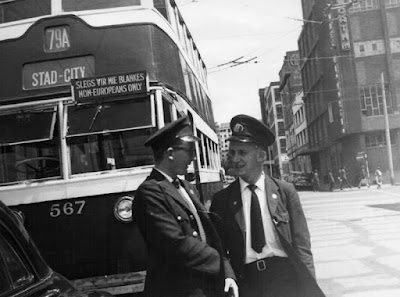
In 1961 the Johannesburg Transport Department had three-way apartheid. There were buses for "Europeans Only", buses for "Non-Europeans Only" and buses for "Asiatics/Coloureds Only".  

And on 5 December 1961 Desmond Tutu got on the Parktown North bus on which I was conductor. The bus was a two-man operated BUT 6-wheeler trolley bus, with a staircase at the back leading to the top deck, and long sideways seats  over the back wheels, where Desmond Tutu was sitting. When I had finished collecting the fares, I stood on the back platform, because there were few new passengers whose fares needed to be collected, and my job was simply to give the right-of-way signal to the driver (two rings of a bell), when all the passengers had safely disembarked. So when I wasn't doing that, I chatted to Desmond Tutu. 

I had known him for a little over two years then, mainly from Shoe Parties at St Benedict's House in Rosettenville. In 1959 Desmond Tutu had been a student at St Peter's Theological College in Rosettenville, and as it was just over the road from St Benedict's House, many of the students came to the monthly Shoe Parties, as did people from Anglican parishes all over Johannesburg. We had also both been members of the Postulants Guild, for those in the Anglican Diocese of Johannesburg who thought they might be called to serve in the ordained ministry of the Anglican Church. 

He was then a deacon, and was on his way to see the bishop, Leslie Stradling, to discuss his ordination as a priest, which took place 12 days later, on 17 December. 

The bus trip to the stop for the bishop's house, near the Johannesburg Zoo, only took about 20 minutes, of which we only chatted for about 10 minutes, when I'd finished collecting fares. Our chat was mainly about church things -- his impending ordination as a priest, what Leslie Stradling was like as a bishop (he was relatively new at the time, having been enthroned as bishop only two months before). Neither of us envisaged that within 25 years Desmond himself would be Bishop of Johannesburg. 

What was significant about our conversation was not what we said, but that it took place at all, especially in the year of the triumph of the Spirit of Apartheid. 

When Desmond got off the bus and we waved goodbye and I said I would see him at his ordination, and as soon as the bus pulled away from the stop, the other passengers began asking me "Who is that man? How do you know him? Why were you talking to him? Where does he come from? Where do you come from?"

If I had had foresight I could have said "That man is the future Anglican Archbishop of Cape Town," but of course I didn't and I just said that he was a deacon going to see the bishop about his future ministry as a priest. 

But where did he come from? Where did I came from?

I said we both lived in Johannesburg, but he was originally from the Northern Cape, and I was originally from Durban. 

The passengers didn't believe me. We must have come from overseas somewhere. 

"Where are you from? France? Germany? America? Is that man an American Negro?"

It was simply inconceivable to the man on the Parktown North omnibus that a black South African and a white South African could have a normal human conversation in Johannesburg in 1961, the year of the triumph of apartheid. In 1961 South Africa was indeed a very strange society, in which normal behaviour seemed abnormal, even to normal people. But that was the society in which Desmond Tutu lived half his life, a society in which we used to sing at the time:

When I'm walking down the street
I must be careful not to greet
people of a different pigmentation
lest the government suspect
or the Special Branch detect
a dark affiliation -- to a communist organisation
I

02 October 2021

Midnight's children

Midnight's ChildrenMidnight's Children by Salman Rushdie
My rating: 4 of 5 stars

A fictional autobiography of a child born at the moment India became independent in 1947.

And as the child grows up, he feels that the ups and downs of his own life mirror the fortunes of the country. Quite a long time ago I read a novel, A bend in the Ganges, set in the time of India's independence, and from that I knew it was beset by violence. That novel, like this one, followed the history of a family, and how the family was affected by the historical events. But Midnight's Children is no straightforward historical novel. It is surreal. Or perhaps paranormal. Or perhaps magic realism. It aims to show not the mere historical events, but the spiritual significance of them.

And so the children who were born at or immediately after midnight on 15 August 1947 are able to communicate with each other telepathically, and have abilities that science fiction writers of the 1950s used to indicate conventionally with the abbreviation PSI.

It is quite a dense and complex book, and I thought that, like some long and complex Russian novels, it needed a list of Dramatis Personae that one could refer to. There are so many characters that when one finds a reference to something that happened to one of them 150 pages earlier, one needs to reread the earlier incident to remember what happened and who was involved. But that means it is not the kind of book to read once and throw away. There ware things that will become clearer on a second or third, or even a seventh or eighth reading.

But now I have to take it back to the library. A few years ago I tried to read The Satanic Verses by the same author, and couldn't finish it. I found it too boring and confusing. If iot was satire, it was satirising things beyond my experience, which I couldn't connect to. But Midnight's Children reminded me of a song from 50 years ago:

Yesterday's dream didn't quite come true
We fought for our freedom and what did it do?
Now no one can see where they stand. 

And fifty years ago, when we sang that song, freedom was still tomorrow's dream, but I knew, back then, that when it came and faded into the past as yesterday's dream, we would know that it didn't quite come true. 

Twenty-five years ago I visited Kenya, which had been independent for just over 30 years, as India was at the end of Salman Rushdie's book. Several Kenyans asked me about South Africa, which had then enjoyed about a year of its brand-new democracy, which we had been all excited about, but the Kenyans showed no interest in that. Their questions showed that what interested them most about South Africa was the Mandela divorce, and who would get the money. They could not conceive of a politician who was not in it purely for the money. And 25 years later we have reached the same point in South Africa. And Salman Rushdie shows the spiritual reality of that, as it played out in India.


View all my reviews

07 September 2021

The Mission: A Life for Freedom in South Africa, by Denis Goldberg

The Mission: A Life for Freedom in South AfricaThe Mission: A Life for Freedom in South Africa by Denis Goldberg
My rating: 4 of 5 stars

A very readable autobiography of a South African political activist.

Denis Goldberg was born and grew up in Cape Town. His parents were communists, and imparted to their children a desire for social justice. He went to university and studied engineering, and became a civil engineer. In the 1950s he joined the Congress of Democrats which was part of the Congress Alliance of organisations opposed to apartheid, with separate organisations for black, white, coloured and Indian South Africans. The Communist Party had been non-racial, but when the National Party came to power in 1948 one of their first acts was to ban the Communist Party of South Africa, which then went underground as the South African Communist Party.

The Congress Alliance sponsored the Congress of the People in 1955, which in turn adopted the Freedom Charter, which put forward the vision of a democratic non-racial South Africa. But those the National Party government regarded as the organisers were arrested and charged with treason, though after four years they were all acquitted.

In 1960 all the parties in the Congress Alliance were banned and they too went underground, and decided that, since peaceful protest no longer seemed a workable political activity, they should move to armed struggle. Denis Goldberg was among those arrested and tried in the Rivonia Trial of 1962, and was sentenced to life imprisonment, though he was released after 22 years. He describes the events leading up to his arrest, the trial, and his time in prison.

After he was released he went overseas and joined his wife Esme in the UK, where he worked to publicise the African National Congress (ANC) and its cause in Britain, Europe and elsewhere. After the ANC was unbanned in 1990 he worked to gain support for community development projects in South Africa. When his wife Esme died he married again and returned to South Africa, where he used his engineering training to advise successive ministers of Water Affairs and Forestry.

The parts of the book describing his personal and family life and his time in prison are very clear and readable, but his descriptions of the political situation and political activities are less so. These parts of the book could be confusing to readers who do not have prior knowledge of the political history of the times. In some places, when describing the political scene of the 1950s, he mentions the Non-European Unity Movement, but seems to assume that his readers will know that it was, what its policies were, and how it differed from the Congress movement.

In other parts, he gives the impression that he is writing an apology to defend himself from criticisms by his colleagues in the ANC. This is no doubt because he was criticised in some quarters, but exactly for what is only hinted at and not stated explicitly. In these parts of the story one gets the impression that he is writing for his colleagues to defend his own actions, and not for the general reader.

I do not agree with all his views, and there were some attitudes that seemed alien to me. As a pacifist, I was never too taken with the idea of the armed struggle and the use of violence, though I recognise that not everyone is a pacifist and most people are unlikely to be. And as a liberal I felt a bit uncomfortable with the top-down authoritarian structure. Of course that was partly because they saw themselves as an army, and so developed along military lines with a top-down command structure. Nevertheless, the need for getting approval for everything from the next level of command in the rather rigid hierarchy seemed strange to me, especially when the movement was underground. I would have expected more flexibility, and expecting members to do things on their own initiative rather than passing everything up the command chain and waiting for permission to come back down.

It would make more sense to me to ensure that people are familiar with the general principles and policies of the organisation, and apply them in ways that are possible in particular circumstances of time and place. But Goldberg writes in such a way as to give the impression that he is trying hard to preclude or counter accusations that he was acting on his own initiative.

Later, however, when the ANC was in power, he accuses civil servants of being dull and unimaginative and obstructive of changes that would better the life of the people. I think his criticisms are justified, but it might be the authoritarian structure of the ANC that has caused it.

View all my reviews

21 August 2021

King Arthur: the True Story

King Arthur: The True Story

King Arthur: The True Story by Graham Phillips
My rating: 4 of 5 stars

King Arthur is a well-known figure in European romantic literature, but the historical character he is based on is vague and elusive. The authors of this book believe they have identified him as Owain Ddanngwyn, ruler of Powys in west-central Britain from about AD 488-520. "Arthur", they say, was not his actual name, but an epithet or nom de guerre meaning "The Bear", being a combination of the Brythonic "arth" and the Latin "ursus", both of which mean "bear".

I am in no position to evaluate the accuracy of their claims, because I am not sufficiently versed in the history of that period, which many historians have referred to as "the Dark Ages" because so little written history has survived from then, and so historians of the period are left feeling their way in the dark. It is like trying, in 2021, to find the biography of a ruler in southern Africa around 1390. There are no contemporary written sources, so that for us is the southern African "Dark Ages". 

I came to read this book in a strange way. I went to the library to renew some books I hadn't finished reading, and saw this one lying on a table. Someone had taken it off the shelf, decided not to take it out, and left it lying there for a librarian to reshelve. I wasn't looking for it, nor would I probably have found it if I had been, but it just appeared in front of me, as if it were saying "Read Me".

What I can say of the book by way of evaluation is that it starts off with a good summary of the Arthurian literature, and how the legends of Arthur were popularised (and in many instances created) in the 12th century by Geoffrey of Monmouth and subsequent writers. So I found the first few chapters very good as an account of how the Arthurian legend developed, and its early sources.

The further one goes into the book, however the more tenuous and speculative the story becomes, and the less convincing becomes the sub-title, "The True Story". The authors don't pretend otherwise. Their prose in the later chapters is extremely conditional, "if x happened, then y could have followed", "It is conceivable that...".

Much of the knowledge of the period comes from archaeology, which can tell us something of what life was like in a particular period, and what kind of people lived where, but it tells us very little of the actual events that led to those conditions. Pottery fragments can tell us whether the people who lived in a place were Angles or Saxons or British, but does not tell us their names, and whether they were ruled or led by someone called Arthur.

I also have to ask myself why I should be interested in Arthur or Arthurian literature. Most of the literature was written 600 years later, and tells us more about that period than about the time when Arthur lived, if he ever did live. One of the things that interests me about it is the intersection of history, myth, legend and theology, some aspects of which I have dealt with in an earlier blog post -- see South African Camelot.


View all my reviews

03 March 2020

The Horse Road (book review and some reminiscences)

The Horse RoadThe Horse Road by Troon Harrison

My rating: 4 of 5 stars


This book is an interesting mix of genres.

It is set in Central Asia in the first century BC, so it is basically a historical novel. The protagonist, Kallisto, is a horse-obsessed 14-year-old girl, and there is an entire literary genre aimed at horse-mad 14-year-old girls. It is also a Bildungsroman. because she has to cope with a series of crises when her father is away on business and her mother is ill, so she has to grow up fast. The crises include war, famine and earthquake.

The Horse Road also has cultural and racial diversity. Kallisto's father is a Greek merchant, her mother a Sarmatian horse breeder, and they live in the Fergana valley in what is now Kyrgyzstan, at the meeting place of East and West.

For the horse-obsessed 14-year-old girls there is plenty of detail about the horses, their care and grooming, their gaits, harness and training, their character and the skills of the rider. At times I thought it went a bit overboard on the details. One horse is described as an Appaloosa, a specifically American breed which would be very unlikely to have been found in Central Asia in that period. And cruppers are mentioned several times -- the leather loop attached to the rear of the saddle that goes under the horse's tail and stops the saddle from sliding forward over the horse's withers. I'm not sure that cruppers had been invented at that time. But those are the kind of details that appeal to the horse-mad young.

It's now 20 years since I last sat on a horse, and so this book took me back to times long past. One of the priests in our diocese, Father Justin Venn, was a farrier by trade, but he recently gave it up because it required too much travelling in the Johannesburg area, and he too observed that in today's urban society the only people who keep horses are middle-aged middle-class women and 14-year-old girls, but  perhaps the range of readership of books about horses is slightly wider.

I certainly enjoyed reading about horses at the age of 10 or 11, and perhaps the interest of boys in horses peaks slightly younger than among girls, at about 11 or 12. At that age boys are big enough to mount a horse bareback, but not so big and heavy that they are a burden to the horse.

Steve Hayes, Brassie & Elizabeth Dods, Aug 1952
When I was 11 I had a horse called Brassie, and he became to object of attraction to a 14-year-old girl, Elizabeth Dods, who asked if she could ride him. She rode him so much that I had to go by bicycle, which did not have off-road capability. Fortunately a riding school across the road closed and sold off all their horses cheaply, and so I acquired a pony called Tom as a Christmas present, and the first ride on him on Christmas day was to St Nicholas Church in Sandringham, Johannesburg with Elizabeth. That was the first church service I had ever been to (apart from a couple of family baptisms which I was too young to remember).

A few months later Elizabeth turned 15, and lost interest in horses, but she had a marvellous collection of horse books that she had acquired during the period of her obsession, which I eagerly borrowed and read. One of my favourites was Silver Snaffles by Primrose Cumming, which also had an element of fantasy.


The Horse Road has all the details that horse book addicts seem to love, but there is also enough drama, excitement and danger to make it a gripping adventure story for those who wouldn't know a crupper from a martingale..


View all my reviews

25 January 2017

The Tudors

The Tudors (British Monarchy)The Tudors by Geoffrey Christopher Morris

My rating: 2 of 5 stars


There is a chapter on each of the Tudor monarchs of England, a dynasty that lasted from 1485-1603. Each chapter deals with the character and relationships of the particular ruler, derived from contemporary sources.

One of the most interesting of these sources was Edward VI's diary. He came to the throne at the age of 9, and died before he was 16, and was one of the earliest English diarists.

The biggest problem I had with the book is that it assumed the knowledge one expects to gain from such a book. It is not really a history, or even a series of biographies, but a series of character sketches of the reigning monarchs. It is therefore best to be familiar with the history before reading this book.

For example, it says that Henry VII, the first of the Tudor monarchs, came to the throne not so much because of a hereditary claim, because his claim was weaker than that of some other candidates, but because he won the Battle of Bosworth. It does not, however, explain what his hereditary claim was, not even in the genealogical tables at the end of the book, or who the other claimants were. Nor does it explain the Battle of Bosworth, who the combatants were, or what they were fighting for, other than the throne of England.

I knew some parts of the history, having studied Church History at an English university, though that was 50 years ago. The period was that of the English Reformation, and the character sketches of the monarchs throw some light upon that, but this book is best read after reading a more general history of the period. Or else be prepared to interrupt your reading by Googling such things as the Battle of Bosworth.

The Background section of the Wikipedia article is the kind of introduction that should have been included in this book, but wasn't. The lack is all the more remarkable since, when the book was first published, neither Wikipedia, nor Google, nor the Internet itself would have been available.

And since Wikipedia is now available, I suggest reading the Wikipedia article on The House of Tudor before reading this book.


View all my reviews

19 August 2012

Not your average Scandiwegian whodunit

Between Summer's Longing and Winter's Cold (The Fall of the Welfare State, #1) Between Summer's Longing and Winter's Cold (The Fall of the Welfare State, #1) by Leif G.W. Persson

My rating: 3 of 5 stars


Over the last 10 years or so Scandinavian crime fiction has come to dominate the genre in the English-speaking world. Many of the books in the genre have a gloomy boozy divorced (or about to be) detective as protagonist. This one is different.

There is no protagonist. We are given glimpses into the lives and loves and hates of members of different branches of the Swedish police as they are touched in some way by the apparent suicide of an American journalist who fell from the 16th floor of a student residence.

The book is not well-written; in many ways there seems to be too much irrelevant detail. Describing in detail how a single protagonist spends Christmas is one thing; doing it for five or six different characters seems to be overdoing it. Some of the problems in the writing may be problems in translation rather than in the original. The writing sometimes seems stilted.

One of the more disconcerting things is that it takes one a while to work out the period the story is set in. The book was first published in 2002, so one expects it to be at around the turn of the century, but the technology doesn't fit -- there are no personal computers, only typewriters. No cell phones. The technology used would seem to date it to about the mid-1970s, but the story also concerns the investigation of a possible plot to assassinate the Swedish prime minister, which links it to the assassination of prime minister Olof Palme in 1986. Though the prime minister in the book is not named, there are sufficient resemblances in the story to make that a possible period as well.

One of the minor characters is a South African student with an improbable name, and there were stories of South African connections to the assassination of Olof Palme, and in Totale aanslag by De Wet Potgieter this is presented as historical fact. As an aside (this is not mentioned in the story, and is rather a personal anecdote), in 1988 my wife worked in a factory and the office next door to hers was used by a company that was indirectly linked. Sometimes she could not help overhearding conversations in the next door office, and she got the impression that they were involved in some shady business -- money laundering, illicit diamond buying, or something like that, and possibly the assassination of the Swedish prime minister. At about that time we had a break-in at our house, and the house was thoroughly ransacked, cupboards and boxes were emptied, but the only things that were taken were the cheap loudspeakers for our radiogram, which had been carefully unscrewed from their cabinets (the cabinets themselves were left behind), and some food. We had the impression that the thieves were looking for something very specific, which they didn't find, and the usual things that thieves took, cameras, computers etc., were left behind.

But, to get back to the book, in spite of its deficiencies, it was an interesting story, even if it was not well-told, and ultimately worth reading.


View all my reviews

12 July 2012

Liberalism and old liberals revisited

Yesterday, while on holiday in Pietermaritzburg, we visited old friends Colin and Mary Gardner, whom we had not seen for a long time, and one of the things we talked about was a proposal by Paul Trewhela for a new history of the Liberal Party of South Africa, and also Paul Trewhela's notion that the Liberal Party ought to have gone underground in 1968, instead of disbanding when the Improper Interference Act became law.

(the picture shows Val Hayes, Colin & Mary Gardner)

I've blogged about Paul Trewhela's proposals before, so I won't repeat everything that I said there, but Colin Gardner came up with a new slant on it. He was a member of the national executive of the Liberal Party at the time the decision was made to disband, and he said that they had considered ignoring the Improper Interference Act (which prohibited multiracial political parties) and just carry on as if nothing had happened, and decided not to. One of the reasons for that, that I had not been aware of, was that some Liberal lawyers, who were in touch with some National Party lawyers, said that that was what the government was expecting, and if it happened, they would declare the Liberal Party a "white" party, and prosecute the black members for contravening the Improper Interference Act. Basing political decisions on what was, in effect, idle gossip over tea at a Law Society meeting, or something similar, may seems strange, but that was one way of gaining intelligence of the intentions of the government.

And as for Paul Trewhela's idea, which he still seems to be pushing, that the Liberal Party ought to have, or even could have, gone underground, it would have been impossible, for reasons I have already noted (Notes from underground: A liberal underground in South Africa), namely that, having operated openly and publicly for 15 years, all active Liberals were known to the SB (Security Police), and any such activity would have been reported to them immediately by their izimpimpi.

Colin Gardner also remarked that one of the things that followed the passing of the Improper Interference Act, though not necessarily caused by it, was the rise of Black Consciousness. At first the National Party government welcomed BC, because they saw it as their policies bearing fruit, but it didn't take them long to realise that it was independent of their control, and not at all what they had in mind by "own affairs". Steve Biko's declaration of himself as a "non-nonracialist" could initially be mistaken for what the National Party government had in mind when it passed the Improper Interference Act, but eventually they learned that it wasn't.

Colin also thought that Steve Biko was using "non-nonracialism" as a tactic, and would, if he had lived, become nonracialist, though whether he or his ideals would have survived in the current South African political climate might be questionable.

Steve Biko didn't have a good word for what he called "white liberals" (which continues to be a swear word in South Africa), but I suspect that what he had in mind when he used the term "liberal" was Nusas (the National Union of South African Students), rather than the Liberal Party. And, as have pointed out in Notes from underground: A new history of the Liberal Party?, the word "liberal" is still misused, and still misunderstood, as much as, if not more than, it was 45-50 years ago.

08 January 2012

The ANC centenary

The African National Congress, which has ruled South Africa for nearly 18 years, is having a big bash in the Free State to celebrate its centenary.

ANC parties in Bloemfontein | News24:
An ANC centenary torch was lit at midnight in Bloemfontein on Saturday, while party leaders, members, heads of state and guests celebrated until early hours on Sunday.

ANC president Jacob Zuma and Archbishop Desmond Tutu lit the torch at the Wesleyan Church in the company of various party elders including former President Thabo Mbeki and guests. The ANC was founded at the church.

Fourteen heads of state, five former heads of state and four heads of governments in Africa and elsewhere were welcomed at the presidential gala dinner at the Vista campus during the night.


Coming home from Vespers last night we heard Namibian President Hifikepunye Pohamba speaking on the radio. "We didn't know we were making history, but we were making history," he said.

And history was what it was all about.

At that meeting 100 years ago, history was made -- but who realised it at the time?

Therr or four years before an all-white National Convention was held, which hammered out a racist constitution for South Africa. Those blacks in the Cape Colony who had qualified to vote before Union continued to be able to vote, but the new constitution gave all white males the right to vote. And in 1936 the right of blacks to votes was severely reduced, and in 1960 it was abolished altogether.

When the ANC started, as the then South African Native National Congress, its aim was to reverse that process, and to strive for a society with more equal rights. It was a long, hard and uphill struggle. And it was a struggle in which history was made. And it is good to celebrate it.

For 80 years, from Union in 1910 until 1990, freedoms in South Africa were gradually whittled away, and they weren't all that great to start with. Though for a long time the ANC only had black membership, it fought for freedom for all of us. And that is something worth remembering, and worth throwing a party for.

But I also feel ambivalent about it.

President Pohamba said "We didn't know that we were making history, but we were making history."

And the history is there, though there were bad moments as well as good in it.

But there is also a sense in which history is all it is.

The ANC today is not the ANC of Albert Luthuli, Oliver Tambo, and Nelson Mandela, two of whom won international recognition as Nobel Peace Prize winners. And many people who are involved in the celebrations recognise this, realising that the motives of amy who are joining and seeking office in the ANC today are very different from those who led the organisation before 1994. Back then the dangers were many, and the rewards few.

Well, it is still true today that the dangers are many, but the dangers are different from what they were in the glory days of the treason trial. Today the dangers are of being caught with one's fingers in the till, and for those who are not, the rewards are great too.

So perhaps one can hope that in recalling the history, the current crop of leaders, especially those at provincial and municipal level, will be inspired with something of the vision of the leaders of yesteryear. But I'm not counting on it.

As Lord Acton said, "All power tends to corrupt..."

21 August 2011

Opinionated Vicar: Boring vs Dangerous

Opinionated Vicar: Boring vs Dangerous:
A person with a sense of history and no sense of destiny is no doubt a very boring fellow; a person with a sense of destiny and no sense of history is a very dangerous fellow.


... now why did that make me immediately think of Julius Malema?

21 June 2011

Namibian turning point - forty years ago today

Forty years ago today the World Court announced its judgement that South Africa's rule of Namibia was illegal. It happened, most appropriately, on the Winter Solstice. Until then the nights had been longer than the days and getting longer. But thereafter, though the nights were still longer than the days, they were getting shorter.

It was to be another nineteen long years before the last South African troops crossed the southern border, and Namibia heaved a collective sigh of relief.

The longest night was still the longest night, but for the first time it gave real hope, hope that the dawn was getting ever closer. Nothing changed, yet everything had changed.

Here's what I wrote in my diary at the time, for what it's worth. Perhaps I should explain, by way of background, that I was at the time a self-supporting priest in the Anglican Church in Windhoek and worked at the Windhoek Advertiser as a proof reader, and that Deve de Beer (who also worked for the Anglican Church) and I were stringers for the Argus Africa News Service, which fed most of the evening newspapers in South Africa.

Monday 21 June 1971

I took Musrum up to Woodway to have its silencer fixed, and then Dave took me to work. I sent off stories to the Argus Africa News Service about the World Court verdict due to be given today. There was a surface calm, and apparent indifference, but people in high places appear to be worried. Die Suidwester had an editorial asking people to keep calm, and not to take hasty decisions, and Dirk
Mudge, the acting administrator, also made a plea for calm.

At lunch time I went to the court, and saw Chris Nicholson there. He said he had heard on the radio that the World Court had decided by 13 votes to 2 that South Africa had no right to be in South West, and thought it would be interesting to see who the 2 were. It would be a guide to the impartiality of the court. If they were British and French, it would show that national self-interest dominated the proceedings, rather than a real concern for justice.

We carried the story on the front page of the Advertiser, and Cowley wrote an editorial about Bantustan presidents or leaders going overseas to do a power of good to the homelands policy. Jimmy [Jimmy Simpson, the subesitor]was bitter about the World Court, and said it looked like his fishing would be over. When I asked him why, he said, "Well, with the United Nations taking over". I don't see why the United Nations will prohibit Jimmy from fishing, but he seemed convinced they will.

After work I went to the diocesan office and Dave was there; I went out to see Clemens Kapuuo, but was told he had gone to town, and on the way saw Johan Penderis walking back from rugby practice, and gave him a lift. I went out again later to try to find Clemens Kapuuo, calling at the diocesan office again. Abraham Hangula was there, and he asked what the verdict was and when I told him he beamed and shouted "Alleluia!" and then said "If the South African government leaves, then we can really preach the gospel."

I gave Dina a lift to Katutura, and ran out of petrol. I asked her what she thought about the World Court decision, and she said she didn't think. But she asked all sorts of questions, like what would South Africa do, what would happen if they pulled out, and would they really pull out. When I got to Clemens Kapuuo's shop there was a group of men standing outside, Mbuende among them. Mbuende introduced me to the others, who were Herero councillors from Aminuis. One of them burst out "We are so glad about the World Court decision that our country is ours", and there were great smiles all round. Mbuende said that Kapuuo was not at home, but had gone to Omaruru. I asked if any of the councillors was prepared to make a statement, but they all wanted to wait until Clemens came back.

I then asked him about a Mr Meroro, the chairman of Swapo, who had recently issued a press statement denying that he had said what the SABC had said he had said. Mbuende took me to see him - his shop was nearby - and he said he would not like to make any comment until he had spoken to his vice president in Walvis Bay. But he would say that he was very pleased with the decision. He seems quite a pleasant bloke - though
not a leader like Clemens Kapuuo. I took Mbuende back to the diocesan office to see the bishop, and arranged what was to happen about the Herero church conference, but the bishop and Dave had gone to see pastor Reeh. We spoke to Clive Whitford who said we could quote him as saying he was "overjoyed" by the World Court decision. He said I should attribute it to "a white professional man" and not to a "teacher", since he and Chris Roering were the only teachers (white) in town who could possibly make such a remark.

I took Mbuende back to Katutura, and started writing stories for the Argus Africa News Service, which we went to put in the telegram box at the post office, and returned to listen to Vorster's speech on the radio at 8:00, which was predictable enough. It was funny to hear a man who bends the law to suit his own purposes complaining that others were doing this. The fact that it was the British and French judges who dissented might lend credence to this, because it was their national self-interest that was at stake.

After the speech Meroro phoned, and said I should ring the acting president of Swapo at Walvis Bay, Nathaniel Mahuiriri, and he would give me a statement, and how he did. They seemed to be having a party at his house to celebrate the decision, and he asked loudly in Herero what they all thought of the judgement, and everyone clapped. He said he regarded the judgement of the World Court as the judgement of God, and that they did not hate whites, the whites must stay, but there must be no more
apartheid, no more homelands, only one homeland for all, one nation, one Namibia. He went on for half an hour, cataloguing his objections to the contract labour system, saying Vorster's speech on the radio was hypocritical, and when I asked him what he thought of Clemens Kapuuo, he said Swapo respected him as an honest man who spoke for his people; unlike Ushona Shiimi who was a stooge, a puppet, a tape recorder, who repeated what he was told to say.

That, I thought, was true, but nobody in their right mind could take Ushona Shiimi seriously, or think he spoke on behalf of anyone but the South African government. I have not met a single Ambo who does not think Ushona Shiimi is a big joke. After the call ended, I wrote out his statement, or the relevant bits of it, and Dave wrote a description of Windhoek at lunch time, and then we dumped those in the telegram box too, and then went off to have a drink at the Berg Hotel to celebrate, and went home to bed.

LinkWithin

Related Posts with Thumbnails