Showing posts with label literary genres. Show all posts

10 August 2023

Celtic themes in fantasy literature and literary genres

Here's an interesting review of a collection of essays on the influence and use of Celtic mythology, or themes from Celtic mythology in fantasy literature. 

I'm unlikely to find the book in a bookshop, or to be able to afford it even if I could, but I found the review itself very interesting and informative, and it sparked off several ideas. If you find these things interesting, you might like to read the review. and possibly the book if you can get hold of it. Strange Horizons - Imagining the Celtic Past in Modern Fantasy edited by Dimitra Fimi and Alistair J.P. Sims By Debbie Gascoyne:

In her introduction to this useful and insightful collection, co-editor Dimitra Fimi writes: “This edited volume aims to open a conversation about fantasy's multifaceted and enduring fascination with the Celtic past, and its various perceptions” (p. 4). Fimi notes that, while previous scholarship (including her own 2017 monograph) has focused on work written for children, the essays in this volume examine texts aimed at adult readers. The collection is divided into four sections: the first deals with what is loosely defined as “intrusion fantasy,” in which a Celtic “otherworld” overlaps with our own; section two looks at “worldbuilding” and the way authors use Celtic elements to create a fantasy world; section three has discussion of works in languages other than English; and the fourth and final section looks at how “the fantastic is situated within cultural practices perceived as Celtic” (p. 5).

The first thing that struck me about that was the notion of "intrusion fantasy", a term that I was unfamiliar with, but which seems to me an apt description of the novels of Charles Williams and the early children's novels of Alan Garner, which are among my favourites. It also seems to describe most of the fiction I have tried to write (examples of which you can see in the side panel on the right).

 Since  I had not heard of "intrusion fantasy" before I did a web search to make sure that it meant what I thought it did, and came across some interesting web sites, such as this one: Bring These 5 Intrusive Fantasy Books Into Your World

If you’re wondering what intrusive fantasy is—apart from sounding like something very rude and impatient—you’re not alone. In Rhetorics of Fantasy, Farah Mendlesohn argues there are four categories of fantasy, one of which is “intrusive.” (The others, in case you’re interested, are portal, immersive, and liminal.) If a portal fantasy is one in which the protagonist and the reader travel from the ordinary world into a magical one (Alice in Wonderland and The Lion, the Witch, and the Wardrobe are classic examples), then an intrusive fantasy is the reverse. In intrusive fantasy, magic comes from an Elsewhere into the ordinary world, changing it and the protagonist forever.

Of the five books mentioned there, I've read 1.15. I read The Historian by Elizabeth Kostova about 12 years ago -- see my review here: At last, a good vampire story. I did find Jonathan Strange & Mr Norrell among the new books in our local library, but it is an enormously long book, and after reading 150 pages and realising it would take forever to finish, I returned it to the library to give other readers a chance.

For more on Farah Mendlesohn's four categories of fantasy, see here.

Concerning Celtic mythology and its use by fantasy authors, Debbie Gascoyne goes on to say:

Several of the chapters in this volume make it clear how many of the most popular ideas about “Celtic mythology” or “Celtic traditions” actually arose from the nineteenth and early twentieth centuries. Robert Graves and Jessie Weston (among others) have a lot to answer for. For example, I was quite shocked to learn from Gwendolen Grant’s chapter on Alan Garner that the “triple goddess figure” he weaves through his Weirdstone trilogy owes more to The White Goddess (1948) than to any Irish or Welsh source material (p. 44). Juliette Wood’s chapter on “The Celtic Tarot” describes an “imaginative, though unhistorical link between current ideas about Celtic myth and a divination device that dated back only to the eighteenth century” (p. 175).

...from which I infer that most of the authors of the book disapprove of the rather loose way in which many fantasy writers use mythological themes and tropes, or at least Celtic ones.

Without having read the essays themselves it is hard to tell, but I don't think that in writing fiction one can treat mythology and folklore as if one were documenting them for an academic study. Alan Garner, for example, borrows eclectically from Celtic, Anglo-Saxon, Nordic and 20th Century English mythology and folklore, and stirs the mixture quite vigorously. Though the blurb mentions "Celtic mysteries", he freely links the Anglo-Saxon Herlathing with the modern notions of ley lines and the "old straight track" with nothing Celtic about either. He does include Celtic mythology in the mix, but also Norwegian (the strömkarl), more old English (mara - related to nightmare), Nordic (the lios alfar and the svart alfar, as well as Ymir, whose maggot brood they were). The Morrigan is Irish, and hence Celtic, and the bodachs and brollachan are Scottish but Garner gives each of them some characteristics derived from his own imagination, to suit his story.

I haven't made much use of specifically Celtic mythology in my own writing, but as most of my stories are set in southern Africa, there are other mythologies to draw on, but I assume that what the essaysts say about Celtic mythology would apply, mutatis mutandis, to any other system of mythology.


06 January 2022

Wildwood, a novel in the tradition of Alan Garner

Wildwood

Wildwood by Helen Scott Taylor
My rating: 4 of 5 stars

More than fifty years ago I read The Weirdstone of Brisingamen by Alan Garner, and went on to read his other children's books, and wished he'd written more, or that someone else would, and now someone else has. This book is certainly in the same genre, though see below for a discussion of what exactly that genre is. The protagonist, Todd Hunter, is a teenager, but the story had more in common with Alan Garner's children's novels than his teenage ones like The Owl Service and Red Shift.

Todd Hunter's father has been missing for five years, and he doesn't get on well with his mother's new boyfriend, so when the rest of the family go to spend their holidays with the mother's boyfriend's family in France, Todd goes to stay with his paternal grandfather in a small Cornish fishing village. There he hopes to learn more about his father, and even perhaps to learn something about the mystery of his disappearance.

Todd's grandfather John runs a grocery shop, in which Todd helps out occasionally. There are few young people of his own age in the village. He meets a rather unpleasant boy of about his age, Andrew Bishop, who, like Todd, doesn't get on with his stepfather. But soon after Todd's arrival, Andrew disappears, and Todd discovers his body at the foot of a cliff. The police rule his death accidental, but Todd suspects that he was murdered by his stepfather, perhaps reflecting his dislike of his own stepfather, and decides to investigate Andrew's death on his own. He also meets a teenage girl, Marigold, whom he finds quite attractive, but is rather wary of, because he discovers that her mother is reputed to be a witch.

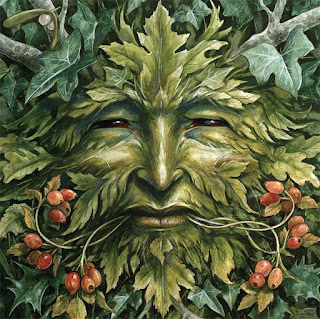
Before he has been in the village a week, Todd find himself investigating several mysteries -- his father's disappearance, Andrew's death, and a cult of the Green Man, which several people seem to be involved in. He also befriends an artist, Shaun, and his pet dog Picasso. Shaun, like Todd, is not originally from the village, and sometimes Todd finds his outsider's point of view refreshing. The longer he spends there, the more he feels he wants to get out, and the more he learns about the place and its history, and the activities of its present inhabitants, who seem determined to keep him there forever, the more he wants to leave.

I found it an exciting book, full of unexpected plot twists, though towards the end some of them became too inconsistent and inexplicable, with some characters shifting a bit too rapidly back and forth between loyalty and betrayal to be convincing.

The book seems to be only available on Smashwords,  and if you like juvenile books with adventure, mystery, ghosts and a touch of supernatural magic, it's definitely worth a read. You can see a fuller description on the Smashwords site here.

As I said at the beginning, I thought this book would appeal to people who liked Alan Garner's children's books. I would say that this one is roughly in the same genre. But what genre is that, and how does one describe it? On Smashwords, Wildwood is described as "Y/A Paranormal" and I don't think I've ever seen Alan Garner's books described as "paranormal" before. I have written a couple of children's books in the same genre, and described them as "children's adventure/fantasy", though one of my reviewers did classify one of them as "paranormal-fantasy". In adult books with similar themes, the novels of Charles Williams have been described as "supernatural thrillers", but never, as far as I am aware, as "paranormal".

The problem here seems to be that for many people "fantasy" implies that the story is set in a location out of this world, and these stories are not (with the partial exception of Alan Garner's Elidor). The problem with "paranormal", for me at least, is that it evokes images of movies like Ghostbusters, and rather misguided attempts to measure spiritual phenomena with material instruments, like using a photographic light meter to measure the light from the transfiguration of Jesus, or parlour tricks like Uri Geller bending teaspoons.

Anyway, whatever you want to call this genre, I like it, and am glad to see other people writing it, and hope to write some more in it myself.  Another book in the same genre is The Dark is Rising by Susan Cooper, which I had read a few months before reading this one. As I explained in my review of The Dark is Rising, one of the things I didn't like much about that book was that the protagonist was not really human, but had superpowers, and there is a hint of that in Wildwood, where we are frequently told that Todd Hunter has a "hunter's instinct" that makes him different from everyone else. It's one of the reasons I gave the book four stars rather than five, not because it makes it a bad book or anything, but the star rating is subjective, how much a particular reader likes a book, and I don't much like books where the protagonist has superpowers, even when, as in the case of Todd Hunter, they so often fail at a critical moment.

  View all my reviews

13 November 2020

Horror as a genre

Horror has long been assumed to be a literary genre. We all know what horror is -- or do we? A couple of years ago I reviewed a book on horror as a genre (see here Horror as a literary genre (review) | Khanya), and the author failed to come up with a satisfactory definition.

My introduction to horror literature came at the age of 9, when I read a book called Uncle Arthur's Bedtime Stories, which belonged to my cousin. I found most of the stories absolutely horrific. See here Children’s literature: fantasy or moral realism?

Later I developed a taste for horror | Khanya after reading an anthology of short stories called Detection, Mystery, Horror edited by Dorothy Sayers.

Then I read my first full-length "horror" novel, Dracula. I read various books described as "horror", many of them compilations of short stories, some good, some dreck. I also read a few longer novels classified as "horror"; one of the best of them was Stephen King's zombie story, Pet Sematary. But what was the horror genre? I wasn't sure.

I read a few books about the horror genre -- see here for my reviews of some of them Horror as a literary genre (review) | Khanya, which gave no satisfactory definition of horror at all, and Danse Macabre: monsters in literature and life | Khanya by Stephen King, where he did define monsters, but do they define "horror" as a genre? Lots of books have monsters of various kinds, but we don't classify them all as "horror" -- The Hobbit, for example.

Then comes a page on GoodReads celebrating the horror genre. But are all the books listed there really "horror"? 50 Most Popular Horror Novels on Goodreads - Goodreads News & Interviews:

For Horror Week, Goodreads set out to reveal the most popular horror stories. To create our list, we focused on the books that have been added the most to Goodreads members' shelves.

From literal monsters to purely psychological terrors, these are tales of madness and pandemonium, retribution and absolution. Long heralded as the "Master of Horror," Stephen King reigns supreme, with five books on our list, but his son Joe Hill is not far behind, nabbing four spots. And along with classics from Mary Shelley and Edgar Allan Poe, Robert Kirkman's end-of-the-world comic, The Walking Dead, made the cut as well as an award-winning children's ghost story, The Graveyard Book, from Neil Gaiman.

I've come to the conclusion that horror, as a genre, is confined to short stories, and even there it is often combined with other genres. In longer works, like full-length novels, horror is an element, but does not a genre make. In The Lord of the Rings there are horror elements, at the gates of Moria, when Frodo encounters Shelob and so on. But these do not make it a book in a horror genre.

Among short stories, Stephen King's "The Jaunt" or "The Mist" are horror, but they can also be classed as science fiction. The stories in the Horror section of Dorothy Sayers's anthology were definitely horror, but in most of the longer works that end up being classified as horror the actual horrific episodes are usually no longer within the larger works than a standalone horror short story.

LinkWithin

Related Posts with Thumbnails