The Cupertino effect is the tendency of a spellchecker to suggest inappropriate words to replace misspelled words and words not in its dictionary.
The origin of the term is that the spelling 'cooperation' was often changed to 'Cupertino' by older spellcheckers with dictionaries containing only the hyphenated form 'co-operation'. (Cupertino is the home of Apple Inc., and thus would be in most computer spelling dictionaries.) Users sometimes clicked 'Change All' without checking whether the spellchecker's first suggestion was correct to begin with, resulting in even official documents with phrases like 'as well as valuable experience in international Cupertino' and 'and reinforcing bilateral and multinational Cupertino and assistance actions.' Other examples include 'South Asian Association for Regional Cupertino' and 'presentation on African-German Cupertino.'
It gives a name to something that I've experienced several times. One was a book published by the Orthodox Archdiocese of Johannesburg and Pretoria, written by one of the priests, which had an entire chapter on the novel theological concept of the Divine Lethargy. I saw it in the table of contents, and turned to the chapter concerned to discover more, and it turned out that it was supposed to be "the Divine Liturgy", but the entire book was full of Cupertinos like this, and so was utterly useless. It seemed to have been done by the initiative of the printers, but no one had bothered to proof-read it.
Another one that affected me was a contribution I wrote for a book:
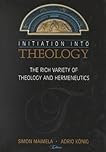 Initiation into Theology: The Rich Variety of Theology and Hermeneutics by Adrio Konig
Some one quoted something from my chapter in the book in an article, which they then sent to me, and I could not recognise it as anything I had written, or would have written. I then looked at the published book, and found that my contribution had been mangled by the Cupertino effect, applied in the interests of political correctness.
When I wrote my contribution, on the theology of African Independent Churches, the editor of the book, Professor Adrio König, of the Department of Systematic Theology and Ethics at the University of South Africa, called me several times to check the spelling of a word or the wording of a phrase in my article. I was impressed by his thoroughness, and was sure that this would be one publication in which there would be few or no errors. One of the things he asked me about was my use of the term "African Independent Churches", and he said that the tendency nowadays was to use the term "African Initiated Churches". I agreed with him that there was such a tendency, but pointed out that the terms were not interchangeable, and that they meant different things, and that in the article I used them to mean different things though the commonly-used abbreviation AIC could be applied to both, and also to the related terms African Indigenous Churches and African Instituted Churches.
Though he seemed doubtful, he appeared to accept my argument, but when the book was published, it seemed that he had run a spelling check, and substituted "Initiated" for "Independent" wherever it had occurred, including the titles of four books and articles in the bibliography. In some contexts in the article, this changed word turned the sentences in which they occurred into meaningless garbage, so I do not acknowledge that I wrote the contribution to the book, and would not include it in my CV. The contrast with the thoroughness with which he had checked for accuracy before publication was marked, and it amazed me that he was willing to throw all that work away by rashly letting a spelling checker make word salad of the book.
Another observation: why are they called spellcheckers? Witches might find spell checkers useful, but writers and publishers would prefer prefer spelling checkers. Perhaps that's why they've put a hex on so many publications.


