Showing posts with label ecology. Show all posts

19 November 2021

Fantasy, ecology and children's literature

A couple of days ago I participated in a webinar on Imagining Ecological Pasts and Futures: Folklore, Fantasy, and Speculative Fiction in the Climate Crisis, in which one of the speakers, Gina Lyle, spoke on "Fantasy, Ecology and Children's Literature".

Immediately after the webinar I happened to finish reading the third volume of The Spiderwick Chronicles, and it ended with a trope that seemed very applicable: children meet elves who are hostile to humans because of the damage that humans cause to the environment. The same trope may be found in The Moon of Gomrath by Alan Garner, where the elves of Sinadon come to Fundindelve, and show a similar hostility to human children for the same reason.

Lucinda's Secret (The Spiderwick Chronicles, #3)

Lucinda's Secret by Tony DiTerlizzi
My rating: 4 of 5 stars

This is the third book of the Spiderwick Chronicles. I've read the first, but the second was not in the library, so I'm having doubts about whether I'll be able to read and review the whole series, in which the Grace family go to live in an old house belonging to a great aunt, and find it has some strange inhabitants. 

The main character seems to be Jared Grace, aged nine, with his twin brother Simon, and their older sister Mallory, aged 13. They discover a book about faeries, which apparently belonged to their great uncle, who disappeared many years before. But the faeries, or some of them, want the book, and seem determined to get hold of it, by fair means or foul. Each volume in the series is fairly short, about 100 pages, of which nearly half are taken up with illustrations. The ecology trope is seen here:

The leaf-horned elf sniffed. "We have long known that mankind is brutal. Once, at least, humans were ignorant. Now we would keep knowledge of our existence from you to protect ourselves."

"You cannot be trusted. You cleave the forests." Lorengorm scowled and his eyes flashed. "Poison the rivers, hunt the griffins from the skies and the serpents from the seas. Imagine what you could do if you knew all of our weaknesses."

In The Moon of Gomrath the same trope appears:

... no elf has a natural love of men; for it is the dirt and ugliness and unclean air that men have worshipped these two hundred years that have driven the lios-alfar to the trackless places and the broken lands. You should see the smoke-sickness in the elves of Talebollon and Sinadon. You should hear it in their lungs.  That is what men have done.

There is a similar trope in Prince Caspian by C.S. Lewis:

He remembered that he was, after all, a Telmarine, one of the race who cut down trees wherever they could and were at war with all wild things; and though he himself might be unlike other Telmarines the trees could not be expected to know this.

For more on this and similar themes see Inside Prince Caspian. Though in that case it is trees rather than elves, the theme of ecological damage is similar. 

Another similarity in all three instances is that the children, though not necessarily personally responsible for the evil, nevertheless belong to the the race that has caused the evil, and are hated or feared for it. In other contexts, this phenomenon is known as "white privilege". In all three instances mentioned here, the children belong to a class that has been enriched by damage they have inflicted on the environment that others depend on, and the children have benefited from that enrichment. The children were not aware of the damage, having been insulated from it by their privileged position.

In the webinar nobody mentioned capitalism as being responsible for damage to the environment, yet Alan Garner alludes to the Industrial Revolution as being responsible for the damage, and explicitly mentions the Age of Reason -- the Enlightenment, and thus the mentality of modernity.

In C.S. Lewis the context is more colonialism -- the Telmarines are conquerors, and implicitly propagate an ideology of Telmarine supremacy. A similar ideology characterises Weston, the villain of his adult science fiction series, with capitalism being represented by his partner Dick Devine who, while not an allegory of Cecil Rhodes, is at least cut from the same cloth. Both are combined in Prince Caspian.

I'm sure other instances of this trope could be found in children's literature -- environmental destruction, children as unconscious beneficiaries, and the resentful victims. 

04 September 2012

Diet, fasting and the environment

I've read a number of blog posts recently about eating and drinking and the environment, and this one suggests that we should drink water to save water The Green Phone Booth: Drink Water!

Well, I have to admit that in addition to drinking plain water, I also drink rather a lot of tea and coffee, though one thing I try to avoid is bottled water, unless it has some flavour added.

I've previously blogged about the strange habit of many people of drinking bottled water, which is expensive, unhealthy, and environmentally unfriendly. Quite a lot of the bottled water that is sold is just tap water anyway, so why not drink it straight from the tap?

Blogger Clarissa gives some reasons for not drinking it straight from the tap here Does Anybody Drink Tap Water? | Clarissa's Blog -- she thinks tap water tastes horrible, and she finds that in every city she has ever lived in.

I have been warned not to drink tap water in some cities -- Mosc0w and Athens come to mind -- but I've been living in Tshwane for 30 years and I don't think I've come to any harm from drinking the tap water yet. The tap water is quite safe and palatable, as it is in most South African cities.

I agree with Clarissa on one point, though. I know some people who are forever banging on about the environment, but even when they are at home they still drink bottled water.

And then, from the same source as the recommendation to drink tap water, comes this The Green Phone Booth: Four Small Changes to Make in Your Daily Life:
Eat less meat. Meat production is a major contributing factor in climate change - in fact, livestock produce as much as 18% of the planet's greenhouse gases. Meat production also uses far more water than growing plants. I'm not a vegetarian, but I have taken steps to reduce my meat consumption. Even one veggie meal every day can make a big difference, and you may even get the chance to try some new recipes while you're at it.


And one of the commenters on that recommended this Meatless Monday | one day a week, cut out meat, which appears to be a new secular fast. Orthodox Christians, of course have meatless Wednesdays and Fridays.

So if the secularists fast on Mondays, and the Christians really observe the fast on Wednesdays and Fridays, perhaps meat consumption could be reduced.

But there is also a downside to this: School Districts Take on 'Meatless Mondays' to Support Healthy and Humane Eating Habits:
Schools are in a unique and powerful position to influence students' eating habits for a lifetime to come. These pioneering schools recognize that responsibility, and the many benefits Meatless Monday offers for our health, for our planet, and for animals.
In a country where "separation of church and state" is elevated to a sacred principle, why are they imposing the secular fast on Christians? Should they not be providing the option of Meatless Fridays for Christian pupils? And would it make any difference at all to the secularists if they fasted on Fridays instead of on Mondays -- other than that that would not provide them with an opportunity to stick it to the Christians? This seems to be a case of outright religious discrimination.

But some of the arguments for this need to reduce meat consumption seem a bit odd to me. Why Meatless?:
The water needs of livestock are tremendous, far above those of vegetables or grains. An estimated 1,800 to 2,500 gallons of water go into a single pound of beef. Soy tofu produced in California requires 220 gallons of water per pound.
I've seen other arguments that cattle farts produce greenhouse gases that contribute to global warming, but the same would apply to any other animals on the planet, including wild animals and human beings. If we follow that line of reasoning, we should exterminate all animals, wild and tame, to save the planet -- but to save it for what?

A better argument that I have seen, and one worth considering, is from a book I read recently The long road home: book review | Khanya:
Americans now wanted to eat more meat, and it paid their farmers to feed their cereals to the livestock needed to produce that meat, rather than to human beings. For the first time in history, high meat consumption in one major country would distort agricultural output all over the world.

If you want to be environmentally friendly about meat, then insist that the meat you buy comes from grass-fed and not corn-fed/grain-fed cattle.

And one last little tip: at public events caterers have learnt to be sensitive to religious diversity and provide kosher and halaal food, but most of them have never heard of nistisimo. Perhaps they had better learn it now, and provide nistisimo food on Wednesdays and Fridays for the Christians, and on Mondays for the secularists who observe Meatless Mondays. Oh yes, and even the secularists can Google for "nistisimo recipes".


23 April 2008

Biofuels and food prices

The Washington Post reports on its front page today: "More than 100 million people are being driven deeper into poverty by a 'silent tsunami' of sharply rising food prices, which have sparked riots around the world and threaten U.N.-backed feeding programs for 20 million children, the top U.N. food official said Tuesday."

MARIA LUISA MENDONGA, marialuisa1@uol.com.br,

Maria Luisa Mendonga is based in Sco Paulo, Brazil, and is director of the Social Network for Justice and Human Rights. She co-wrote an article titled "Agrofuels: Myths and Impacts." She said today:

"In many regions of [Brazil], the increase in ethanol production has caused the expulsion of small farmers from their lands, and has generated a dependency on the so-called 'sugarcane economy,' where only precarious jobs exist in the sugarcane fields. Large landowners' monopoly on land
blocks other economic sectors from developing, and generates unemployment, stimulates migration, and submits workers to degrading conditions.

"This model has caused negative impacts on peasant and indigenous communities, who have their territories threatened by the constant expansion of large plantations. The lack of policies in support of food production leads peasants to substitute their crops for agrofuels, and,
as a result, compromises our food sovereignty. In Brazil, small- and medium-sized farmers are responsible for 70 percent of the food production for the internal market.

"It is necessary to strengthen rural workers' organizations to promote sustainable peasant agriculture, prioritizing diversified food production for local consumption. It is crucial to advocate for policies that guarantee subsidies for food production through peasant agriculture. We cannot keep our tanks full while stomachs go empty."

RACHEL SMOLKER, rsmolker@globaljusticeecology.org,
Research biologist at the Global Justice Ecology Project, Smolker said today:

"The massive diversion of crops and land to producing biofuel crops instead of food is a major factor in the very dramatic food price increases. Governments and industries have foolishly pursued biofuels in spite of this and in spite of a cascade of scientific studies and statements from all levels of society which clearly demonstrate that biofuels are not only exacerbating hunger, but also rural displacement, climate change and deforestation. Last week the UK instated its Renewable Transport Fuel Obligation for the use of biofuels even as the European Environment Agency warned that the EU-wide mandate should be reconsidered. Even the World Bank recently stated that biofuels are contributing to rising food prices and hunger.

"Incentives and mandates for the use of biofuels are being promoted by agribusiness giants like Monsanto, ADM and Cargill along with big oil, biotechnology and automobile industries -- all of whom stand to profit enormously. The price is being paid right now by those who can no
longer afford food or access to land. Civil society is pushing back: this week the Round Table on Responsible Soy is meeting in Buenos Aires and will be met with intense opposition as people denounce the entire concept of 'sustainable industrial agriculture' of the sort that has
despoiled so much of Argentina, Paraguay and Brazil.

"The International Assessment of Agricultural Science and Technology for Development report took a strong position opposing industrial agriculture and GE [genetically engineered] crops while a major new report from University of Kansas makes it clear that GE crops have not
delivered on the promise of increased yields. We need new models for food and energy production that do not leave people hungry and displaced, do not contaminate our crop biodiversity and pollute our water and soils, and do not leave food and energy production in the
hands of profit-seeking multinational corporations. People are beginning to wake up to this fact.

"Meanwhile, the food crisis is pushing biofuel proponents to argue that the next generation of technologies based on cellulose will avert problems with food competition and deliver greater climate benefits. In fact they could worsen the problems: There is limited space available
and we are losing land to desertification and deforestation at an alarming rate. A few weeks ago, [the journal] Science published a pair of articles showing that the greenhouse gas emissions that result from indirect land use changes far outweigh any gains from substituting fossil fuel use. Wood is considered to be one of the most promising feedstocks. But demand for wood is skyrocketing as countries attempting to meet Kyoto commitments are shifting to wood and other biomass for heat and electricity production, as well as chemicals and manufacturing processes.

"On top of that, the pulp and paper industry is undergoing a planned fivefold expansion and China has a very rapidly expanding wood products industry. The scale of demand for wood to satisfy all of these demands can only be met by further deforestation and by enormous industrial
monocultures of fast-growing trees. The biotechnology industries are racing to genetically engineer both trees and microorganisms for these uses. Next month at the Convention on Biological Diversity, civil society organizations will be asking for a moratorium on the commercialization of GE trees because of the potential risks of contaminating native forests."

For more information, contact at the Institute for Public Accuracy:
Sam Husseini, (202) 347-0020; or David Zupan, (541) 484-9167

Institute for Public Accuracy
915 National Press Building, Washington, D.C. 20045
(202) 347-0020 * http://www.accuracy.org * ipa@accuracy.org

05 April 2008

Ethnic cleansing -- for tortoises

The Christian Radical: Tortoises Give Way to Tanks in Desert: "Scientists have begun moving the Mojave Desert’s flagship species, the desert tortoise, to make room for tank training at the Army’s Fort Irwin despite protests by some conservationists."

02 April 2008

Storm in an aluminium smelter

South Africa would not have a power crisis if there were no big aluminium smelters, said Valli Moosa, the chairman of the Eskom board, and former Minister of Environmental Affairs, but this as a sensitive matter, as the row between Standard Bank and BHP Billiton shows.

Both mining giant BHP Billiton and South African banking group Standard Bank were on Friday tight-lipped over the name of a senior bank executive who made remarks that led to the diversified miner taking its business away from the firm.

This came after financial daily Business Day reported that a Standard Bank senior executive had suggested at a Business Leadership meeting with government that BHP Billiton should shut down its power-heavy Richards Bay Hillside aluminium smelter because it added little value to the economy.

"All I can say is that BHP Billiton can confirm it has taken a corporate decision to phase out its business links with Standard Bank," BHP Billiton spokesperson Bronwyn Wilkinson told Mining Weekly Online. "The reasons behind this decision have been conveyed to the bank."
blog it


Moosa was speeking at a public meeting at St Martin's School Hall, Rosettenville, arranged as part of the annual conference of the Southern African Faith Communities' Environment Institute (SAFCEI).

For more on his speech see SAFCEI: Eskom is one of the biggest polluters in the world.

15 October 2007

Orthodox environmentalism

Since today is Blog Action Day on the environment, and so I feel under some kind of obligation to blog about the environment. The problem is that I only discovered that is was blog action day this morning, so there wasn't really time to write anything original about it. The best I can manage is to string together some articles and resources that may be useful to me in future if I want to write something about it later, and may possibly be of use to anyone else reading it and looking for resource materials.

And I close with a couple of quotes from the last item:
For most environmentalists, theology remains a last resort, if they resort to it at all. This generalization stands, I believe, despite the new academic interest in religion and ecology. Even if secular environmentalists are now actively seeking theology’s support, it is not as the “queen of the sciences” that they turn to theology, but merely as a form of eco-ethics buttressed by the supposed moral support of “religion” in general.

For those, however, who are genuinely interested in the interface between religion and the environment as a first line of defense against the rape of nature, a restored theological vision capable of overcoming a disastrously individualistic and anthropocentric worldview and reintegrating God, man, and the natural world is a vision-quest worthy of every effort. Arguably, the deepest ecological thinking, the widest and most inclusive scope of environmental reconciliation, and the loftiest and most complete cosmic vision and spirituality are to be found in the riches of the Orthodox Christian theological tradition.

Blog action day on the environment

Blog action day on the environment -- and it's today!

I hadn't heard anything about it before, and wonder if any South African "green" blogs are taking part. Anyway, for those interested, here's the blurb:
An international initiative of bloggers known as "Blog Action Day" launched today, with the aim of uniting thousands of blogging voices, talking about one issue for one day. This year on Blog Action Day, which is slated for Oct. 15, 2007, bloggers will be discussing the environment.

Major blogs have signed up to participate, including Lifehacker, Dumb Little Man, Lifehack.org, Get Rich Slowly, Web Worker Daily, GigaOm, The Simple Dollar, Zen Habits, Freelance Switch, LifeClever, Unclutterer, Pronet Advertising, Wise Bread and many more.

"For just one day, we'd like to unite as many of the millions of bloggers around the world and speak about one issue - the environment," said Collis Ta'eed, an Australian blogger from FreelanceSwitch.com, and a cofounder of Blog Action Day. "We want to display the potential and the power of the blogging community, which is a disparate community but one with an amazing size, breadth and diversity. By bringing everyone together for one day, we can see just how much can be achieved, and how much we can be heard."


What Kind of Blogger Are You?

20 September 2007

BIOFUEL -- the answer to the energy crisis?

I've seen quite a number of bloggers promoting the idea of biofuels to solve the energy crisis, without the bloggers apparently being aware of the problems, which are well summarised here: Journey Home: BIOFUEL Realities - Not so fast big guys!

One of the biofuels that has been around longest is snake oil, and we ought to know by now that that is not the answer.

South Africans are no strangers to biofuels. In my youth one could buy "Union Spirit" at just about every garage in Durban. It was a by-product of sugar refining, made from sugar cane. It wasn't sold outside the Natal coastal belt though, with one exception. There one one garage in Jeppe, Johannesburg, which sold it in the 1960s. That was before petrol was sold with two octane ratings, premium and regular. Union was 100 octane, and was therefore prized by car enthusiasts who souped up their cars by increasing the compression ratio so that they could no longer run on regular petrol.

But even in the days of sanctions, in the late 1980s, when South Africa's oil supply was erratic and precarious, and the government stockpiled oil in secret locations around the country, Union was not plugged as the answer, and in fact that is when it declined and disappeared from the market.

01 September 2007

Happy New Year, Happy Spring day!

It seems appropriate that the ecclesiastical new year coincides with Spring Day, and also that the first few days of September are dedicated by the Orthodox Church to environmental awareness.

And also, after the end-of-month Broadband Blues, I once again have access to the web after eight days of deprivation. At least they let my e-mail through this time. What did we do before the Web?

09 February 2007

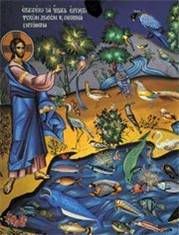
Images of creation

Photobucket - Video and Image HostingSally's Journey: Ecology, responsibility and mission, has some images relating to creation. One showed a leaf, with a face that reminded me of a praying mantis. The other, from Matt Stone, Lord of the Fertile Earth, shows Jesus as the Green Man, crucified.

Sally asked for comments, and I said that neither of those images really spoke to me. But at the same time I do believe that we need some images that can speak to the theme of Ecology, responsibility and mission. These images of creation speak to me of one aspect of it.

I don't think the first picture was intended to look like a praying mantis. That was just something it reminded me of. But it is sometimes said that |kaggen, the creator God of the San, the earliest human inhabitants of South Africa, sometimes took the form of a mantis.

Photobucket - Video and Image HostingThe San, who were called Bushmen by white settlers, lived as hunter-gatherers, and painted numerous pictures on the rocks and caves of South Africa, but for the most part the meaning of the pictures was not preserved when the San were driven out by the white and black pastoralists.

Trevor Verryn, in his book Symbols and scriptures gives an acount of some preserved explanations that were written down from San informants from the |Xam people of the Drakensberg, whose totem was the eland, and told the story of some of the paintings. The story of creation and fall according to at least some of the San was thus preserved.

Photobucket - Video and Image Hosting|kaggen (God) gave orders and caused all things to appear - sun, moonm stars, wind mountains and animals. |kaggen reprimanded his wife who spoilt his knife by using it to sharpen her digging stick, and as a result she brought forth an eland calf. One day |kaggen's son shot the eland, and |kaggen mourned for it. So |kaggen mourned for the evil that had befallen his creation.

This is a very abbeviated account, but it shows God mourning for his spoiled creation. But the mantis too is a creature. If it is a symbol of God, it is yet not God. I'm not sure that a mantis is an appropriate image for a wounded creation.

I found Matt Stone's image of the crucified Green Man also didn't really speak to me. It seems to mix two incompatible concepts, though I can't really put a finger on it. Maybe some others have some ideas on how they relate or don't relate.

Photobucket - Video and Image HostingI suppose one of the reasons that it doesn't speak to me is that the symbolism is obscure. Until the 1930s the name "The Green Man" was used for pubs, and it was only in the 20th century that it began to be applied to the foliate heads found on medieval churches. Of course that is one of the advantages of postmodernity -- one can make up traditions and symbolisms to mean anything one wants. But to me, at least, a crucified green man just doesn't seem to fit.

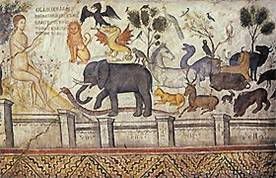
But when it comes to ecology, the image of Adam naming the animals seems to fit better. Perhaps he was the original green man!

29 November 2006

Interfaith environmental conference

Photobucket - Video and Image Hosting
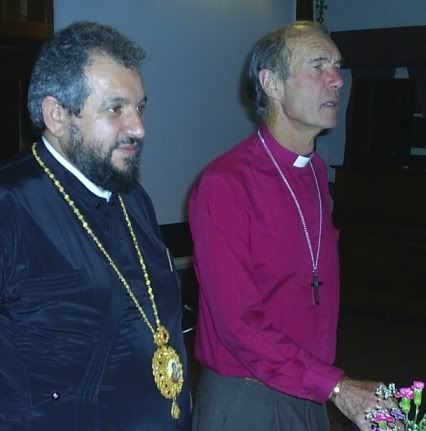
I've spent the last couple of days at a meeting of the management board of SAFCEI -- the South African Faith Communities Environmental Institute. Our Archbishop Seraphim (seen here with Anglican Bishop Geoff Davies, the Executive Director of the Institute) has been a member of the SAFCEI board since its inception, and invited the board to meet at St Cosmas and St Damian Orthodox Church in Sophiatown, Johannesburg.

You can read more about what happened at the conference itself in my LiveJournal.

But one of the things that became clear at the conference was the eagerness with which Canadians were destroying the environment. There are plenty of countries that have been pointed out as villains in the world, but Canada has not usually been among them. But the evidence has started piling up.

I had known for some time that Canadians seemed to have some strange ideas. They have had trolley buses in western towns like Vancouver, and that seems to be a good environment-friendly means of public transport, running it on locally-generated renewable hydro-electric power. But now they seem to want to run their buses on diesel fuel -- a non-renewable fossil fuel, most likely imported from the Middle East.

That's just odd, and anyway I'm prejudiced in favour of trolley buses.

But now, it appears, the Canadians are intending to bring aluminium ore here to South Africa, and refine it here using heavily-subsidised electricity generated in coal-fired plants, and export the ingots. So our electricity bills are inflated to make Canadian companies rich, our cities have to endure acid rain to make Canadian companies rich, and our non-renewable fossil fuels are being depleted to make Canadian companies rich.

And Canada is, apparently, one of the biggest pushers of genetically-modified foods.

That makes Canada a bigger threat to our life-support system than Al-Quaeda. Bush and Blair, move aside. Your villany has been superseded.

Now I'll have to Google to find out who the Prime Minister of Canada is.

LinkWithin

Related Posts with Thumbnails